
G32.81 Cerebellar Ataxia in Diseases Classified Elsewhere: V28 HCC 182, and the Cause Goes First
G32.81 is billable, maps to V28 HCC 182, and always follows its cause code. Cerebellar ataxia with no cause indexes to G11.9 (HCC 200); alcoholic ataxia is G31.2, which does not map.
By the HCC Buddy Coding Team
Updated: November 11, 2026
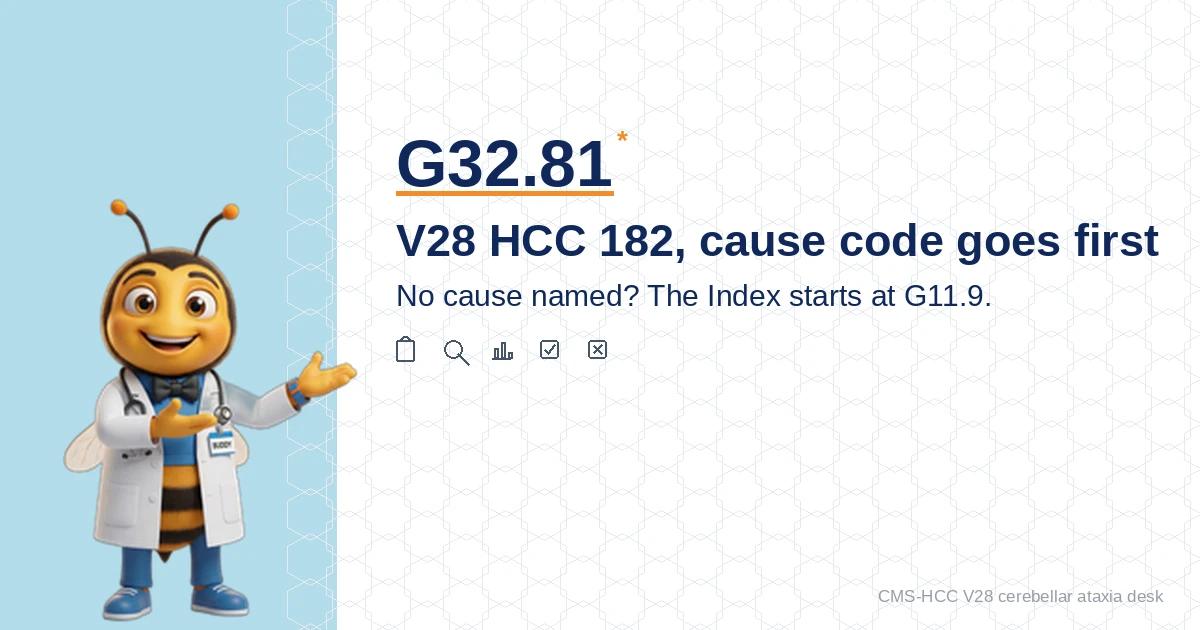
If you searched G32.81, cerebellar ataxia ICD-10, or cerebellar ataxia in diseases classified elsewhere, here is the short answer. G32.81 (Cerebellar ataxia in diseases classified elsewhere) is a billable code that maps to CMS-HCC V28 HCC 182 (Spinal Cord Disorders/Injuries). The PY2026 V28 CSV on HCC Buddy main has the row `G3281,182.0,,,`, the V28 column of the CMS 2026 Final ICD-10-CM Mappings lists 182 for it, and the live card shows HCC 182.
G32.81 is a manifestation code. It never goes on the claim by itself or in first position. The disease that causes the ataxia goes first, and G32.81 follows it.
There is a second point that matters more for most searches. If the note says "cerebellar ataxia" and names no cause, the Alphabetic Index does not send you to G32.81. It sends you to G11.9 Hereditary ataxia, unspecified, which maps to a different category, HCC 200. This guide walks through both paths.
The G32 and G11 codes, descriptors, and Tabular notes are the same in the FY2026 and FY2027 files, and the FY2027 Tabular and Index addenda have no entries for them.
Desk table: ataxia codes
| Code | Official descriptor | V28 result | CSV (no decimal) |
|---|---|---|---|
| G32.81 | Cerebellar ataxia in diseases classified elsewhere | HCC 182 | 1 row, CC 182.0 |
| G32.0 | Subacute combined degeneration of spinal cord in diseases classified elsewhere | HCC 182 | 1 row, CC 182.0 |
| G32.89 | Other specified degenerative disorders of nervous system in diseases classified elsewhere | No V28 HCC | no row |
| G11.9 | Hereditary ataxia, unspecified | HCC 200 | 1 row, CC 200.0 |
| G11.11 | Friedreich ataxia | HCC 200 | 1 row, CC 200.0 |
| G11.2 | Late-onset cerebellar ataxia | HCC 200, age condition | 1 row, CC 200.0, "age >= 15" |
| G31.2 | Degeneration of nervous system due to alcohol | No V28 HCC | no row |
| G31.9 | Degenerative disease of nervous system, unspecified | No V28 HCC | no row |
| G13.2 | Systemic atrophy primarily affecting the central nervous system in myxedema | No V28 HCC | no row |
| R27.0 | Ataxia, unspecified | No V28 HCC | no row |
| I69.393 | Ataxia following cerebral infarction | No V28 HCC | no row |
The other G11 codes, G11.0, G11.10, G11.19, G11.3, G11.4, G11.5, G11.6, and G11.8, also map to HCC 200 with no condition. G32, G32.8, and G11 are nonbillable headings, and the live cards say so.
The Index decides which code you start from
Under the main term Ataxia, ataxy, ataxic, the FY2027 Index reads cerebellar (hereditary) G11.9. The word "hereditary" is in parentheses, so it is a nonessential modifier. The provider does not have to write it for the entry to apply. That is why a note reading only "cerebellar ataxia" lands on G11.9, whose inclusion terms include "Hereditary cerebellar ataxia NOS."
The subterms under cerebellar then refine it:
- in specified disease NEC G32.81
- in neoplastic disease (see also Neoplasm) D49.9 [G32.81]
- in alcoholism G31.2, and alcoholic G31.2
- in myxedema E03.9 [G13.2]
- with defective DNA repair G11.3
- early-onset G11.10, and late-onset (Marie's) G11.2
Two more entries sit under the main term. Gluten goes to M35.9 [G32.81], and gluten, with celiac disease goes to K90.0 [G32.81]. Under Degeneration, cerebellar NOS goes to G31.9, and cerebellar, primary (hereditary) (sporadic) goes to G11.9.
So G32.81 is the code when the provider links the cerebellar ataxia to another disease, except alcohol (G31.2) and myxedema (E03.9 with G13.2), which have their own Index entries. When the provider names no cause, the Index default is G11.9. If the note leaves you unsure whether the provider sees the ataxia as hereditary or as caused by something else, ask. Both codes map, but to different categories, and the claim should say what the provider means.
Code first: what goes ahead of G32.81
Section I.A.13 of the FY2027 Official Guidelines says that "In diseases classified elsewhere" codes "are never permitted to be used as first listed or principal diagnosis codes. They must be used in conjunction with an underlying condition code and they must be listed following the underlying condition." It also says that in the Index "The code in brackets is always to be sequenced second."
The Tabular gives the examples. At G32.81 it reads: "Code first underlying disease, such as: celiac disease (with gluten ataxia) (K90.0); cerebellar ataxia (in) neoplastic disease (paraneoplastic cerebellar degeneration) (C00-D49); non-celiac gluten ataxia (M35.9)."
One level up, subcategory G32.8 carries its own note: "Code first underlying disease, such as: amyloidosis cerebral degeneration (E85.-); cerebral degeneration (due to) hypothyroidism (E00.0-E03.9); cerebral degeneration (due to) neoplasm (C00-D49); cerebral degeneration (due to) vitamin B deficiency, except thiamine (E52-E53.-)."
The pairing works from the other side too. K90.0 Celiac disease says: "Use additional code for associated disorders including: dermatitis herpetiformis (L13.0); gluten ataxia (G32.81)."
Some common pairs, each from the Index or Tabular text above:
- Gluten ataxia with celiac disease: K90.0, then G32.81.
- Gluten ataxia without celiac disease: M35.9, then G32.81.
- Cerebellar ataxia the provider attributes to a neoplasm: the neoplasm code, then G32.81. The Index points to D49.9 and says "see also Neoplasm," so use the site and behavior the provider documents.
Does the cause code map too?
Often it does not. That surprises coders who expect the first code to carry the weight.
- K90.0, M35.9, E03.9, and D49.9 have no row in the PY2026 V28 CSV.
- A neoplasm code maps on its own row. For example, `C3490,20.0,,,` puts C34.90 in HCC 20, and `D496,23.0,,,` puts D49.6 in HCC 23. These are examples only. Look up the code the provider's documentation supports.
So for gluten ataxia, the HCC 182 result comes from G32.81, not from K90.0 or M35.9. For a paraneoplastic ataxia, the claim can carry the neoplasm category and HCC 182, when both are documented and supported.
Alcohol and myxedema are not G32.81
G32.81 has an Excludes1 note: "systemic atrophy primarily affecting the central nervous system in alcoholic cerebellar ataxia (G31.2); systemic atrophy primarily affecting the central nervous system in myxedema (G13.2)." Section I.A.12.a says an Excludes1 note "indicates that the code excluded should never be used at the same time as the code above the Excludes1 note." The same section makes an exception when the two conditions are unrelated to each other, and says to query the provider when that is not clear. A cerebellar ataxia the provider attributes to alcohol or to myxedema is not unrelated to those codes.
- Alcohol. G31.2 Degeneration of nervous system due to alcohol lists "Alcoholic cerebellar ataxia" and "Alcoholic cerebellar degeneration" as inclusion terms. It has a "code also" note for associated alcoholism (F10.-). G31.2 has no V28 row. The alcohol use disorder code maps on its own row when it is documented; for example, `F1020,139.0,,,` puts F10.20 in HCC 139.
- Myxedema. The Index pairs E03.9 with G13.2, and G13.2 says "Code first underlying disease, such as: hypothyroidism (E03.-); myxedematous congenital iodine deficiency (E00.1)." Neither E03.9 nor G13.2 has a V28 row.
G32.8 adds one more Excludes1 note for "superior hemorrhagic polioencephalitis [Wernicke's encephalopathy] (E51.2)."
Why HCC 182 says spinal cord
HCC 182 is named Spinal Cord Disorders/Injuries. The cerebellum is not the spinal cord, so the label can look wrong next to G32.81. It is not a coding error. CMS places G32.81 in that category in the V28 mapping, along with G32.0 and codes such as G95.9 Disease of spinal cord, unspecified. The live HCC 182 hub lists 251 codes, which matches the CSV row count.
The category name does not describe the patient. Do not add a spinal cord diagnosis because of it, and do not avoid G32.81 because of it. Code what the provider documents.
Where HCC 182 and HCC 200 sit
In the V28 hierarchy file, HCC 182 is the lower category in four rows:
- `HCC180,HCC181,HCC182,HCC253,HCC254,,` (Quadriplegia)
- `HCC181,HCC182,HCC254,,,,` (Paraplegia)
- `HCC191,HCC180,HCC181,HCC182,HCC192,HCC253,HCC254` (Quadriplegic Cerebral Palsy)
- `HCC192,HCC180,HCC181,HCC182,HCC253,HCC254,` (Cerebral Palsy, Except Quadriplegic)
When a member also has one of those higher categories, HCC 182 drops. HCC 182's own row is `HCC182,,,,,,`, so it supersedes nothing.
HCC 200's row is `HCC200,,,,,,`, and no other row lists it. It neither supersedes nor is superseded by another category.
The PY2026 V28 relative factors list HCC 182 with a CNA reference of 0.478 and a COMMUNITY_ND value of 0.368, and HCC 200 with a CNA reference of 0.279. These are community segment values, not member totals. The segment a member is scored in depends on that member's enrollment data.
The age condition on G11.2
The CSV row for G11.2 Late-onset cerebellar ataxia is `G112,200.0,age >= 15,,`. The value "age >= 15" sits in the MCE_AGE_CONDITION column. The live card shows the same thing: "This code has a CMS age requirement: applies when age >= 15." The other G11 codes in the table have no condition. The HCC 200 hub lists 17 codes, 2 of them under an age condition, which matches the CSV.
Plain ataxia, gait, and stroke
Not every ataxia is cerebellar, and not every ataxia maps.
- R27.0 Ataxia, unspecified is the Index default for "ataxia" alone. R27.8 covers "acute" and "general" ataxia in the Index. Neither has a V28 row.
- Category R27 has an Excludes1 note for ataxic gait (R26.0), hereditary ataxia (G11.-), and vertigo NOS (R42). R26.0 has no V28 row.
- R27.0 has an Excludes1 note for "ataxia following cerebrovascular disease (I69. with final characters -93)." For ataxia after a cerebral infarction, the code is I69.393, which has no V28 row. See acute stroke vs history of stroke for the rest of that family.
- Section I.B.5 says "Signs and symptoms that are associated routinely with a disease process should not be assigned as additional codes, unless otherwise instructed by the classification." When the provider documents cerebellar ataxia due to a named disease, G32.81 describes it; do not add R27.0 for the same finding.
The Index has no "acute" subterm under "cerebellar." If a note says "acute cerebellar ataxia," look at the cause the provider names, and ask when the note does not say.
The CSV rows behind the answer
Each of these codes has one row in the PY2026 V28 CSV:
- `G3281,182.0,,,`
- `G320,182.0,,,`
- `G110,200.0,,,`
- `G1110,200.0,,,`
- `G1111,200.0,,,`
- `G1119,200.0,,,`
- `G112,200.0,age >= 15,,`
- `G113,200.0,,,`
- `G118,200.0,,,`
- `G119,200.0,,,`
The columns are ICD10, CC, MCE_AGE_CONDITION, AGE_EDIT_CONDITION, and SEX_EDIT_CONDITION. There is no row for G3289, G312, G319, G132, K900, M359, E039, D499, R270, R278, R260, or I69393.
The CMS 2026 Final ICD-10-CM Mappings agree: V28 category 182 for G32.81 and G32.0, V28 category 200 for the G11 codes above, and a blank V28 cell for G31.2, G31.9, G13.2, K90.0, M35.9, and E03.9. This post covers the CMS-HCC V28 result only.
MEAT for G32.81
For G32.81, the note should support both the ataxia and the disease the provider links it to:
- M Monitor: how the provider is following the ataxia at this visit
- E Evaluate: the exam findings or results the provider reviewed for it
- A Assess: cerebellar ataxia named as current, with the cause stated in the provider's words ("due to," "from," "in")
- T Treat: the plan the provider documents for the ataxia or the cause, such as referral, therapy, or management of the underlying disease
MEAT is a review mnemonic, not a universal CMS coding rule. Follow the applicable coding, encounter, program, and payer requirements. See MEAT.
Reporting rules that apply
Section IV.H says not to code diagnoses documented as "probable", "suspected," "questionable," "rule out," "compatible with," "consistent with," or "working diagnosis" or other similar terms indicating uncertainty, and to code "the condition(s) to the highest degree of certainty for that encounter/visit, such as symptoms, signs, abnormal test results, or other reason for the visit." The guideline notes that this differs from the practices of short-term, acute care, long-term care and psychiatric hospitals. In an office note, "possible paraneoplastic cerebellar degeneration" or "rule out gluten ataxia" is not coded as G32.81. Code what the provider has confirmed, or the signs and symptoms they document, such as R27.0.
Audit and query traps
1. Putting G32.81 first, or reporting it with no cause code.
2. Coding "cerebellar ataxia" with no cause as G32.81. The Index default is G11.9.
3. Coding G11.9 when the provider links the ataxia to celiac disease, a neoplasm, or another named disease. That is the cause, then G32.81.
4. Coding alcoholic cerebellar ataxia as G32.81. It is G31.2, which G32.81 excludes and which has no V28 row.
5. Coding ataxia in myxedema as G32.81. The Index pairs E03.9 with G13.2.
6. Assuming the cause code maps. K90.0, M35.9, E03.9, and D49.9 do not.
7. Reading the HCC 182 label as a spinal cord diagnosis, or skipping G32.81 because of the label.
8. Missing the hierarchy. HCC 182 drops when HCC 180, 181, 191, or 192 is also present.
9. Missing the age condition on G11.2.
10. Adding R27.0 next to G32.81 or a G11 code for the same ataxia, or using R27.0 for ataxia after a stroke.
11. Using a CNA reference as a member RAF total, or inventing Coding Clinic quotes, competitor comparisons, or PHI examples.
Two-minute check
1. Does the provider document cerebellar ataxia, or ataxia that is not described as cerebellar?
2. Does the provider link it to a disease? If yes, and step 3 does not apply, code that disease first and add G32.81.
3. Is the cause alcohol (G31.2) or myxedema (E03.9 with G13.2)? Then it is not G32.81.
4. Is the ataxia hereditary or named with no cause? Start at G11.9 and the G11 subterms, and ask when the note is unclear.
5. Is it ataxia after a stroke? Use the I69 code ending in -93.
6. Expect HCC 182 for G32.81, HCC 200 for G11 (G11.2 only at age 15 or older), and no V28 HCC for G31.2, G13.2, R27.0, and I69.393.
7. Check the hierarchy against HCC 180, 181, 191, and 192.
8. Confirm the map on the live card and the CSV row. Confirm MEAT for this year.
Related desks and tools
- Live cards: G32.81, G32.0, G11.9, G11.11, G11.2, G31.2, G13.2, K90.0, M35.9, R27.0, I69.393
- Hubs: HCC 182, HCC 200
- Lookup: ICD-10 to HCC, Encoder
- Evidence habits: MEAT, provider query templates, hierarchy and trumping rules
- Nearby: acute stroke vs history of stroke, excludes 1 vs excludes 2, codes that do not map, FY2027 code changes
Sources
- Live HCC Buddy ICD-10-CM cards (FY2027 Tabular display) and the V28 HCC 182 and HCC 200 hubs, fetched November 10, 2026
- FY2026 and FY2027 ICD-10-CM order file billable flags, the FY2026 and FY2027 Tabular, the FY2027 Alphabetic Index, and the FY2027 Tabular and Index addenda
- CMS, FY2027 ICD-10-CM Official Guidelines for Coding and Reporting, Sections I.A.12.a, I.A.13, I.B.5, and IV.H
- PY2026 V28 mapping, hierarchy, and relative factor files on HCC Buddy main
- CMS, ICD-10 codes (FY2027 ICD-10-CM code files and addendum, effective October 1, 2026)
- CMS, 2026 Model Software/ICD-10 Mappings (PY2026 V28 mappings, hierarchies, relative factors, and the 2026 Final ICD-10-CM Mappings)
V28 mappings come from the cited live code pages and the PY2026 V28 CSV. Coefficients are source-labeled references, not member totals. Not medical advice. Not a Coding Clinic reprint.
Current as of November 10, 2026. Always confirm the V28 mapping for the payment year you are scoring and the live code card before you lock a map claim. The map claims here come from the PY2026 V28 CSV. For PY2027 scores, use the PY2027 V28 mapping.
Frequently asked questions
What is the ICD-10 code for cerebellar ataxia?
It depends on what the provider documents. With no cause and no further type named, the Alphabetic Index entry Ataxia, cerebellar (hereditary) leads to G11.9, Hereditary ataxia, unspecified, which maps to V28 HCC 200. If the note names a type, follow the subterm instead: early-onset G11.10, late-onset (Marie's) G11.2, or with defective DNA repair G11.3, all HCC 200 (G11.2 with the CSV age >= 15 condition). When the provider links the cerebellar ataxia to another disease and the Index leads to G32.81 (in specified disease NEC, in neoplastic disease, or gluten ataxia), code that disease first and add G32.81. Alcoholic cerebellar ataxia is G31.2, and cerebellar ataxia in myxedema is E03.9 with G13.2, not G32.81.
Does G32.81 map to an HCC in V28?
Yes. G32.81 has the row G3281,182.0 in the PY2026 V28 CSV and maps to HCC 182, Spinal Cord Disorders/Injuries. The CMS 2026 Final ICD-10-CM Mappings list V28 category 182 for it, and the live card shows HCC 182.
Can G32.81 be the first-listed diagnosis?
No. Section I.A.13 says in diseases classified elsewhere codes are never permitted to be used as first listed or principal diagnosis codes. The underlying disease goes first and G32.81 follows it.
What is the ICD-10 code for gluten ataxia?
With celiac disease, code K90.0 and then G32.81. Without celiac disease, the Index sends gluten ataxia to M35.9 and then G32.81. Neither K90.0 nor M35.9 has a V28 row, so the HCC 182 result comes from G32.81.
Is alcoholic cerebellar ataxia coded G32.81?
No. G31.2, Degeneration of nervous system due to alcohol, lists Alcoholic cerebellar ataxia as an inclusion term, and G32.81 has an Excludes1 note for it. G31.2 has no V28 HCC. It has a code also note for associated alcoholism (F10.-).
How do I code paraneoplastic cerebellar ataxia?
Code the neoplasm the provider documents first, then G32.81. The Index entry for cerebellar ataxia in neoplastic disease points to D49.9 with see also Neoplasm, so use the site and behavior in the note. A neoplasm code maps by its own CSV row.
Why does G32.81 map to a spinal cord HCC?
HCC 182 is named Spinal Cord Disorders/Injuries, and CMS places G32.81 there in the V28 mapping. The category name does not describe the patient. Do not add a spinal cord diagnosis because of it.
Does G11.2 always map to HCC 200?
Not always. The PY2026 V28 CSV row is G112,200.0,age >= 15, with the age condition in the MCE_AGE_CONDITION column. The live card shows the same age requirement.
Related Tools
G32.81 card
Cerebellar ataxia in diseases classified elsewhere. Billable. V28 HCC 182.
G11.9 card
Hereditary ataxia, unspecified. Billable. V28 HCC 200.
G11.2 card
Late-onset cerebellar ataxia. Billable. V28 HCC 200 when age >= 15 (CSV age condition).
G31.2 card
Degeneration of nervous system due to alcohol. Billable. No V28 HCC (No CMS category on the card).
G13.2 card
Systemic atrophy primarily affecting the central nervous system in myxedema. Billable. No V28 HCC (No CMS category on the card).
K90.0 card
Celiac disease. Billable. No V28 HCC (No CMS category on the card).
R27.0 card
Ataxia, unspecified. Billable. No V28 HCC (No CMS category on the card).
HCC 182 hub
Spinal Cord Disorders/Injuries. CNA ref 0.478. 251 mapped codes.
HCC 200 hub
Friedreich and Other Hereditary Ataxias; Huntington Disease. CNA ref 0.279. 17 mapped codes.
ICD-10 to HCC
Look up one diagnosis against the current V28 map.
Encoder
Look up G32 and G11 ataxia codes with live V28 status.

HCC Buddy Coding Team
Editorial
Every HCC Buddy article is checked against the current CMS-HCC model and the active FY ICD-10-CM tabular release before it publishes.
Get HCC Coding Tips in Your Inbox
Join our newsletter for coding tips, guideline updates, and tool announcements.