
I82.210 SVC Thrombosis: V28 HCC 267; Syndrome Alone Is I87.1
Acute SVC thrombosis I82.210 is billable and maps to V28 HCC 267. Chronic I82.211 is HCC 267 too; vena cava syndrome without thrombosis is I87.1 and does not map.
By the HCC Buddy Coding Team
Updated: November 6, 2026
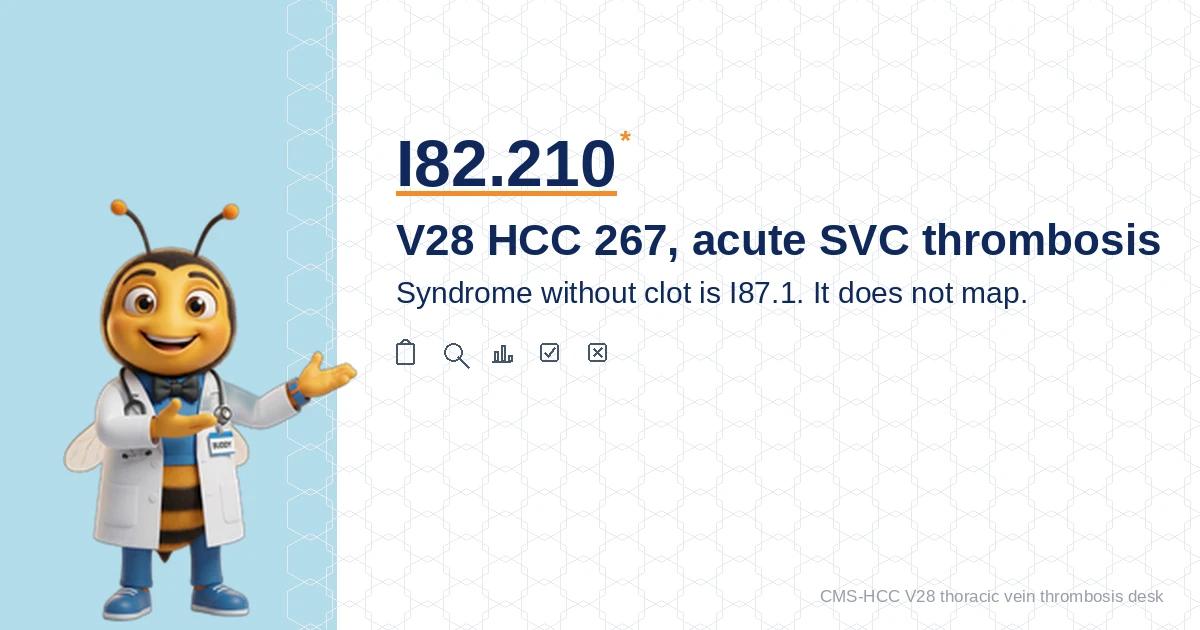
If you searched SVC syndrome ICD-10, I82.210, or superior vena cava thrombosis ICD-10, here is the short answer. I82.210 (Acute embolism and thrombosis of superior vena cava) is a billable code that maps to CMS-HCC V28 HCC 267 (Deep Vein Thrombosis and Pulmonary Embolism). The PY2026 V28 CSV on HCC Buddy main has the row `I82210,267.0,,,`, the V28 column of the CMS 2026 Final ICD-10-CM Mappings lists 267 for it, and the live card shows HCC 267.
The chronic code for the same vein, I82.211 (Chronic embolism and thrombosis of superior vena cava), maps to HCC 267 too. So acute versus chronic does not change the V28 category. It still changes the code, and the code has to match what the provider wrote.
What does change the result is naming thrombosis when the note only says "SVC syndrome." Category I87.1 (Compression of vein) lists "Vena cava syndrome (inferior) (superior)" as an inclusion term, and it has no V28 HCC. Most of the audit risk in this cluster sits on that line.
The I82.2 codes, descriptors, and Tabular notes are the same in the FY2026 and FY2027 files, and the FY2027 Tabular addenda have no entries for them.
Desk table: SVC and thoracic vein codes
| Code | Official descriptor | V28 result | CSV (no decimal) |
|---|---|---|---|
| I82.210 | Acute embolism and thrombosis of superior vena cava | HCC 267 | 1 row, CC 267.0 |
| I82.211 | Chronic embolism and thrombosis of superior vena cava | HCC 267 | 1 row, CC 267.0 |
| I82.220 | Acute embolism and thrombosis of inferior vena cava | HCC 267 | 1 row, CC 267.0 |
| I82.221 | Chronic embolism and thrombosis of inferior vena cava | HCC 267 | 1 row, CC 267.0 |
| I82.290 | Acute embolism and thrombosis of other thoracic veins | HCC 267 | 1 row, CC 267.0 |
| I82.291 | Chronic embolism and thrombosis of other thoracic veins | HCC 267 | 1 row, CC 267.0 |
| I82.3 | Embolism and thrombosis of renal vein | HCC 267 | 1 row, CC 267.0 |
I82.2, I82.21, I82.22, and I82.29 are nonbillable headings, and the live cards say so. Pick a billable child code.
How the code is built
Category I82.2 covers embolism and thrombosis of the vena cava and other thoracic veins. The fifth character names the vessel, and the sixth character names acute or chronic.
- I82.21- Superior vena cava. Acute is I82.210. Chronic is I82.211. I82.210 lists "Embolism and thrombosis of superior vena cava NOS" as an inclusion term.
- I82.22- Inferior vena cava. Acute is I82.220. Chronic is I82.221. I82.220 lists "Embolism and thrombosis of inferior vena cava NOS" as an inclusion term.
- I82.29- Other thoracic veins. Acute is I82.290. Chronic is I82.291. Subcategory I82.29 lists the brachiocephalic (innominate) vein as an inclusion term.
- I82.3 Renal vein. This is a single billable code with no acute or chronic split in the Tabular.
In the Alphabetic Index under Embolism, the subterm vena cava sends superior (acute) to I82.210 and chronic to I82.211, and inferior (acute) to I82.220 and chronic to I82.221. Under Embolism, brachiocephalic (innominate) goes to I82.290, with chronic at I82.291. The same vessel paths appear under Thrombosis.
SVC syndrome is not automatically a thrombosis code
Searches that land on the I82.210 card often ask for "SVC syndrome ICD-10." That phrase is not the same thing as documenting a clot in the superior vena cava.
- Category I87.1 Compression of vein includes "Stricture of vein" and "Vena cava syndrome (inferior) (superior)". It is billable, and it has no CSV row and no V28 HCC.
- In the Alphabetic Index, Syndrome, vena cava (inferior) (superior) (obstruction) goes to I87.1. So does Syndrome, superior, vena cava.
So the provider's words decide the path:
- If the provider documents embolism or thrombosis of the superior vena cava, use I82.210 or I82.211.
- If the provider documents vena cava syndrome, compression, obstruction, or stricture without calling it a thrombosis, I87.1 fits both the Index and the Tabular inclusion term.
- If the note only says "SVC syndrome" and the imaging or assessment is unclear about clot versus compression, ask the provider before you pick a map-bearing code.
Do not treat the search phrase as the diagnosis. Code what the note supports.
A separate congenital code, Q26.1 (Persistent left superior vena cava), also has no V28 HCC. It is not the Index landing for acquired SVC syndrome.
Acute versus chronic
The Index entries for vena cava carry "(acute)" as a nonessential modifier, and each vessel has its own chronic subterm. The chronic code needs the provider to call the clot chronic.
The Tabular has no definition of acute or chronic for these codes. That is the provider's call, so code the word the provider uses. When a note says "SVC thrombosis" with no acuity and the plan reads like a long-standing clot, ask the provider rather than picking one.
Both columns land in the same place under V28. I82.210 and I82.211 each have one row with CC 267.0, as do the IVC and other thoracic vein pairs.
The CSV rows behind the answer
Each code has one row in the PY2026 V28 CSV, with no age or sex condition:
- `I82210,267.0,,,`
- `I82211,267.0,,,`
- `I82220,267.0,,,`
- `I82221,267.0,,,`
- `I82290,267.0,,,`
- `I82291,267.0,,,`
- `I823,267.0,,,`
The columns are ICD10, CC, MCE_AGE_CONDITION, AGE_EDIT_CONDITION, and SEX_EDIT_CONDITION. There is no row for I871, Q261, Z86718, Z86711, or Z7901.
The CMS 2026 Final ICD-10-CM Mappings agree. They list V28 category 267 for I82.210, I82.211, I82.220, I82.221, I82.290, I82.291, and I82.3. This post covers the CMS-HCC V28 result only.
Where HCC 267 sits
In the V28 hierarchy file, the row for HCC 267 is `HCC267,,,,,,`. It lists no lower category, and no other row lists HCC 267. So HCC 267 does not supersede another category, and no category supersedes it.
The PY2026 V28 relative factors list HCC 267 with a CNA reference of 0.294 and a COMMUNITY_ND value of 0.431. These are community segment values, not member totals, and the segment a member is scored in depends on that member's enrollment data.
The live HCC 267 hub lists 167 codes, and that count matches the CSV.
Pulmonary embolism with an SVC or IVC clot
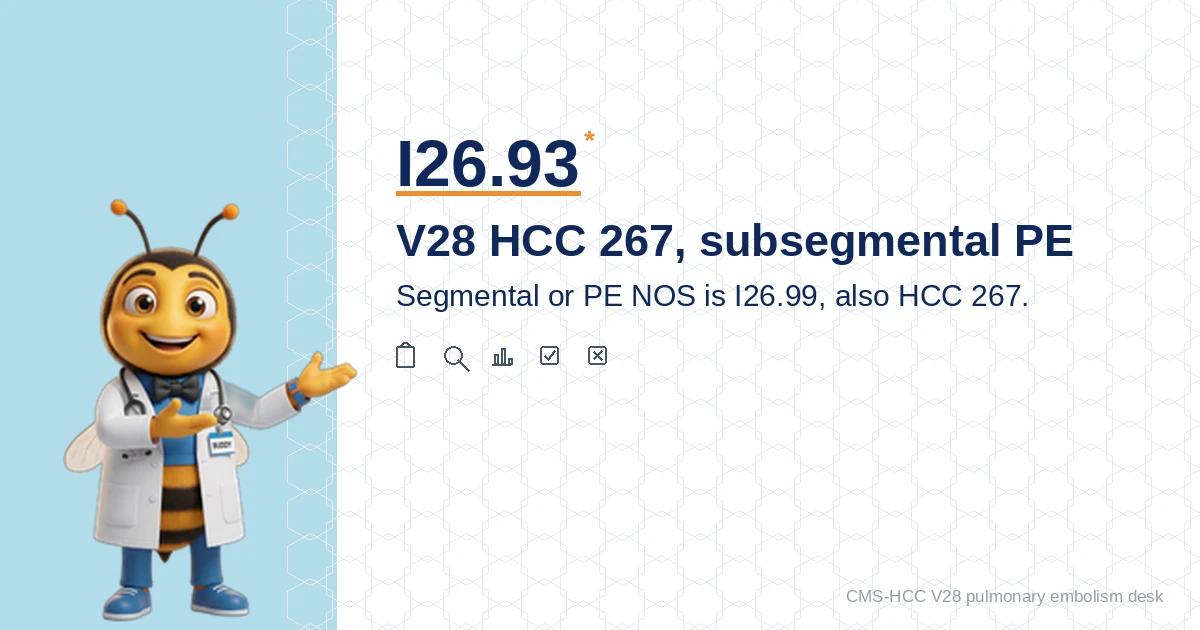
Category I82 has an Excludes2 note for venous embolism and thrombosis of the pulmonary veins, "pulmonary (I26.-)". Section I.A.12.b says that "When an Excludes2 note appears under a code, it is acceptable to use both the code and the excluded code together, when appropriate." So an SVC or IVC thrombosis and a pulmonary embolism the provider documents at the same time are both coded. I26.93 (Single subsegmental thrombotic pulmonary embolism without acute cor pulmonale) and I26.99 (Other pulmonary embolism without acute cor pulmonale) each map to HCC 267 as well, so both codes fall into the same V28 category.
History, anticoagulants, and resolved clots
When the clot is no longer current:
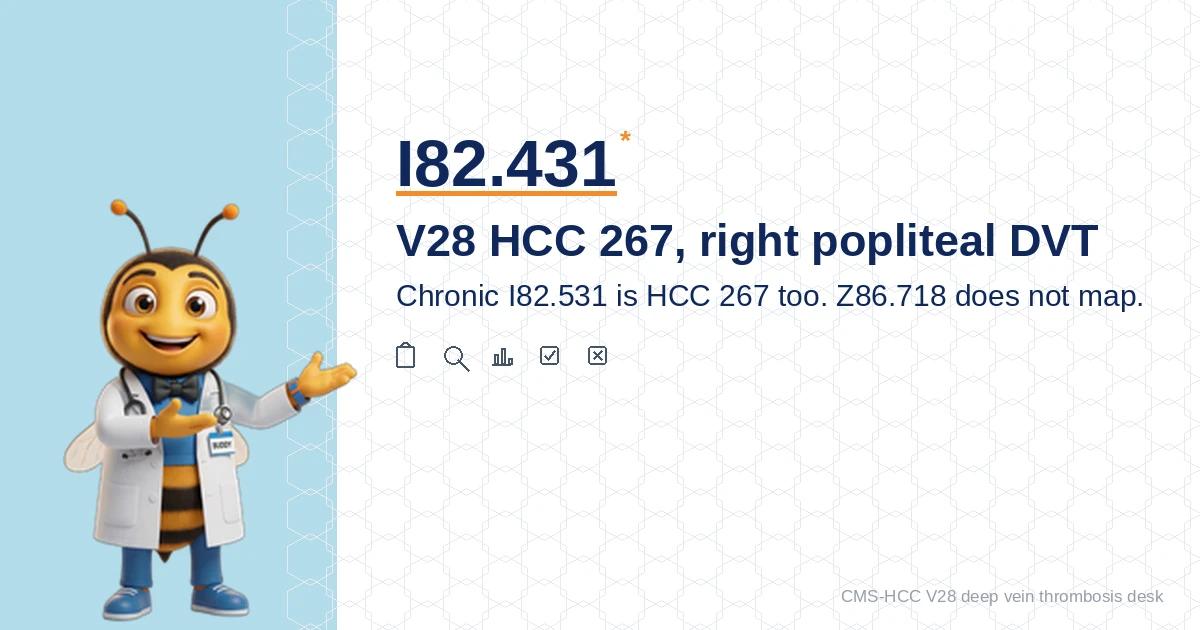
- Z86.718 Personal history of other venous thrombosis and embolism has no V28 HCC. Section I.C.21.c.4 says "Personal history codes explain a patient's past medical condition that no longer exists and is not receiving any treatment, but that has the potential for recurrence, and therefore may require continued monitoring."
- Z86.711 Personal history of pulmonary embolism also has no V28 HCC.
- Z79.01 Long term (current) use of anticoagulants has no V28 HCC. Section I.C.21.c.3 says "Assign a code from Z79 if the patient is receiving a medication for an extended period as a prophylactic measure (such as for the prevention of deep vein thrombosis) or as treatment of a chronic condition (such as arthritis) or a disease requiring a lengthy course of treatment (such as cancer)." It describes the drug, not the clot.
So the provider's words decide it:
- If the provider documents a current SVC or IVC clot, acute or chronic, and is managing it, the I82.2 code is supported. Add Z79.01 when the patient is on long-term anticoagulation.
- If the provider documents that the clot is resolved and the patient is no longer being treated for it, Z86.718 fits, and it does not map.
- If the note says "history of SVC thrombosis" while the plan shows ongoing anticoagulation for a clot the provider still treats as present, the two do not line up. Ask the provider whether the clot is current, chronic, or resolved.
Neighbors coders mix up
| Code | Official descriptor | V28 result | CSV (no decimal) |
|---|---|---|---|
| I87.1 | Compression of vein | Does not map | no CSV row |
| Q26.1 | Persistent left superior vena cava | Does not map | no CSV row |
| I26.93 | Single subsegmental thrombotic pulmonary embolism without acute cor pulmonale | HCC 267 | 1 row, CC 267.0 |
| I26.99 | Other pulmonary embolism without acute cor pulmonale | HCC 267 | 1 row, CC 267.0 |
| I82.409 | Acute embolism and thrombosis of unspecified deep veins of unspecified lower extremity | HCC 267 | 1 row, CC 267.0 |
| I82.90 | Acute embolism and thrombosis of unspecified vein | Does not map | no CSV row |
| Z86.718 | Personal history of other venous thrombosis and embolism | Does not map | no CSV row |
| Z86.711 | Personal history of pulmonary embolism | Does not map | no CSV row |
| Z79.01 | Long term (current) use of anticoagulants | Does not map | no CSV row |
Compression versus clot. I87.1 is the Tabular home for vena cava syndrome as compression or stricture. It does not map. I82.210 is for embolism and thrombosis of the SVC. Mixing those two is the main capture miss in this cluster.
Congenital left SVC. Q26.1 Persistent left superior vena cava is a congenital anomaly code. It is not an acquired clot or acquired syndrome code, and it does not map.
Unspecified vein. I82.90 has the inclusion terms "Embolism of vein NOS" and "Thrombosis (vein) NOS". It has no V28 HCC. A note that says only "central vein clot" without naming the vessel is a query, not an automatic I82.210.
MEAT for an SVC thrombosis code
For I82.210, I82.211, and the other I82.2 codes, the note should support the clot as a current condition the provider is managing, not just a line in the past history:
- M Monitor: the course of the clot as the provider follows it at this visit
- E Evaluate: the imaging or other results the provider reviewed for it
- A Assess: the thrombosis named as current, with the vessel and acute or chronic
- T Treat: the anticoagulation, referral, or other plan the provider documents for it
MEAT is a review mnemonic, not a universal CMS coding rule. Follow the applicable coding, encounter, program, and payer requirements. See MEAT.
Reporting rules that apply
Section IV.H says not to code diagnoses documented as "probable", "suspected," "questionable," "rule out," "compatible with," "consistent with," or "working diagnosis" or other similar terms indicating uncertainty, and to code "the condition(s) to the highest degree of certainty for that encounter/visit, such as symptoms, signs, abnormal test results, or other reason for the visit." A "rule out SVC thrombosis" order in an office note is not coded as I82.210. Code what the provider has confirmed, or the symptoms and findings they document.
Audit and query traps
1. Coding I82.210 from the search phrase "SVC syndrome" when the note documents compression or syndrome without thrombosis. I87.1 is the Tabular inclusion for vena cava syndrome, and it does not map.
2. Coding Q26.1 for an acquired SVC syndrome or clot. Q26.1 is persistent left superior vena cava, a congenital anomaly code. Acquired vena cava syndrome without thrombosis indexes to I87.1.
3. Choosing the chronic code without the provider's word "chronic".
4. Coding an IVC clot to I82.21-. Inferior vena cava is I82.220 or I82.221.
5. Coding a brachiocephalic or innominate vein clot to I82.210. That is I82.290 or I82.291.
6. Carrying an acute SVC thrombosis code forward after the provider documents the clot as resolved and treatment as finished. That is Z86.718, which does not map.
7. Treating Z79.01 as if it proves a current clot. It describes the drug, and it has no V28 HCC.
8. Dropping the I82.2 code because a PE is also coded. The I82 Excludes2 lets both codes go on the claim; both fall into HCC 267.
9. Coding "thrombosis NOS" as an SVC clot. I82.90 has no V28 HCC; ask which vein.
10. Using a CNA reference as a member RAF total, or inventing Coding Clinic quotes, competitor comparisons, or PHI examples.
Two-minute check
1. Does the provider document embolism or thrombosis of a named thoracic vein, or only "SVC syndrome" / compression?
2. Which vessel? SVC is I82.21-, IVC is I82.22-, other thoracic (including brachiocephalic) is I82.29-, renal is I82.3.
3. Does the provider call it acute, chronic, or resolved?
4. Is it current and managed at this visit, or documented as past with no current treatment?
5. Add Z79.01 when the patient is on long-term anticoagulation.
6. Expect HCC 267 for every I82.2, I82.3, and I26 code in this desk, and no V28 HCC for I87.1, Q26.1, I82.90, Z86.718, Z86.711, or Z79.01.
7. Confirm the map on the live card and the CSV row. Confirm MEAT for this year.
Related desks and tools
- Live cards: I82.210, I82.211, I82.220, I82.221, I82.290, I87.1, I26.93, Z86.718, Z79.01
- Hubs: HCC 267
- Lookup: ICD-10 to HCC, Encoder
- Evidence habits: MEAT, provider query templates, acute vs history of, hierarchy and trumping rules
- Nearby: excludes 1 vs excludes 2, codes that do not map, status Z codes that map, FY2027 code changes
Sources
- Live HCC Buddy ICD-10-CM cards (FY2027 Tabular display) and the V28 HCC 267 hub, fetched November 6, 2026
- FY2026 and FY2027 ICD-10-CM order file billable flags, the FY2026 and FY2027 Tabular, the FY2027 Alphabetic Index, and the FY2027 Tabular and Index addenda
- CMS, FY2027 ICD-10-CM Official Guidelines for Coding and Reporting, Sections I.A.12.b, I.C.21.c.3, I.C.21.c.4, and IV.H
- PY2026 V28 mapping, hierarchy, and relative factor files on HCC Buddy main
- CMS, ICD-10 codes (FY2027 ICD-10-CM code files and addendum, effective October 1, 2026)
- CMS, 2026 Model Software/ICD-10 Mappings (PY2026 V28 mappings, hierarchies, relative factors, and the 2026 Final ICD-10-CM Mappings)
V28 mappings come from the cited live code pages and the PY2026 V28 CSV. Coefficients are source-labeled references, not member totals. Not medical advice. Not a Coding Clinic reprint.
Current as of November 6, 2026. Always confirm the V28 mapping for the payment year you are scoring and the live code card before you lock a map claim. The map claims here come from the PY2026 V28 CSV. For PY2027 scores, use the PY2027 V28 mapping. The PY2027 initial V28 CSV on HCC Buddy main has the same category for every code in this post.
Frequently asked questions
What is the ICD-10 code for acute SVC thrombosis?
Acute embolism and thrombosis of the superior vena cava is I82.210. Chronic is I82.211. Both are billable.
Does I82.210 map to an HCC in V28?
Yes. I82.210 has the row I82210,267.0 in the PY2026 V28 CSV and maps to HCC 267, Deep Vein Thrombosis and Pulmonary Embolism. The CMS 2026 Final ICD-10-CM Mappings list V28 category 267 for it, and the live card shows HCC 267.
Is SVC syndrome the same as I82.210?
Not automatically. I82.210 is for embolism and thrombosis of the SVC. The Index sends Syndrome, vena cava (inferior) (superior) (obstruction) to I87.1, and category I87.1 lists Vena cava syndrome as an inclusion term. I87.1 has no V28 HCC. Code the words the provider documents, and query when clot versus compression is unclear.
What is the ICD-10 code for IVC thrombosis?
Acute embolism and thrombosis of the inferior vena cava is I82.220. Chronic is I82.221. Both map to HCC 267.
Does chronic SVC thrombosis map to HCC 267?
Yes. I82.211 has one row with CC 267.0 in the PY2026 V28 CSV. Acute and chronic land in the same V28 category, but the code still has to match the provider's documentation.
Does a history of SVC thrombosis map to an HCC?
No. Personal history of other venous thrombosis and embolism, Z86.718, has no V28 HCC. Use it when the provider documents the clot as resolved and no longer treated.
Does Z79.01 for anticoagulants count as an HCC?
No. Z79.01, Long term (current) use of anticoagulants, has no CSV row and no V28 HCC. Section I.C.21.c.3 names prevention of deep vein thrombosis as one reason to assign a Z79 code. It describes the drug, not the clot.
Related Tools
I82.210 card
Acute embolism and thrombosis of superior vena cava. Billable. V28 HCC 267.
I82.211 card
Chronic embolism and thrombosis of superior vena cava. Billable. V28 HCC 267.
I82.220 card
Acute embolism and thrombosis of inferior vena cava. Billable. V28 HCC 267.
I82.290 card
Acute embolism and thrombosis of other thoracic veins. Billable. V28 HCC 267.
I87.1 card
Compression of vein. Billable. No V28 HCC (No CMS category on the card).
I26.93 card
Single subsegmental thrombotic pulmonary embolism without acute cor pulmonale. Billable. V28 HCC 267.
Z86.718 card
Personal history of other venous thrombosis and embolism. Billable. No V28 HCC (No CMS category on the card).
Z79.01 card
Long term (current) use of anticoagulants. Billable. No V28 HCC (No CMS category on the card).
HCC 267 hub
Deep Vein Thrombosis and Pulmonary Embolism. CNA ref 0.294. 167 mapped codes.
ICD-10 to HCC
Look up one diagnosis against the current V28 map.
Encoder
Look up I82.2 thoracic vein thrombosis codes with live V28 status.

HCC Buddy Coding Team
Editorial
Every HCC Buddy article is checked against the current CMS-HCC model and the active FY ICD-10-CM tabular release before it publishes.
Get HCC Coding Tips in Your Inbox
Join our newsletter for coding tips, guideline updates, and tool announcements.