
C88.40 MALT Lymphoma: V28 HCC 21; Nodal MZL Is C83.0
MALT lymphoma C88.40 is billable and maps to V28 HCC 21. Nodal and splenic marginal zone lymphoma go to C83.0- (HCC 21); Waldenstrom C88.00 is HCC 21.
By the HCC Buddy Coding Team
Updated: November 4, 2026
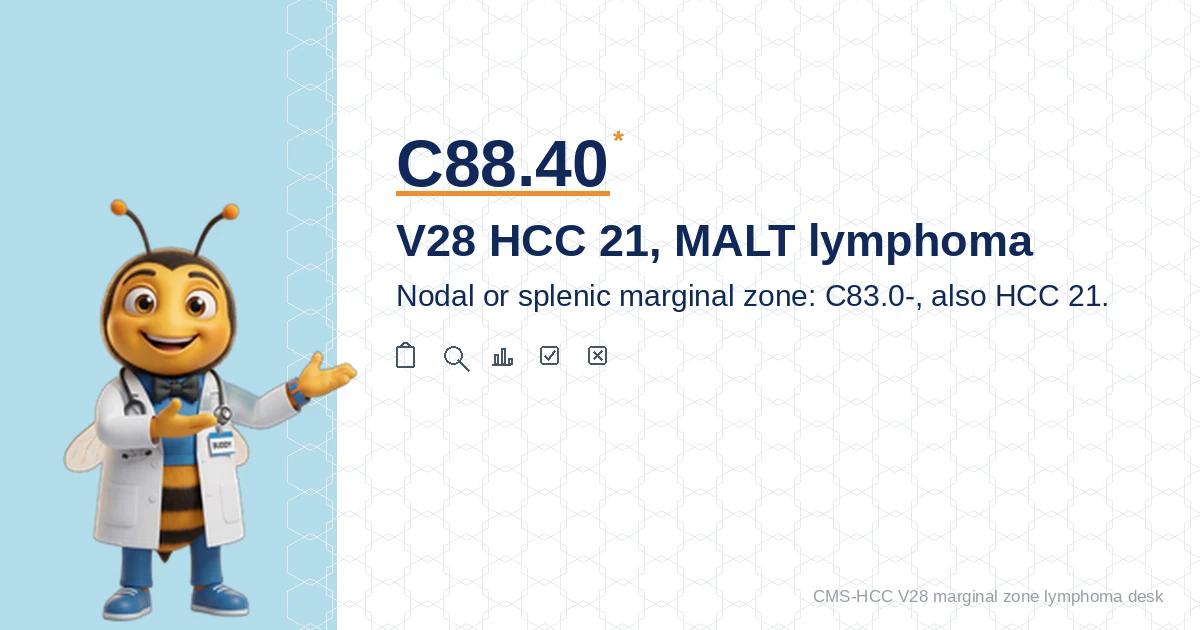
If you searched marginal zone lymphoma ICD-10, MALT lymphoma ICD-10, or C88.40, here is the short answer. C88.40 (Extranodal marginal zone B-cell lymphoma of mucosa-associated lymphoid tissue [MALT-lymphoma] not having achieved remission) is a billable code that maps to CMS-HCC V28 HCC 21 (Lymphoma and Other Cancers). The PY2026 V28 CSV on HCC Buddy main has the row `C8840,21.0,,,`, the V28 column of the CMS 2026 Final ICD-10-CM Mappings lists 21 for it, and the live card shows HCC 21.
The harder question at the desk is which marginal zone lymphoma the provider means. C88.4- is only for the extranodal type, the MALT lymphoma. The Alphabetic Index sends nodal marginal zone lymphoma and splenic marginal zone lymphoma to a different subcategory, C83.0- (Small cell B-cell lymphoma). Both subcategories map to HCC 21, so the choice does not change the V28 category. It still matters, because the code has to match the lymphoma type the provider documented.
Waldenstrom macroglobulinemia sits in the same category as MALT lymphoma. C88.00 also maps to HCC 21.
The C88 and C83.0 codes, descriptors, and Tabular notes are the same in the FY2026 and FY2027 files, and the FY2027 Tabular and Index addenda have no entries for them.
Desk table: C88 codes
| Code | Official descriptor | V28 result | CSV (no decimal) |
|---|---|---|---|
| C88.40 | Extranodal marginal zone B-cell lymphoma of mucosa-associated lymphoid tissue [MALT-lymphoma] not having achieved remission | HCC 21 | 1 row, CC 21.0 |
| C88.41 | Extranodal marginal zone B-cell lymphoma of mucosa-associated lymphoid tissue [MALT-lymphoma], in remission | HCC 21 | 1 row, CC 21.0 |
| C88.00 | Waldenstrom macroglobulinemia not having achieved remission | HCC 21 | 1 row, CC 21.0 |
| C88.01 | Waldenstrom macroglobulinemia, in remission | HCC 21 | 1 row, CC 21.0 |
| C88.90 | Malignant immunoproliferative disease, unspecified not having achieved remission | HCC 21 | 1 row, CC 21.0 |
C88, C88.0, and C88.4 are nonbillable headings, and the live cards say so. Pick a billable child code.
How the Index sorts marginal zone lymphoma
Start at the main term Lymphoma. The FY2027 Alphabetic Index reads:
- Lymphoma, extranodal marginal zone B-cell lymphoma of mucosa-associated lymphoid tissue [MALT-lymphoma] goes to C88.4-.
- Lymphoma, MALT goes to C88.4-. So do Lymphoma, BALT (bronchial-associated lymphoid tissue) and Lymphoma, SALT (skin-associated lymphoid tissue).
- Lymphoma, nodal marginal zone goes to C83.0-.
- Lymphoma, splenic marginal zone goes to C83.0-.
- Lymphoma, small cell B-cell goes to C83.0-.
The Index has no entry for "marginal zone" lymphoma without one of those words. If the note says only "marginal zone lymphoma," the code depends on a detail the note does not give, so ask the provider whether it is extranodal (MALT), nodal, or splenic.
The Tabular agrees. C83.0 Small cell B-cell lymphoma lists "Nodal marginal zone lymphoma" and "Splenic marginal zone lymphoma" among its inclusion terms. C88.4 lists "Lymphoma of skin-associated lymphoid tissue [SALT-lymphoma]" and "Lymphoma of bronchial-associated lymphoid tissue [BALT-lymphoma]".
C88.4 has no site character; C83.0 does
The C88.4 codes carry only a remission character, 0 or 1. There is no character for the site, so a MALT lymphoma of the stomach, the lung, or the skin is still C88.40, or C88.41 in remission. The Lymphoma entries in the Index have no subterm for stage, so a documented stage does not change the code either.
C83.0 works differently. Its fifth character names the site, from C83.00 (unspecified site) through C83.09 (extranodal and solid organ sites), and C83.0A is the in-remission code. Splenic marginal zone lymphoma takes the spleen code, C83.07. Nodal marginal zone lymphoma takes the lymph node region the provider documents, or C83.08 for lymph nodes of multiple sites. When the provider documents either one as in remission, the code is C83.0A, whatever the site.
Section I.C.2.t of the FY2027 guidelines covers lymphoma that spreads beyond the nodes: "When a malignant neoplasm of lymphoid tissue metastasizes beyond the lymph nodes, a code from categories C81-C85 with a final character identifying 'extranodal and solid organ sites' should be assigned rather than a code for the secondary neoplasm of the affected solid organ." For a nodal marginal zone lymphoma documented with that spread, the code is C83.09.
Remission and "failed remission"
C88.40 includes the inclusion terms "Extranodal marginal zone B-cell lymphoma of mucosa-associated lymphoid tissue [MALT-lymphoma] NOS" and "Extranodal marginal zone B-cell lymphoma of mucosa-associated lymphoid tissue [MALT-lymphoma] with failed remission". So a MALT lymphoma with no remission status documented goes to C88.40, and so does one the provider calls a failed remission. C88.41 is for a MALT lymphoma the provider documents as in remission. C88.00 and C88.01 split Waldenstrom macroglobulinemia the same way. For nodal and splenic marginal zone lymphoma, remission has one code, C83.0A.
Section I.C.2.n is written for leukemia and category C90, and it says that "If the documentation is unclear as to whether the leukemia has achieved remission, the provider should be queried." The C88 codes carry the same remission split, so the same habit is sensible here: when the note does not make the remission status clear, ask.
All four codes, C88.40, C88.41, C88.00, and C88.01, map to HCC 21. Remission does not change the V28 category, but it does change the code.
Waldenstrom and lymphoplasmacytic lymphoma
The Index has two paths that look alike:
- Lymphoma, lymphoplasmacytic goes to C83.0-. Its subterm with IgM-production goes to C88.0-.
- Macroglobulinemia (idiopathic) (primary) and Macroglobulinemia, Waldenstrom go to C88.0-. The subterm Macroglobulinemia, monoclonal (essential) goes to D47.2.
The Tabular backs both splits. C88.0 Waldenstrom macroglobulinemia includes "Lymphoplasmacytic lymphoma with IgM-production" and has an Excludes1 note for "small cell B-cell lymphoma (C83.0)". C83.0 lists "Lymphoplasmacytic lymphoma" as an inclusion term and has an Excludes1 note for "Waldenstrom macroglobulinemia (C88.00)". So the provider's words decide it. Lymphoplasmacytic lymphoma documented as IgM-producing, or documented as Waldenstrom, goes to C88.0-. Lymphoplasmacytic lymphoma with no IgM production documented goes to C83.0-.
D47.2 (Monoclonal gammopathy) includes "Monoclonal gammopathy of undetermined significance [MGUS]". It has no V28 HCC. Do not code it as Waldenstrom unless the provider documents Waldenstrom.
The CSV rows behind the answer
Each code has one row in the PY2026 V28 CSV, with no age or sex condition:
- `C8840,21.0,,,`
- `C8841,21.0,,,`
- `C8800,21.0,,,`
- `C8801,21.0,,,`
- `C8300,21.0,,,`
- `C8307,21.0,,,`
- `C8308,21.0,,,`
- `C8309,21.0,,,`
- `C830A,21.0,,,`
The columns are ICD10, CC, MCE_AGE_CONDITION, AGE_EDIT_CONDITION, and SEX_EDIT_CONDITION. There is no row for D472, Z8572, or Z8579.
The CMS 2026 Final ICD-10-CM Mappings agree. They list V28 category 21 for C88.40, C88.41, C88.00, C88.01, and the C83.0 codes above. This post covers the CMS-HCC V28 result only.
Hierarchy: where HCC 21 sits among the cancer categories
In the V28 hierarchy file, the row `HCC21,HCC22,HCC23,,,,` shows that HCC 21 supersedes HCC 22 (Bladder, Colorectal, and Other Cancers) and HCC 23 (Prostate, Breast, and Other Cancers and Tumors). The row `HCC19,HCC20,HCC21,HCC22,HCC23,,` shows that HCC 19 (Myelodysplastic Syndromes, Multiple Myeloma, and Other Cancers) supersedes HCC 21, and the row `HCC20,HCC21,HCC22,HCC23,,,` shows the same for HCC 20 (Lung and Other Severe Cancers). HCC 17 and HCC 18 also sit above HCC 21.
So when a member has a supported HCC 21 code and a supported HCC 19 or HCC 20 code in the same year, only the higher category counts. The hierarchy works on the model categories, not on the claim. Keep reporting every lymphoma and cancer code the provider supports.
The PY2026 V28 relative factors list HCC 21 with a CNA reference of 0.671 and a COMMUNITY_ND value of 0.54. HCC 19 has a CNA reference of 1.798. These are community segment values, not member totals, and the segment a member is scored in depends on that member's enrollment data.
The live HCC 21 hub lists 463 codes and the HCC 19 hub lists 68 codes, and both counts match the CSV.
Neighbors coders mix up
| Code | Official descriptor | V28 result | CSV (no decimal) |
|---|---|---|---|
| C83.07 | Small cell B-cell lymphoma, spleen | HCC 21 | 1 row, CC 21.0 |
| C83.08 | Small cell B-cell lymphoma, lymph nodes of multiple sites | HCC 21 | 1 row, CC 21.0 |
| C83.09 | Small cell B-cell lymphoma, extranodal and solid organ sites | HCC 21 | 1 row, CC 21.0 |
| C83.0A | Small cell B-cell lymphoma, in remission | HCC 21 | 1 row, CC 21.0 |
| C85.90 | Non-Hodgkin lymphoma, unspecified, unspecified site | HCC 21 | 1 row, CC 21.0 |
| C90.00 | Multiple myeloma not having achieved remission | HCC 19 | 1 row, CC 19.0 |
| D47.2 | Monoclonal gammopathy | Does not map | no CSV row |
| Z85.72 | Personal history of non-Hodgkin lymphomas | Does not map | no CSV row |
| Z85.79 | Personal history of other malignant neoplasms of lymphoid, hematopoietic and related tissues | Does not map | no CSV row |
Large B-cell lymphoma. C88.4 has an Excludes1 note for "high malignant (diffuse large B-cell) lymphoma (C83.3-)". Diffuse large B-cell lymphoma is coded in C83.3-, which maps to HCC 20, not HCC 21. See the C83.398 DLBCL desk.
Unspecified B-cell lymphoma. Category C88 has an Excludes1 note for "B-cell lymphoma, unspecified (C85.1-)". A note that says only "B-cell lymphoma" does not go to C88.
Multiple myeloma. C90.00 maps to HCC 19, which supersedes HCC 21. It is a separate code with its own Index entry, Myeloma (multiple), and it is not coded from a Waldenstrom diagnosis.
History of MALT or marginal zone lymphoma
Many searches ask for the code for a history of marginal zone lymphoma. Section I.C.2.m says that when a primary malignancy "has been previously excised or eradicated from its site, there is no further treatment (of the malignancy) directed to that site, and there is no evidence of any existing primary malignancy at that site, a code from category Z85, Personal history of malignant neoplasm, should be used to indicate the former site of the malignancy."
The right history code depends on which category the lymphoma came from:
- MALT lymphoma or Waldenstrom (C88). Category C88 has an Excludes1 note for "personal history of other malignant neoplasms of lymphoid, hematopoietic and related tissues (Z85.79)", and Z85.79 lists "Conditions classifiable to C88-C90, C96" as an inclusion term.
- Nodal or splenic marginal zone lymphoma (C83.0). Category C83 has an Excludes1 note for "personal history of non-Hodgkin lymphoma (Z85.72)", and Z85.72 lists "Conditions classifiable to C82-C85".
Section I.A.12.a says an Excludes1 note "indicates that the code excluded should never be used at the same time as the code above the Excludes1 note." So the history code and the code for the same active lymphoma are not reported together. The same section makes one exception: "An exception to the Excludes1 definition is the circumstance when the two conditions are unrelated to each other. If it is not clear whether the two conditions involving an Excludes1 note are related or not, query the provider." Neither Z85.72 nor Z85.79 has a V28 HCC.
So the provider's words decide it:
- If the provider documents the lymphoma as current, under treatment, or in remission with a current assessment, the C88 or C83.0 code is supported.
- If the provider documents that the lymphoma was treated in the past and there is no current disease and no current treatment, the Z85 code fits, and it does not map.
- If the note says "history of" while the plan shows ongoing treatment or monitoring of active disease, the two do not line up. Ask the provider.
MEAT for marginal zone lymphoma
For C88.40, C88.41, C88.00, C88.01, and the C83.0 codes, the note should support the lymphoma as a current condition the provider is managing, not just a line in the past history:
- M Monitor: the course of the lymphoma or its remission as the provider follows it at this visit
- E Evaluate: the results or findings the provider reviewed for the lymphoma
- A Assess: the lymphoma named as current, with its type and remission status
- T Treat: the current treatment, referral, or plan the provider documents for it
MEAT is a review mnemonic, not a universal CMS coding rule. Follow the applicable coding, encounter, program, and payer requirements. See MEAT.
Reporting rules that apply
Section IV.H says not to code diagnoses documented as "probable", "suspected," "questionable," "rule out," "compatible with," "consistent with," or "working diagnosis" or other similar terms indicating uncertainty, and to code "the condition(s) to the highest degree of certainty for that encounter/visit, such as symptoms, signs, abnormal test results, or other reason for the visit." A suspected lymphoma in an office note is not coded as C88 or C83. Code what the provider has confirmed, or the symptoms and findings they document.
Audit and query traps
1. Coding nodal or splenic marginal zone lymphoma to C88.40. The Index sends both to C83.0-.
2. Coding "marginal zone lymphoma" with no type without asking. The Index has no entry for it without the words extranodal, MALT, nodal, or splenic.
3. Coding a site for MALT lymphoma. C88.4 has no site character.
4. Coding lymphoplasmacytic lymphoma to C88.00 when the provider documents no IgM production and no Waldenstrom. The Index sends it to C83.0-.
5. Coding MGUS or monoclonal macroglobulinemia as Waldenstrom. The Index sends monoclonal (essential) macroglobulinemia to D47.2, which has no V28 HCC.
6. Choosing the remission code without provider language. Ask when remission status is unclear.
7. Reporting Z85.72 or Z85.79 with the code for the same active lymphoma. The C83 and C88 Excludes1 notes do not allow it unless the two conditions are unrelated, and an unclear relationship is a query.
8. Carrying a lymphoma code forward from a history line when the provider documents no current disease or management.
9. Using a CNA reference as a member RAF total.
10. Inventing Coding Clinic quotes, competitor comparisons, or PHI examples.
Two-minute check
1. Does the provider name the lymphoma type: extranodal (MALT, BALT, SALT), nodal, splenic, lymphoplasmacytic, or Waldenstrom?
2. Extranodal MALT goes to C88.4-. Nodal and splenic marginal zone go to C83.0- with the site character, or C83.0A when the provider documents remission. Waldenstrom, or lymphoplasmacytic with IgM production, goes to C88.0-.
3. Is the lymphoma in remission, not in remission, or a failed remission?
4. Is it current and managed at this visit, or documented as past with no current disease or treatment?
5. Expect HCC 21 for every C88 and C83.0 code in this desk, HCC 19 for multiple myeloma, no V28 HCC for D47.2, Z85.72, or Z85.79, and HCC 19 and HCC 20 to supersede HCC 21.
6. Confirm the map on the live card and the CSV row. Confirm MEAT for this year.
Related desks and tools
- Live cards: C88.40, C88.41, C88.00, C88.01, C83.07, C83.08, C83.0A, D47.2, Z85.72, Z85.79
- Hubs: HCC 21, HCC 19
- Lookup: ICD-10 to HCC, Encoder
- Evidence habits: MEAT, provider query templates, acute vs history of, hierarchy and trumping rules
- Nearby: C83.398 DLBCL desk, excludes 1 vs excludes 2, codes that do not map, FY2027 code changes
Sources
- Live HCC Buddy ICD-10-CM cards (FY2027 Tabular display) and the V28 HCC 21 and HCC 19 hubs, fetched November 4, 2026
- FY2026 and FY2027 ICD-10-CM order file billable flags, the FY2026 and FY2027 Tabular, the FY2027 Alphabetic Index, and the FY2027 Tabular and Index addenda
- CMS, FY2027 ICD-10-CM Official Guidelines for Coding and Reporting, Sections I.A.12.a, I.C.2.m, I.C.2.n, I.C.2.t, and IV.H
- PY2026 V28 mapping, hierarchy, and relative factor files on HCC Buddy main
- CMS, ICD-10 codes (FY2027 ICD-10-CM code files and addendum, effective October 1, 2026)
- CMS, 2026 Model Software/ICD-10 Mappings (PY2026 V28 mappings, hierarchies, relative factors, and the 2026 Final ICD-10-CM Mappings)
V28 mappings come from the cited live code pages and the PY2026 V28 CSV. Coefficients are source-labeled references, not member totals. Not medical advice. Not a Coding Clinic reprint.
Current as of November 4, 2026. Always confirm the V28 mapping for the payment year you are scoring and the live code card before you lock a map claim. The map claims here come from the PY2026 V28 CSV. For PY2027 scores, use the PY2027 V28 mapping. The PY2027 initial V28 CSV on HCC Buddy main has the same category for every code in this post.
Frequently asked questions
What is the ICD-10 code for marginal zone lymphoma?
It depends on the type. Extranodal marginal zone B-cell lymphoma of mucosa-associated lymphoid tissue, the MALT lymphoma, is C88.40, or C88.41 in remission. The Alphabetic Index sends nodal marginal zone lymphoma and splenic marginal zone lymphoma to C83.0-, with the fifth character for the site, such as C83.07 for the spleen, or C83.0A when the provider documents remission. If the note gives no type, ask the provider.
Does C88.40 map to an HCC in V28?
Yes. C88.40 has the row C8840,21.0 in the PY2026 V28 CSV and maps to HCC 21, Lymphoma and Other Cancers. The CMS 2026 Final ICD-10-CM Mappings list V28 category 21 for it, and the live card shows HCC 21.
Is splenic marginal zone lymphoma coded to C88.4?
No. The Index entry Lymphoma, splenic marginal zone goes to C83.0-, and C83.0 lists splenic marginal zone lymphoma as an inclusion term. The spleen code is C83.07, or C83.0A when the provider documents remission. Both map to HCC 21, the same category as C88.40.
Does the site of a MALT lymphoma change the code?
No. The C88.4 codes have no site character. A MALT lymphoma of the stomach, lung, or skin is C88.40, or C88.41 when the provider documents remission.
What is the ICD-10 code for Waldenstrom macroglobulinemia?
C88.00, Waldenstrom macroglobulinemia not having achieved remission, or C88.01 in remission. Both map to V28 HCC 21. Lymphoplasmacytic lymphoma with IgM production also goes to C88.0-. Lymphoplasmacytic lymphoma without that detail goes to C83.0-.
What is the code for a history of MALT lymphoma?
When the provider documents that the lymphoma was treated in the past and there is no current disease and no current treatment, a history of MALT lymphoma or Waldenstrom goes to Z85.79, and a history of nodal or splenic marginal zone lymphoma goes to Z85.72. Neither has a V28 HCC. The C88 and C83 Excludes1 notes keep them off the same claim as the code for the same active lymphoma. Section I.A.12.a allows both when the two conditions are unrelated, and says to query the provider when that is not clear.
Does multiple myeloma supersede HCC 21?
Yes. Multiple myeloma, C90.00, maps to HCC 19. The V28 hierarchy row HCC19,HCC20,HCC21,HCC22,HCC23 shows that HCC 19 supersedes HCC 21. The hierarchy is applied by the model, so keep reporting every lymphoma code the provider supports.
Related Tools
C88.40 card
Extranodal marginal zone B-cell lymphoma of mucosa-associated lymphoid tissue [MALT-lymphoma] not having achieved remission. Billable. V28 HCC 21.
C88.41 card
Extranodal marginal zone B-cell lymphoma of mucosa-associated lymphoid tissue [MALT-lymphoma], in remission. Billable. V28 HCC 21.
C88.00 card
Waldenstrom macroglobulinemia not having achieved remission. Billable. V28 HCC 21.
C83.07 card
Small cell B-cell lymphoma, spleen. Billable. V28 HCC 21.
C83.08 card
Small cell B-cell lymphoma, lymph nodes of multiple sites. Billable. V28 HCC 21.
D47.2 card
Monoclonal gammopathy. Billable. No V28 HCC for 2026 dates of service.
Z85.79 card
Personal history of other malignant neoplasms of lymphoid, hematopoietic and related tissues. Billable. No V28 HCC for 2026 dates of service.
HCC 21 hub
Lymphoma and Other Cancers. CNA ref 0.671. 463 mapped codes.
HCC 19 hub
Myelodysplastic Syndromes, Multiple Myeloma, and Other Cancers. CNA ref 1.798. 68 mapped codes.
ICD-10 to HCC
Look up one diagnosis against the current V28 map.
Encoder
Look up C88 and C83.0 lymphoma codes with live V28 status.

HCC Buddy Coding Team
Editorial
Every HCC Buddy article is checked against the current CMS-HCC model and the active FY ICD-10-CM tabular release before it publishes.
Get HCC Coding Tips in Your Inbox
Join our newsletter for coding tips, guideline updates, and tool announcements.