
M31.6 Giant Cell Arteritis: V28 HCC 94; With PMR It Is M31.5
Other giant cell arteritis, billable, V28 HCC 94. GCA with polymyalgia rheumatica is M31.5 (HCC 94); PMR alone, M35.3, has no V28 HCC.
By the HCC Buddy Coding Team
Updated: November 2, 2026
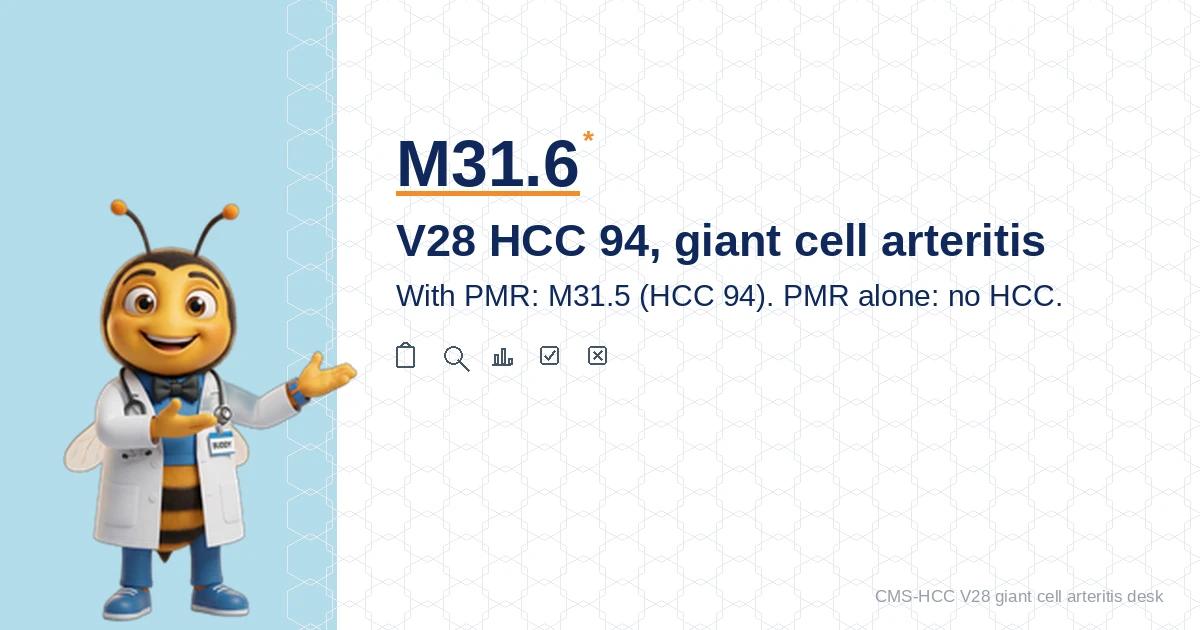
If you searched giant cell arteritis ICD-10 or M31.6, here is the short answer. M31.6 (Other giant cell arteritis) is a billable code that maps to CMS-HCC V28 HCC 94 (Systemic Lupus Erythematosus and Other Specified Systemic Connective Tissue Disorders). The PY2026 V28 CSV on HCC Buddy main has the row `M316,94.0,,,`, the V28 column of the CMS 2026 Final ICD-10-CM Mappings lists 94 for it, and the live card shows HCC 94.
Giant cell arteritis has two codes, and the deciding fact is polymyalgia rheumatica. When the provider documents giant cell arteritis together with polymyalgia rheumatica, the code is M31.5 (Giant cell arteritis with polymyalgia rheumatica), which also maps to HCC 94. When the provider documents giant cell arteritis without polymyalgia rheumatica, including temporal giant cell arteritis, the code is M31.6. Polymyalgia rheumatica on its own is M35.3, and it has no V28 HCC.
The M31.5, M31.6, and M35.3 codes, descriptors, and Tabular notes are the same in the FY2026 and FY2027 files, and the FY2027 Tabular and Index addenda have no entries for them.
Desk table: giant cell arteritis and PMR
| Code | Official descriptor | V28 result | CSV (no decimal) |
|---|---|---|---|
| M31.6 | Other giant cell arteritis | HCC 94 | 1 row, CC 94.0 |
| M31.5 | Giant cell arteritis with polymyalgia rheumatica | HCC 94 | 1 row, CC 94.0 |
| M35.3 | Polymyalgia rheumatica | Does not map | no CSV row |
| I77.6 | Arteritis, unspecified | Does not map | no CSV row |
M31 and M35 are nonbillable headings, and the live cards say so. The PY2026 V28 CSV has no row for M35.3 or I77.6, and the CMS 2026 Final ICD-10-CM Mappings leave the V28 column blank for both.
How the Index gets you to M31.6
Most of the time the provider writes "giant cell arteritis," "temporal arteritis," or the short form GCA. The FY2027 Alphabetic Index handles each of those words a little differently, so start at the main term Arteritis and read the subterms:
- Arteritis, giant cell NEC goes to M31.6. Its subterm with polymyalgia rheumatica goes to M31.5.
- Arteritis, temporal, giant cell goes to M31.6.
- Arteritis, cranial, giant cell goes to M31.6.
- Arteritis with no subterm goes to I77.6, Arteritis, unspecified, which has no V28 HCC.
So a note that says "temporal arteritis" with nothing else does not name giant cell arteritis on its face, and the Index has no "temporal" subterm without "giant cell." If the provider means giant cell arteritis, ask them to say so. Do not add "giant cell" yourself to reach a code that maps.
From the other direction, Polymyalgia rheumatica goes to M35.3, and its subterm with giant cell arteritis goes to M31.5. The Index also lists Polymyalgia, arteritica, giant cell at M31.5.
GCA with PMR is one code, not two
Section I.B.9 of the FY2027 guidelines says to "Assign only the combination code when that code fully identifies the diagnostic conditions involved or when the Alphabetic Index so directs." M31.5 is that combination code. It names both conditions in its title, and the Index sends both paths to it.
The Tabular backs this up. M35.3 Polymyalgia rheumatica has an Excludes1 note for "polymyalgia rheumatica with giant cell arteritis (M31.5)". So when the provider documents both conditions, report M31.5 alone. Do not report M31.6 with M35.3.
Section I.A.15 explains why the link is assumed. The word "with" in the Index means "associated with" or "due to," and the conditions "should be coded as related even in the absence of provider documentation explicitly linking them, unless the documentation clearly states the conditions are unrelated." So if the provider clearly states that the giant cell arteritis and the polymyalgia rheumatica are unrelated, the M31.5 presumption does not apply. If the note is unclear, ask the provider.
Getting this right does not change the V28 result, because M31.5 and M31.6 both map to HCC 94 and M35.3 does not map at all. It still matters, because the claim should say what the provider documented, and a pair of codes that an Excludes1 note forbids is an easy audit finding.
The CSV rows behind the answer
Each code in the desk table has at most one row in the PY2026 V28 CSV, with no age or sex condition:
The columns are ICD10, CC, MCE_AGE_CONDITION, AGE_EDIT_CONDITION, and SEX_EDIT_CONDITION. There is no row for M353 or I776.
The CMS 2026 Final ICD-10-CM Mappings agree. They list V28 category 94 for M31.5 and M31.6 and leave the V28 column blank for M35.3 and I77.6. This post covers the CMS-HCC V28 result only.
History of GCA or current GCA
A good share of searches ask for the code for a history of giant cell arteritis, and this is where the most care is needed.
Section I.C.21.c.4 says personal history codes "explain a patient's past medical condition that no longer exists and is not receiving any treatment, but that has the potential for recurrence, and therefore may require continued monitoring." The Index sends a personal history of a connective tissue disease NEC to Z87.39 (Personal history of other diseases of the musculoskeletal system and connective tissue), which has no V28 HCC.
In outpatient and office visits, Section IV.J says: "Code all documented conditions that coexist at the time of the encounter/visit and that require or affect patient care, treatment or management. Do not code conditions that were previously treated and no longer exist." Section IV.I adds that "Chronic diseases treated on an ongoing basis may be coded and reported as many times as the patient receives treatment and care for the condition(s)."
So the provider's words decide it:
- If the provider documents giant cell arteritis as a current condition that is being treated or managed at this visit, M31.6 (or M31.5 with polymyalgia rheumatica) is supported.
- If the provider documents that the condition was treated in the past and no longer exists, with no current treatment, the history code fits, and it does not map.
- If the note says only "history of GCA" while the medication list shows ongoing therapy, the two facts do not line up. Ask the provider whether the condition is current.
Long-term steroid use is a separate code
Section I.C.21.c.3 says codes from category Z79 "indicate a patient's continuous use of a prescribed drug ... for the long-term treatment of a condition," and it names treatment of a chronic condition as one use. When the provider documents long-term systemic steroid therapy, Z79.52 (Long term (current) use of systemic steroids) can be reported as an additional code. Z79.52 has no V28 HCC.
A medication on the list is not a diagnosis. The provider still has to document the giant cell arteritis and connect it to current care for M31.6 to be supported.
Hierarchy: HCC 93 sits above HCC 94
HCC 94 is Systemic Lupus Erythematosus and Other Specified Systemic Connective Tissue Disorders. In the V28 hierarchy file, the row `HCC93,HCC94,,,,,` shows that HCC 93 (Rheumatoid Arthritis and Other Specified Inflammatory Rheumatic Disorders) supersedes HCC 94. The row `HCC94,,,,,,` shows that HCC 94 supersedes nothing. So when a member has a supported HCC 93 code and a supported giant cell arteritis code in the same year, the HCC 94 category drops and only HCC 93 counts.
The PY2026 V28 relative factors list HCC 94 with a CNA reference of 0.268 and a COMMUNITY_ND value of 0.239. HCC 93 has a CNA reference of 0.617. These are community segment values, not member totals, and the segment a member is scored in depends on that member's enrollment data.
The live hubs list HCC 94 with 71 codes and HCC 93 with 508 codes, and both counts match the CSV.
Neighbors coders mix up
The vasculitis codes in M30 and M31 are spread across three V28 categories, so check each one on its own card.
| Code | Official descriptor | V28 result | CSV (no decimal) |
|---|---|---|---|
| M31.4 | Aortic arch syndrome [Takayasu] | HCC 93 | 1 row, CC 93.0 |
| M31.7 | Microscopic polyangiitis | HCC 94 | 1 row, CC 94.0 |
| M31.30 | Wegener's granulomatosis without renal involvement | HCC 93 | 1 row, CC 93.0 |
| M31.31 | Wegener's granulomatosis with renal involvement | HCC 93 | 1 row, CC 93.0 |
| M31.8 | Other specified necrotizing vasculopathies | HCC 94 | 1 row, CC 94.0 |
| M31.9 | Necrotizing vasculopathy, unspecified | HCC 94 | 1 row, CC 94.0 |
| M30.0 | Polyarteritis nodosa | HCC 94 | 1 row, CC 94.0 |
| M30.1 | Polyarteritis with lung involvement [Churg-Strauss] | HCC 278 | 1 row, CC 278.0 |
| I77.82 | Antineutrophilic cytoplasmic antibody [ANCA] vasculitis | HCC 93 | 1 row, CC 93.0 |
| M35.9 | Systemic involvement of connective tissue, unspecified | Does not map | no CSV row |
Takayasu. The Index sends Arteritis, aortic arch, Arteritis, brachiocephalic, and Arteritis, young female aortic arch syndrome to M31.4, which maps to HCC 93, not HCC 94. Large vessel arteritis is not automatically giant cell arteritis. Code the type the provider names.
Microscopic polyangiitis. M31.7 has an Excludes1 note for "polyarteritis nodosa (M30.0)". Both map to HCC 94, but they are different diagnoses and are not reported together.
Thrombotic microangiopathy. M31.1 sits in the same category but maps elsewhere: M31.10 and M31.19 to HCC 112, and M31.11 to HCC 454. See the M31.11 HSCT-TMA desk.
Vision findings. When the provider documents a vision complication, code it from the Index and Tabular on its own. H47.011 (Ischemic optic neuropathy, right eye) has no V28 HCC, and no M31.5 or M31.6 note tells you to add it.
MEAT for giant cell arteritis
For M31.6 or M31.5, the note should support the arteritis as a current condition the provider is managing, not just a line in the past history:
- M Monitor: the course of the condition as the provider follows it at this visit
- E Evaluate: the results or findings the provider reviewed for the arteritis
- A Assess: giant cell arteritis named as current, with or without polymyalgia rheumatica
- T Treat: the current treatment or plan the provider documents for it
MEAT is a review mnemonic, not a universal CMS coding rule. Follow the applicable coding, encounter, program, and payer requirements. See MEAT.
Reporting rules that apply
Section IV.H says not to code diagnoses documented as "probable", "suspected," "questionable," "rule out," "compatible with," "consistent with," or "working diagnosis" or other similar terms indicating uncertainty, and to code "the condition(s) to the highest degree of certainty for that encounter/visit, such as symptoms, signs, abnormal test results, or other reason for the visit." A suspected giant cell arteritis in an office note is not coded as M31.6. Code what the provider has confirmed, or the symptoms they document.
Audit and query traps
1. Reporting M31.6 with M35.3 when the provider documents both conditions and does not state that they are unrelated. The Index and the M35.3 Excludes1 note send that to M31.5.
2. Expecting a V28 HCC from polymyalgia rheumatica alone. M35.3 has no V28 row.
3. Coding "temporal arteritis" or "arteritis" as M31.6 when the provider never names giant cell arteritis. The Index default for Arteritis is I77.6.
4. Coding M31.6 from a history-of line when the provider documents that the condition no longer exists and is not receiving any treatment. Section I.C.21.c.4 points to a history code in that case. If the note does not make the status clear, ask the provider rather than assume the condition is past.
5. Treating Z79.52 or a steroid on the medication list as proof that the arteritis is current.
6. Coding a suspected diagnosis in an office visit. Section IV.H says not to.
7. Coding Takayasu (M31.4, HCC 93) as giant cell arteritis, or the reverse.
8. Using a CNA reference as a member RAF total, or forgetting that HCC 93 supersedes HCC 94.
9. Inventing Coding Clinic quotes, competitor comparisons, or PHI examples.
Two-minute check
1. Does the provider name giant cell arteritis, or only "arteritis" or "temporal arteritis"?
2. Does the provider also document polymyalgia rheumatica? Both conditions go to M31.5. GCA alone goes to M31.6. PMR alone goes to M35.3.
3. Is the condition current and managed at this visit, or documented as past and no longer treated?
4. Expect HCC 94 for M31.5 and M31.6, no V28 HCC for M35.3, I77.6, Z87.39, or Z79.52, and HCC 93 to supersede HCC 94.
5. Confirm the map on the live card and the CSV row. Confirm MEAT for this year.
Related desks and tools
- Live cards: M31.6, M31.5, M35.3, I77.6, M31.4, M31.7, Z87.39, Z79.52
- Hubs: HCC 94, HCC 93
- Lookup: ICD-10 to HCC, Encoder
- Evidence habits: MEAT, Excludes1 vs Excludes2, provider query templates, acute vs history of
- Nearby: M31.11 HSCT-TMA desk, codes that do not map, combination codes, FY2027 code changes
Sources
- Live HCC Buddy ICD-10-CM cards (FY2027 Tabular display) and the V28 HCC 93 and HCC 94 hubs, fetched November 2, 2026
- FY2026 and FY2027 ICD-10-CM order file billable flags, the FY2026 and FY2027 Tabular, the FY2027 Alphabetic Index, and the FY2027 Tabular and Index addenda
- CMS, FY2027 ICD-10-CM Official Guidelines for Coding and Reporting, Sections I.A.15, I.B.9, I.C.21.c.3, I.C.21.c.4, IV.H, IV.I, and IV.J
- PY2026 V28 mapping, hierarchy, and relative factor files on HCC Buddy main
- CMS, ICD-10 codes (FY2027 ICD-10-CM code files and addendum, effective October 1, 2026)
- CMS, 2026 Model Software/ICD-10 Mappings (PY2026 V28 mappings, hierarchies, relative factors, and the 2026 Final ICD-10-CM Mappings)
V28 mappings come from the cited live code pages and the PY2026 V28 CSV. Coefficients are source-labeled references, not member totals. Not medical advice. Not a Coding Clinic reprint.
Current as of November 2, 2026. Always confirm the PY2026 V28 CSV and the live code card before you lock a map claim.
Frequently asked questions
What is the ICD-10 code for giant cell arteritis?
M31.6, Other giant cell arteritis, is the billable code for giant cell arteritis without polymyalgia rheumatica, including temporal giant cell arteritis. When the provider documents giant cell arteritis together with polymyalgia rheumatica, the code is M31.5.
Does M31.6 map to an HCC in V28?
Yes. M31.6 has the row M316,94.0 in the PY2026 V28 CSV and maps to HCC 94, Systemic Lupus Erythematosus and Other Specified Systemic Connective Tissue Disorders. The CMS 2026 Final ICD-10-CM Mappings list V28 category 94 for it, and the live card shows HCC 94.
What is the code for GCA with polymyalgia rheumatica?
M31.5, Giant cell arteritis with polymyalgia rheumatica. It is a combination code, and the Alphabetic Index sends both Arteritis, giant cell, with polymyalgia rheumatica and Polymyalgia, rheumatica, with giant cell arteritis to it. M31.5 also maps to V28 HCC 94.
Does polymyalgia rheumatica alone map to an HCC?
No. M35.3, Polymyalgia rheumatica, has no row in the PY2026 V28 CSV, and the CMS 2026 Final ICD-10-CM Mappings leave its V28 column blank. The live card reads No V28 HCC for 2026 dates of service.
Can I code M31.6 and M35.3 together?
No. M35.3 has an Excludes1 note for polymyalgia rheumatica with giant cell arteritis (M31.5). When the provider documents both conditions, report M31.5 alone, unless the provider clearly states that they are unrelated (Section I.A.15). If the note is unclear, ask the provider.
What is the code for a history of giant cell arteritis?
If the provider documents that the condition was treated in the past, no longer exists, and is not receiving any treatment, the Index sends a personal history of a connective tissue disease NEC to Z87.39, which has no V28 HCC. If the provider documents giant cell arteritis as current and managed at the visit, M31.6 or M31.5 is supported.
Does HCC 93 supersede HCC 94?
Yes. The V28 hierarchy file has the row HCC93,HCC94, so when a member has a supported HCC 93 code and a supported HCC 94 code in the same year, HCC 94 drops and only HCC 93 counts. HCC 94 supersedes nothing.
Related Tools
M31.6 card
Other giant cell arteritis. Billable. V28 HCC 94.
M31.5 card
Giant cell arteritis with polymyalgia rheumatica. Billable. V28 HCC 94.
M35.3 card
Polymyalgia rheumatica. Billable. No V28 HCC for 2026 dates of service.
I77.6 card
Arteritis, unspecified. Billable. No V28 HCC for 2026 dates of service.
M31.4 card
Aortic arch syndrome [Takayasu]. Billable. V28 HCC 93.
M31.7 card
Microscopic polyangiitis. Billable. V28 HCC 94.
HCC 94 hub
Systemic Lupus Erythematosus and Other Specified Systemic Connective Tissue Disorders. CNA ref 0.268. 71 mapped codes.
HCC 93 hub
Rheumatoid Arthritis and Other Specified Inflammatory Rheumatic Disorders. CNA ref 0.617. 508 mapped codes.
ICD-10 to HCC
Look up one diagnosis against the current V28 map.
Encoder
Look up M30 and M31 vasculitis codes with live V28 status.

HCC Buddy Coding Team
Editorial
Every HCC Buddy article is checked against the current CMS-HCC model and the active FY ICD-10-CM tabular release before it publishes.
Get HCC Coding Tips in Your Inbox
Join our newsletter for coding tips, guideline updates, and tool announcements.