
ICD-10-CM Changes 2027: All 238 New and 21 Deleted Codes
238 new codes and 21 deleted, effective October 1, 2026. The complete FY2027 ICD-10-CM list by chapter, plus the cardiomyopathy, arrhythmia, and Z-code changes that affect HCC capture.
By the HCC Buddy Coding Team
Updated: September 5, 2026
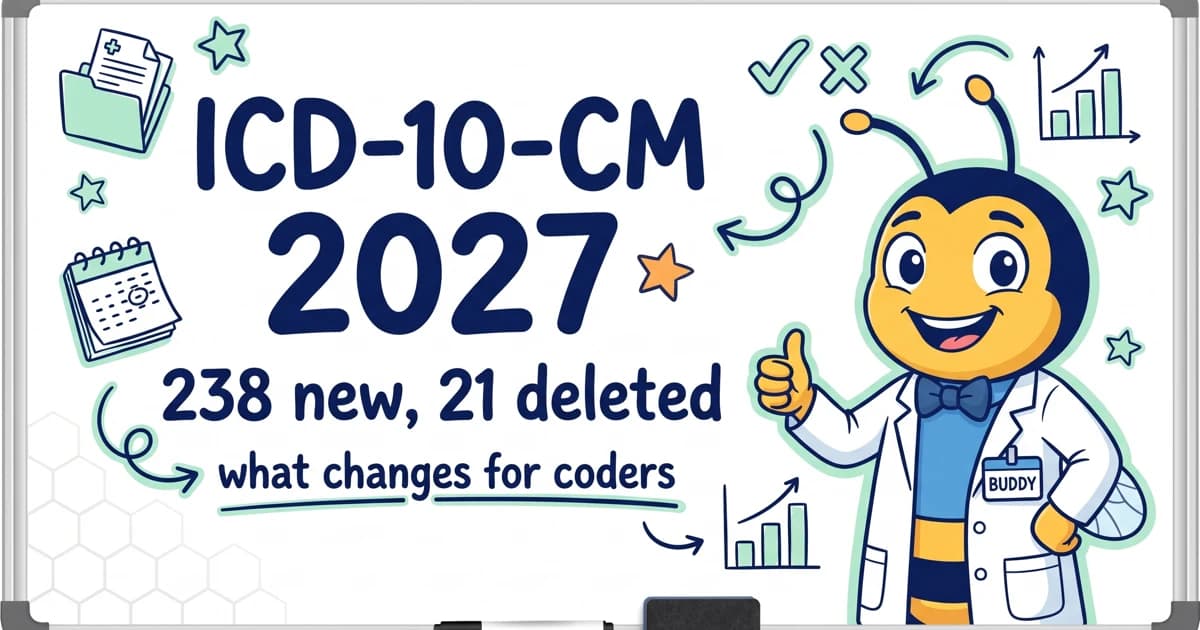
The FY2027 ICD-10-CM update adds 238 new codes and removes 21, effective October 1, 2026, per the official CMS FY2027 order file. The additions cluster in injury and poisoning (85), pregnancy and childbirth (56), and musculoskeletal (33). For risk adjustment coders the headline is not the count. It is where they landed: dilated cardiomyopathy, a set of inherited and arrhythmia conditions, and a new block of Z codes that change how history and exposure get captured.
This is the complete, code-by-code list, grouped by ICD-10-CM chapter, plus the deleted codes and the ones that were restructured rather than truly removed. Every code and description comes straight from the official CMS FY2027 files. Bookmark it: when CMS posts the FY2027 risk adjustment mappings, we will add the HCC impact below. For prior-year context, see our FY2026 ICD-10-CM guidelines recap and the April 2026 ICD-10-CM update.
*Source: the official CMS FY2027 ICD-10-CM files (2027 Code Descriptions in Tabular Order), via the CMS ICD-10 page. Effective for encounters October 1, 2026 through September 30, 2027. Counts reflect a direct diff of the FY2027 and FY2026 order files. Verify against the CMS files before relying on any code for billing.*
FY2027 ICD-10-CM changes at a glance, effective October 1, 2026
As of October 1, 2026, ICD-10-CM expands by a net 217 codes. The 238 additions cluster in Chapter 19 (85 codes, mostly toxic-effect expansions for organic solvents, alkenes, and cycloparaffins), Chapter 15 (56 codes, ectopic pregnancy site specificity and vanishing twin detail), Chapter 13 (33 codes, osteomyelitis by site and plantar fasciitis laterality), and Chapter 21 (17 new Z codes for exposure history and gender transition). Twenty-one codes are deleted outright. Beyond those, several previously billable codes were demoted to non-billable category headers, which is the change most likely to slip past a carried-forward code list.
The FY2027 changes that matter most for risk adjustment
What happens to I42.0 dilated cardiomyopathy on October 1, 2026?
Dilated cardiomyopathy is no longer one code. I42.0 stops being billable at the cutover and becomes a category header. You code instead to I42.00 (unspecified), I42.01 (familial-genetic), or I42.09 (other). I42.8 also becomes a header, splitting into I42.81 (arrhythmogenic cardiomyopathy) and I42.89. If your templates or problem lists carry I42.0 or I42.8, they stop validating on October 1. Cardiomyopathy carries risk weight under current models, so confirm the FY2027 HCC assignment for each child code when CMS posts the mapping. For the co-morbidity context, see our heart failure HCC coding guide.
New arrhythmia and inherited cardiac codes
I49.81 (Brugada syndrome), I49.82 (ventricular bigeminy), and I47.22 (catecholaminergic polymorphic ventricular tachycardia) carve out conditions that previously fell to less specific parents. I49.8 itself becomes a non-billable header on October 1. For how arrhythmia specificity affects capture, see our atrial fibrillation HCC coding guide.
Inherited cancer predisposition gets its own block
The new QA1 category adds Lynch syndrome (QA1.71), familial cancer syndrome with BRCA1 (QA1.790) or BRCA2 (QA1.791) mutation, and Li-Fraumeni syndrome (QA1.792). Loeys-Dietz syndrome (Q87.A) and VEXAS syndrome (M04.3) also get first-time discrete codes. These conditions drive screening and surveillance, so the documentation to support them tends to be in the chart.
Gender-related history codes
Z87.8901 through Z87.8909 capture social, medical, surgical, intersex-surgery, and unspecified gender transition history, with Z87.893 for detransition and F64.A for gender identity disorder in remission.
Exposure and history Z codes
Blast overpressure (Z77.40 through Z77.49), Agent Orange (Z77.33), burn pits in a war theater (Z77.32), and gadolinium exposure (Z77.013) paired with R78.72 (abnormal gadolinium level in blood). Z86.17 adds personal history of Clostridioides difficile infection. Z68.18 (BMI 18.4 or less) and Z68.19 (BMI 18.5 to 19.9) add low-end BMI specificity that matters for malnutrition and frailty documentation.
A note on HCC mappings, and why this page will change
Last reviewed June 2026. This section updates as soon as CMS publishes the FY2027 ICD-10 to CMS-HCC crosswalk.
CMS releases the new fiscal year code descriptions first and the risk adjustment crosswalk (ICD-10 to CMS-HCC under V28) later, usually closer to the payment year. As of this writing the FY2027 mappings are not published. We are not going to guess which new codes map to an HCC, because a wrong RAF assumption is worse than no assumption at all. The moment CMS posts the FY2027 mapping, we will add the HCC and RAF impact below and update the date on this page. If you want that mapping the day it drops, the ICD-10 to HCC tool tracks the same cycle. For the model context, see what changed in CMS-HCC V28.
Deleted and restructured FY2027 codes
Most of the 21 deleted codes were restructured, not retired. The sternoclavicular sprain family (S23.420 and its 7th-character siblings) and the organic-solvent toxic-effect family (T52.8X) were broken into more specific codes, which appear in the new-code lists below. Read the full deleted list as a find-and-replace task, not a cleanup. Separately, the billable-to-header demotions noted earlier (I42.0, I42.8, I49.8) are not on this list because the parent still exists, but they stop being codeable. A carried-forward code or a saved favorite is the usual way any of these slip through after October 1.
| Code | Description |
|---|---|
| S23.420 | Sprain of sternoclavicular (joint) (ligament) |
| S23.420A | Sprain of sternoclavicular (joint) (ligament), initial encounter |
| S23.420D | Sprain of sternoclavicular (joint) (ligament), subsequent encounter |
| S23.420S | Sprain of sternoclavicular (joint) (ligament), sequela |
| T52.8X | Toxic effects of other organic solvents |
| T52.8X1 | Toxic effect of other organic solvents, accidental (unintentional) |
| T52.8X1A | Toxic effect of other organic solvents, accidental (unintentional), initial encounter |
| T52.8X1D | Toxic effect of other organic solvents, accidental (unintentional), subsequent encounter |
| T52.8X1S | Toxic effect of other organic solvents, accidental (unintentional), sequela |
| T52.8X2 | Toxic effect of other organic solvents, intentional self-harm |
| T52.8X2A | Toxic effect of other organic solvents, intentional self-harm, initial encounter |
| T52.8X2D | Toxic effect of other organic solvents, intentional self-harm, subsequent encounter |
| T52.8X2S | Toxic effect of other organic solvents, intentional self-harm, sequela |
| T52.8X3 | Toxic effect of other organic solvents, assault |
| T52.8X3A | Toxic effect of other organic solvents, assault, initial encounter |
| T52.8X3D | Toxic effect of other organic solvents, assault, subsequent encounter |
| T52.8X3S | Toxic effect of other organic solvents, assault, sequela |
| T52.8X4 | Toxic effect of other organic solvents, undetermined |
| T52.8X4A | Toxic effect of other organic solvents, undetermined, initial encounter |
| T52.8X4D | Toxic effect of other organic solvents, undetermined, subsequent encounter |
| T52.8X4S | Toxic effect of other organic solvents, undetermined, sequela |
Complete list of new FY2027 ICD-10-CM codes
All 238 new codes, grouped by ICD-10-CM chapter. Codes tagged "category header" are non-billable and need an additional character. Always code to the highest level of specificity the record supports. (Source: the CMS FY2027 ICD-10-CM order file, effective October 1, 2026.)
Chapter 2. Neoplasms (3 new)
| Code | Description | Billable |
|---|---|---|
| C78.31 | Secondary malignant neoplasm of larynx | Yes |
| C78.32 | Secondary malignant neoplasm of pharynx | Yes |
| C79.83 | Secondary malignant neoplasm of oral cavity | Yes |
Chapter 3. Blood & Immune Disorders (2 new)
| Code | Description | Billable |
|---|---|---|
| D69.11 | Glanzmann thrombasthenia | Yes |
| D69.19 | Other qualitative platelet defects | Yes |
Chapter 4. Endocrine, Nutritional & Metabolic (3 new)
| Code | Description | Billable |
|---|---|---|
| E89.83 | Postprocedural hypoglycemia following a procedure | No (header) |
| E89.830 | Post bariatric hypoglycemia | Yes |
| E89.838 | Other postprocedural hypoglycemia | Yes |
Chapter 5. Mental, Behavioral & Neurodevelopmental (1 new)
| Code | Description | Billable |
|---|---|---|
| F64.A | Gender identity disorder, in remission | Yes |
Chapter 9. Circulatory System (9 new)
| Code | Description | Billable |
|---|---|---|
| I42.00 | Dilated cardiomyopathy, unspecified | Yes |
| I42.01 | Familial-genetic dilated cardiomyopathy | Yes |
| I42.09 | Other dilated cardiomyopathy | Yes |
| I42.81 | Arrhythmogenic cardiomyopathy | Yes |
| I42.89 | Other cardiomyopathies not elsewhere classified | Yes |
| I47.22 | Catecholaminergic polymorphic ventricular tachycardia [CPVT] | Yes |
| I49.81 | Brugada syndrome | Yes |
| I49.82 | Ventricular bigeminy | Yes |
| I49.89 | Other specified cardiac arrhythmias not elsewhere classified | Yes |
Chapter 10. Respiratory System (7 new)
| Code | Description | Billable |
|---|---|---|
| J34.83 | Odontogenic sinusitis | No (header) |
| J34.830 | Odontogenic sinusitis, maxillary sinus | Yes |
| J34.831 | Odontogenic sinusitis, ethmoid sinus | Yes |
| J34.832 | Odontogenic sinusitis, frontal sinus | Yes |
| J34.833 | Odontogenic sinusitis, sphenoid sinus | Yes |
| J34.839 | Odontogenic sinusitis, unspecified | Yes |
| J4B | Pulmonary mycetoma | Yes |
Chapter 11. Digestive System (8 new)
| Code | Description | Billable |
|---|---|---|
| K31.B | Hypertrophic pyloric stenosis, in childhood | Yes |
| K6A | Diseases of the pelvis, not elsewhere classified | No (header) |
| K6A.0 | Pelvic abscess | No (header) |
| K6A.01 | Prevesical abscess | Yes |
| K6A.09 | Other pelvic abscess | Yes |
| K6A.8 | Other diseases of the pelvis, not elsewhere classified | Yes |
| K74.0A | Hepatic fibrosis, moderate fibrosis | Yes |
| K76.83 | Intestinal failure-associated liver disease | Yes |
Chapter 12. Skin & Subcutaneous Tissue (1 new)
| Code | Description | Billable |
|---|---|---|
| L02.237 | Carbuncle of flank | Yes |
Chapter 13. Musculoskeletal & Connective Tissue (33 new)
| Code | Description | Billable |
|---|---|---|
| M04.3 | VEXAS syndrome | Yes |
| M67.A | Plantar fasciitis | No (header) |
| M67.A0 | Plantar fasciitis, foot | No (header) |
| M67.A01 | Plantar fasciitis, right foot | Yes |
| M67.A02 | Plantar fasciitis, left foot | Yes |
| M67.A09 | Plantar fasciitis, unspecified foot | Yes |
| M72.20 | Plantar fascial fibromatosis, unspecified foot | Yes |
| M72.21 | Plantar fascial fibromatosis, right foot | Yes |
| M72.22 | Plantar fascial fibromatosis, left foot | Yes |
| M86.8X11 | Other osteomyelitis, right shoulder | Yes |
| M86.8X12 | Other osteomyelitis, left shoulder | Yes |
| M86.8X19 | Other osteomyelitis, unspecified shoulder | Yes |
| M86.8X21 | Other osteomyelitis, right upper arm | Yes |
| M86.8X22 | Other osteomyelitis, left upper arm | Yes |
| M86.8X29 | Other osteomyelitis, unspecified upper arm | Yes |
| M86.8X31 | Other osteomyelitis, right forearm | Yes |
| M86.8X32 | Other osteomyelitis, left forearm | Yes |
| M86.8X39 | Other osteomyelitis, unspecified forearm | Yes |
| M86.8X41 | Other osteomyelitis, right hand | Yes |
| M86.8X42 | Other osteomyelitis, left hand | Yes |
| M86.8X49 | Other osteomyelitis, unspecified hand | Yes |
| M86.8X51 | Other osteomyelitis, right thigh | Yes |
| M86.8X52 | Other osteomyelitis, left thigh | Yes |
| M86.8X59 | Other osteomyelitis, unspecified thigh | Yes |
| M86.8X61 | Other osteomyelitis, right lower leg | Yes |
| M86.8X62 | Other osteomyelitis, left lower leg | Yes |
| M86.8X69 | Other osteomyelitis, unspecified lower leg | Yes |
| M86.8X71 | Other osteomyelitis, right ankle and foot | Yes |
| M86.8X72 | Other osteomyelitis, left ankle and foot | Yes |
| M86.8X79 | Other osteomyelitis, unspecified ankle and foot | Yes |
| M86.8X80 | Other osteomyelitis, skull | Yes |
| M86.8X81 | Other osteomyelitis, face and sinuses | Yes |
| M86.8X89 | Other osteomyelitis, other site | Yes |
Chapter 14. Genitourinary System (3 new)
| Code | Description | Billable |
|---|---|---|
| N99.86 | Intraoperative and postprocedural complications and disorders of breast | No (header) |
| N99.860 | Intraoperative and postprocedural nipple ischemia | Yes |
| N99.861 | Intraoperative and postprocedural nipple necrosis | Yes |
Chapter 15. Pregnancy, Childbirth & the Puerperium (56 new)
Chapter 15 adds 56 codes, mostly ectopic pregnancy site specificity and vanishing twin syndrome detail. Obstetric coding sits outside Medicare Advantage risk adjustment, so these are included for completeness.
| Code | Description | Billable |
|---|---|---|
| O00.12 | Interstitial ectopic pregnancy without intrauterine pregnancy | No (header) |
| O00.121 | Right interstitial ectopic pregnancy without intrauterine pregnancy | Yes |
| O00.122 | Left interstitial ectopic pregnancy without intrauterine pregnancy | Yes |
| O00.129 | Unspecified interstitial ectopic pregnancy without intrauterine pregnancy | Yes |
| O00.13 | Interstitial ectopic pregnancy with intrauterine pregnancy | No (header) |
| O00.131 | Right interstitial ectopic pregnancy with intrauterine pregnancy | Yes |
| O00.132 | Left interstitial ectopic pregnancy with intrauterine pregnancy | Yes |
| O00.139 | Unspecified interstitial ectopic pregnancy with intrauterine pregnancy | Yes |
| O00.3 | Cesarean scar ectopic pregnancy | No (header) |
| O00.31 | Cesarean scar ectopic pregnancy without intrauterine pregnancy | Yes |
| O00.32 | Cesarean scar ectopic pregnancy with intrauterine pregnancy | Yes |
| O00.4 | Cervical ectopic pregnancy | No (header) |
| O00.41 | Cervical ectopic pregnancy without intrauterine pregnancy | Yes |
| O00.42 | Cervical ectopic pregnancy with intrauterine pregnancy | Yes |
| O00.5 | Cornual ectopic pregnancy | No (header) |
| O00.51 | Cornual ectopic pregnancy without intrauterine pregnancy | No (header) |
| O00.511 | Right cornual ectopic pregnancy without intrauterine pregnancy | Yes |
| O00.512 | Left cornual ectopic pregnancy without intrauterine pregnancy | Yes |
| O00.519 | Unspecified cornual ectopic pregnancy without intrauterine pregnancy | Yes |
| O00.52 | Cornual ectopic pregnancy with intrauterine pregnancy | No (header) |
| O00.521 | Right cornual ectopic pregnancy with intrauterine pregnancy | Yes |
| O00.522 | Left cornual ectopic pregnancy with intrauterine pregnancy | Yes |
| O00.529 | Unspecified cornual ectopic pregnancy with intrauterine pregnancy | Yes |
| O31.4 | Continuing pregnancy after vanishing twin syndrome of one fetus or more | No (header) |
| O31.40 | Continuing pregnancy after vanishing twin syndrome of one fetus or more, unspecified trimester | No (header) |
| O31.40X0 | Continuing pregnancy after vanishing twin syndrome of one fetus or more, unspecified trimester, not applicable or unspecified | Yes |
| O31.40X1 | Continuing pregnancy after vanishing twin syndrome of one fetus or more, unspecified trimester, fetus 1 | Yes |
| O31.40X2 | Continuing pregnancy after vanishing twin syndrome of one fetus or more, unspecified trimester, fetus 2 | Yes |
| O31.40X3 | Continuing pregnancy after vanishing twin syndrome of one fetus or more, unspecified trimester, fetus 3 | Yes |
| O31.40X4 | Continuing pregnancy after vanishing twin syndrome of one fetus or more, unspecified trimester, fetus 4 | Yes |
| O31.40X5 | Continuing pregnancy after vanishing twin syndrome of one fetus or more, unspecified trimester, fetus 5 | Yes |
| O31.40X9 | Continuing pregnancy after vanishing twin syndrome of one fetus or more, unspecified trimester, other fetus | Yes |
| O31.41 | Continuing pregnancy after vanishing twin syndrome of one fetus or more, first trimester | No (header) |
| O31.41X0 | Continuing pregnancy after vanishing twin syndrome of one fetus or more, first trimester, not applicable or unspecified | Yes |
| O31.41X1 | Continuing pregnancy after vanishing twin syndrome of one fetus or more, first trimester, fetus 1 | Yes |
| O31.41X2 | Continuing pregnancy after vanishing twin syndrome of one fetus or more, first trimester, fetus 2 | Yes |
| O31.41X3 | Continuing pregnancy after vanishing twin syndrome of one fetus or more, first trimester, fetus 3 | Yes |
| O31.41X4 | Continuing pregnancy after vanishing twin syndrome of one fetus or more, first trimester, fetus 4 | Yes |
| O31.41X5 | Continuing pregnancy after vanishing twin syndrome of one fetus or more, first trimester, fetus 5 | Yes |
| O31.41X9 | Continuing pregnancy after vanishing twin syndrome of one fetus or more, first trimester, other fetus | Yes |
| O31.42 | Continuing pregnancy after vanishing twin syndrome of one fetus or more, second trimester | No (header) |
| O31.42X0 | Continuing pregnancy after vanishing twin syndrome of one fetus or more, second trimester, not applicable or unspecified | Yes |
| O31.42X1 | Continuing pregnancy after vanishing twin syndrome of one fetus or more, second trimester, fetus 1 | Yes |
| O31.42X2 | Continuing pregnancy after vanishing twin syndrome of one fetus or more, second trimester, fetus 2 | Yes |
| O31.42X3 | Continuing pregnancy after vanishing twin syndrome of one fetus or more, second trimester, fetus 3 | Yes |
| O31.42X4 | Continuing pregnancy after vanishing twin syndrome of one fetus or more, second trimester, fetus 4 | Yes |
| O31.42X5 | Continuing pregnancy after vanishing twin syndrome of one fetus or more, second trimester, fetus 5 | Yes |
| O31.42X9 | Continuing pregnancy after vanishing twin syndrome of one fetus or more, second trimester, other fetus | Yes |
| O31.43 | Continuing pregnancy after vanishing twin syndrome of one fetus or more, third trimester | No (header) |
| O31.43X0 | Continuing pregnancy after vanishing twin syndrome of one fetus or more, third trimester, not applicable or unspecified | Yes |
| O31.43X1 | Continuing pregnancy after vanishing twin syndrome of one fetus or more, third trimester, fetus 1 | Yes |
| O31.43X2 | Continuing pregnancy after vanishing twin syndrome of one fetus or more, third trimester, fetus 2 | Yes |
| O31.43X3 | Continuing pregnancy after vanishing twin syndrome of one fetus or more, third trimester, fetus 3 | Yes |
| O31.43X4 | Continuing pregnancy after vanishing twin syndrome of one fetus or more, third trimester, fetus 4 | Yes |
| O31.43X5 | Continuing pregnancy after vanishing twin syndrome of one fetus or more, third trimester, fetus 5 | Yes |
| O31.43X9 | Continuing pregnancy after vanishing twin syndrome of one fetus or more, third trimester, other fetus | Yes |
Chapter 17. Congenital Malformations (9 new)
| Code | Description | Billable |
|---|---|---|
| Q87.A | Loeys-Dietz syndrome | Yes |
| QA1 | Genetic disorders associated with neoplasms, not elsewhere classified | No (header) |
| QA1.7 | Inherited neoplasm predisposition syndromes involving multiple systems, not elsewhere classified | No (header) |
| QA1.71 | Lynch syndrome | Yes |
| QA1.79 | Other inherited neoplasm predisposition syndrome of multiple systems | No (header) |
| QA1.790 | Familial cancer syndrome with pathogenic BRCA1 mutation | Yes |
| QA1.791 | Familial cancer syndrome with pathogenic BRCA2 mutation | Yes |
| QA1.792 | Li Fraumeni syndrome | Yes |
| QA1.798 | Other inherited neoplasm predisposition syndrome of multiple systems | Yes |
Chapter 18. Symptoms, Signs & Abnormal Findings (1 new)
| Code | Description | Billable |
|---|---|---|
| R78.72 | Abnormal gadolinium level in blood | Yes |
Chapter 19. Injury, Poisoning & External Causes (85 new)
Chapter 19 holds 85 of the 238 additions, almost entirely toxic-effect codes split from the deleted T52.8X family (alkenes, cycloparaffins, hexamethylene diisocyanate, and medetomidine). These are low-relevance for most risk adjustment work and are listed here for completeness.
| Code | Description | Billable |
|---|---|---|
| T52.81 | Toxic effects of alkenes | No (header) |
| T52.811 | Toxic effect of alkenes, accidental (unintentional) | No (header) |
| T52.811A | Toxic effect of alkenes, accidental (unintentional), initial encounter | Yes |
| T52.811D | Toxic effect of alkenes, accidental (unintentional), subsequent encounter | Yes |
| T52.811S | Toxic effect of alkenes, accidental (unintentional), sequela | Yes |
| T52.812 | Toxic effect of alkenes, intentional self-harm | No (header) |
| T52.812A | Toxic effect of alkenes, intentional self-harm, initial encounter | Yes |
| T52.812D | Toxic effect of alkenes, intentional self-harm, subsequent encounter | Yes |
| T52.812S | Toxic effect of alkenes, intentional self-harm, sequela | Yes |
| T52.813 | Toxic effect of alkenes, assault | No (header) |
| T52.813A | Toxic effect of alkenes, assault, initial encounter | Yes |
| T52.813D | Toxic effect of alkenes, assault, subsequent encounter | Yes |
| T52.813S | Toxic effect of alkenes, assault, sequela | Yes |
| T52.814 | Toxic effect of alkenes, undetermined | No (header) |
| T52.814A | Toxic effect of alkenes, undetermined, initial encounter | Yes |
| T52.814D | Toxic effect of alkenes, undetermined, subsequent encounter | Yes |
| T52.814S | Toxic effect of alkenes, undetermined, sequela | Yes |
| T52.82 | Toxic effects of cycloparaffins | No (header) |
| T52.821 | Toxic effect of cycloparaffins, accidental (unintentional) | No (header) |
| T52.821A | Toxic effect of cycloparaffins, accidental (unintentional), initial encounter | Yes |
| T52.821D | Toxic effect of cycloparaffins, accidental (unintentional), subsequent encounter | Yes |
| T52.821S | Toxic effect of cycloparaffins, accidental (unintentional), sequela | Yes |
| T52.822 | Toxic effect of cycloparaffins, intentional self-harm | No (header) |
| T52.822A | Toxic effect of cycloparaffins, intentional self-harm, initial encounter | Yes |
| T52.822D | Toxic effect of cycloparaffins, intentional self-harm, subsequent encounter | Yes |
| T52.822S | Toxic effect of cycloparaffins, intentional self-harm, sequela | Yes |
| T52.823 | Toxic effect of cycloparaffins, assault | No (header) |
| T52.823A | Toxic effect of cycloparaffins, assault, initial encounter | Yes |
| T52.823D | Toxic effect of cycloparaffins, assault, subsequent encounter | Yes |
| T52.823S | Toxic effect of cycloparaffins, assault, sequela | Yes |
| T52.824 | Toxic effect of cycloparaffins, undetermined | No (header) |
| T52.824A | Toxic effect of cycloparaffins, undetermined, initial encounter | Yes |
| T52.824D | Toxic effect of cycloparaffins, undetermined, subsequent encounter | Yes |
| T52.824S | Toxic effect of cycloparaffins, undetermined, sequela | Yes |
| T52.89 | Toxic effects of other organic solvents | No (header) |
| T52.891 | Toxic effect of other organic solvents, accidental (unintentional) | No (header) |
| T52.891A | Toxic effect of other organic solvents, accidental (unintentional), initial encounter | Yes |
| T52.891D | Toxic effect of other organic solvents, accidental (unintentional), subsequent encounter | Yes |
| T52.891S | Toxic effect of other organic solvents, accidental (unintentional), sequela | Yes |
| T52.892 | Toxic effect of other organic solvents, intentional self-harm | No (header) |
| T52.892A | Toxic effect of other organic solvents, intentional self-harm, initial encounter | Yes |
| T52.892D | Toxic effect of other organic solvents, intentional self-harm, subsequent encounter | Yes |
| T52.892S | Toxic effect of other organic solvents, intentional self-harm, sequela | Yes |
| T52.893 | Toxic effect of other organic solvents, assault | No (header) |
| T52.893A | Toxic effect of other organic solvents, assault, initial encounter | Yes |
| T52.893D | Toxic effect of other organic solvents, assault, subsequent encounter | Yes |
| T52.893S | Toxic effect of other organic solvents, assault, sequela | Yes |
| T52.894 | Toxic effect of other organic solvents, undetermined | No (header) |
| T52.894A | Toxic effect of other organic solvents, undetermined, initial encounter | Yes |
| T52.894D | Toxic effect of other organic solvents, undetermined, subsequent encounter | Yes |
| T52.894S | Toxic effect of other organic solvents, undetermined, sequela | Yes |
| T59.82 | Toxic effects of hexamethylene diisocyanate | No (header) |
| T59.821 | Toxic effect of hexamethylene diisocyanate, accidental (unintentional) | No (header) |
| T59.821A | Toxic effect of hexamethylene diisocyanate, accidental (unintentional), initial encounter | Yes |
| T59.821D | Toxic effect of hexamethylene diisocyanate, accidental (unintentional), subsequent encounter | Yes |
| T59.821S | Toxic effect of hexamethylene diisocyanate, accidental (unintentional), sequela | Yes |
| T59.822 | Toxic effect of hexamethylene diisocyanate, intentional self-harm | No (header) |
| T59.822A | Toxic effect of hexamethylene diisocyanate, intentional self-harm, initial encounter | Yes |
| T59.822D | Toxic effect of hexamethylene diisocyanate, intentional self-harm, subsequent encounter | Yes |
| T59.822S | Toxic effect of hexamethylene diisocyanate, intentional self-harm, sequela | Yes |
| T59.823 | Toxic effect of hexamethylene diisocyanate, assault | No (header) |
| T59.823A | Toxic effect of hexamethylene diisocyanate, assault, initial encounter | Yes |
| T59.823D | Toxic effect of hexamethylene diisocyanate, assault, subsequent encounter | Yes |
| T59.823S | Toxic effect of hexamethylene diisocyanate, assault, sequela | Yes |
| T59.824 | Toxic effect of hexamethylene diisocyanate, undetermined | No (header) |
| T59.824A | Toxic effect of hexamethylene diisocyanate, undetermined, initial encounter | Yes |
| T59.824D | Toxic effect of hexamethylene diisocyanate, undetermined, subsequent encounter | Yes |
| T59.824S | Toxic effect of hexamethylene diisocyanate, undetermined, sequela | Yes |
| T65.85 | Toxic effect of medetomidine | No (header) |
| T65.851 | Toxic effect of medetomidine, accidental (unintentional) | No (header) |
| T65.851A | Toxic effect of medetomidine, accidental (unintentional), initial encounter | Yes |
| T65.851D | Toxic effect of medetomidine, accidental (unintentional), subsequent encounter | Yes |
| T65.851S | Toxic effect of medetomidine, accidental (unintentional), sequela | Yes |
| T65.852 | Toxic effect of medetomidine, intentional self-harm | No (header) |
| T65.852A | Toxic effect of medetomidine, intentional self-harm, initial encounter | Yes |
| T65.852D | Toxic effect of medetomidine, intentional self-harm, subsequent encounter | Yes |
| T65.852S | Toxic effect of medetomidine, intentional self-harm, sequela | Yes |
| T65.853 | Toxic effect of medetomidine, assault | No (header) |
| T65.853A | Toxic effect of medetomidine, assault, initial encounter | Yes |
| T65.853D | Toxic effect of medetomidine, assault, subsequent encounter | Yes |
| T65.853S | Toxic effect of medetomidine, assault, sequela | Yes |
| T65.854 | Toxic effect of medetomidine, undetermined | No (header) |
| T65.854A | Toxic effect of medetomidine, undetermined, initial encounter | Yes |
| T65.854D | Toxic effect of medetomidine, undetermined, subsequent encounter | Yes |
| T65.854S | Toxic effect of medetomidine, undetermined, sequela | Yes |
Chapter 21. Factors Influencing Health Status (Z codes) (17 new)
| Code | Description | Billable |
|---|---|---|
| Z68.18 | Body mass index [BMI] 18.4 or less, adult | Yes |
| Z68.19 | Body mass index [BMI] 18.5-19.9, adult | Yes |
| Z77.013 | Contact with and (suspected) exposure to gadolinium | Yes |
| Z77.32 | Contact with and (suspected) exposure to burn pits in war theater | Yes |
| Z77.33 | Contact with and (suspected) exposure to Agent Orange | Yes |
| Z77.4 | Contact with and (suspected) exposure to blast overpressure | No (header) |
| Z77.40 | Contact with and (suspected) exposure to unspecified blast overpressure | Yes |
| Z77.41 | Contact with and (suspected) exposure to low-level blast overpressure | Yes |
| Z77.42 | Contact with and (suspected) exposure to high-level blast overpressure | Yes |
| Z77.49 | Contact with and (suspected) exposure to other blast overpressure | Yes |
| Z86.17 | Personal history of Clostridioides difficile infection | Yes |
| Z87.8901 | Personal history of social gender transition | Yes |
| Z87.8902 | Personal history of medical gender transition | Yes |
| Z87.8903 | Personal history of surgical gender transition | Yes |
| Z87.8904 | Personal history of intersex surgery | Yes |
| Z87.8909 | Personal history of unspecified gender transition | Yes |
| Z87.893 | Personal history of gender detransition | Yes |
How should coders prepare for the FY2027 cutover?
The codes are final. The risk adjustment mapping is the piece still to come, and we will update this page the day it lands.
Related Tools
ICD-10 to HCC Mapping Tool
Look up the HCC and RAF impact of any diagnosis, updated on the CMS mapping cycle.
ICD-10 Encoder
Look up ICD-10-CM codes and check their source period and instructional notes.
RAF Calculator
CMS-HCC V28 Payment Year 2026 scoring with complete member context. No score is shown unless the required source and calculation checks pass.
Buddy Arena
Practice the FY2027 changes against the clock.

HCC Buddy Coding Team
Editorial
Every HCC Buddy article is checked against the current CMS-HCC model and the active FY ICD-10-CM tabular release before it publishes.
Get HCC Coding Tips in Your Inbox
Join our newsletter for coding tips, guideline updates, and tool announcements.