
Atrial Fibrillation HCC Coding: I48 & V28
AFib HCC coding under V28: the I48.x codes (paroxysmal, persistent, chronic), the documentation the HCC needs, and where coders lose the mapping.
By the HCC Buddy Coding Team
Updated: August 25, 2026
Quick Answer
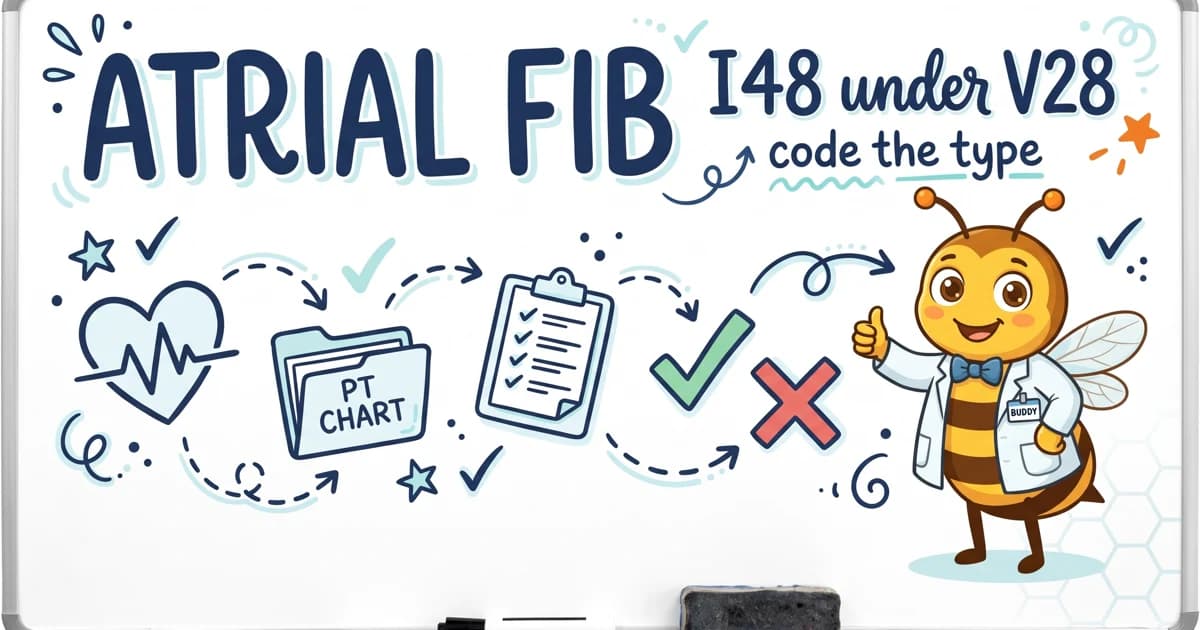
Atrial fibrillation maps to HCC 238 under the V28 model, with a RAF coefficient that reflects the ongoing management burden of this condition. Verify the current segment-specific weight in the CMS 2026 model software. All clinically significant AFib codes, I48.0 (paroxysmal), I48.11 (longstanding persistent), I48.19 (other persistent), I48.20 (chronic, unspecified), I48.21 (permanent), and I48.91 (unspecified), map to HCC 238. The key documentation requirement is specifying the type of AFib (paroxysmal, persistent, longstanding persistent, or permanent) rather than using "unspecified." While I48.91 still maps to HCC 238 under V28, coding to the highest documented specificity is essential for audit defensibility and compliance.
Why Atrial Fibrillation Matters for Risk Adjustment
Atrial fibrillation is the most common sustained cardiac arrhythmia, affecting approximately 6 million Americans and a disproportionate share of the Medicare population. In patients over 65, the prevalence is estimated at 9 to 12%. AFib is a significant driver of healthcare costs because it increases the risk of stroke (5x), heart failure, hospitalization, and long-term anticoagulation management.
Under V28, AFib maps to HCC 238, which reflects the condition's impact on healthcare expenditures. For risk adjustment coders, AFib is a high-frequency, high-value diagnosis that appears in a substantial percentage of Medicare Advantage charts.
Atrial Fibrillation ICD-10 Codes and HCC Mapping
Complete AFib Code Table
| ICD-10 Code | Description | HCC (V28) | Key Documentation |
|---|---|---|---|
| I48.0 | Paroxysmal atrial fibrillation | HCC 238 | Self-terminating, typically < 7 days |
| I48.11 | Longstanding persistent atrial fibrillation | HCC 238 | Continuous > 12 months |
| I48.19 | Other persistent atrial fibrillation | HCC 238 | Continuous > 7 days, < 12 months |
| I48.20 | Chronic atrial fibrillation, unspecified | HCC 238 | Ongoing, type not further specified |
| I48.21 | Permanent atrial fibrillation | HCC 238 | Decision made to stop pursuing rhythm control |
| I48.91 | Unspecified atrial fibrillation | HCC 238 | No type specified, avoid when possible |
| I48.1 | Persistent atrial fibrillation (non-specific parent) | , | Use I48.11 or I48.19 instead |
| I48.2 | Chronic atrial fibrillation (non-specific parent) | , | Use I48.20 or I48.21 instead |
| I48.3 | Typical atrial flutter | HCC 238 | Atrial flutter maps to the same HCC as AFib |
| I48.4 | Atypical atrial flutter | HCC 238 | Atrial flutter maps to the same HCC as AFib |
| I48.92 | Unspecified atrial flutter | HCC 238 | Atrial flutter maps to the same HCC as AFib |
Important Distinction: AFib vs. AFlutter
Atrial fibrillation (I48.0, I48.1x, I48.2x, I48.91) and atrial flutter (I48.3, I48.4, I48.92) are related but distinct conditions with different ICD-10 codes. Many patients have both, which should be coded separately. Do not assume "AFib" in the documentation means both, look for explicit mention of each.
Understanding AFib Types for Accurate Coding
Paroxysmal Atrial Fibrillation (I48.0)
Paroxysmal AFib is defined as AFib that self-terminates within 7 days of onset, usually within 48 hours. The heart returns to normal sinus rhythm on its own. Patients with paroxysmal AFib may have episodes that come and go, with normal rhythm between episodes.
Documentation indicators:
- "Intermittent AFib" or "AFib that self-converts"
- "Episodes of AFib lasting hours to days"
- Holter monitor showing alternating sinus rhythm and AFib
- "PAF" (paroxysmal atrial fibrillation) abbreviation in the chart
Persistent Atrial Fibrillation (I48.19)
Persistent AFib lasts longer than 7 days and does not self-terminate. It requires cardioversion (electrical or pharmacological) or ablation to restore sinus rhythm. This is coded as I48.19 when the duration is between 7 days and 12 months.
Documentation indicators:
- "Persistent AFib" or "AFib requiring cardioversion"
- History of cardioversion attempts
- Documentation of continuous AFib lasting more than one week
- Antiarrhythmic drug therapy aimed at maintaining sinus rhythm
Longstanding Persistent Atrial Fibrillation (I48.11)
Longstanding persistent AFib has been continuous for more than 12 months, and the clinical team is still pursuing a rhythm control strategy (attempting to restore sinus rhythm). This is a relatively specific clinical designation.
Documentation indicators:
- "Longstanding persistent AFib" explicitly documented
- Continuous AFib for > 12 months with ongoing rhythm control attempts
- Referral for ablation after extended AFib duration
Permanent Atrial Fibrillation (I48.21)
Permanent AFib means that the patient and provider have made a joint decision to stop attempting to restore or maintain sinus rhythm. The AFib is accepted as the patient's ongoing rhythm, and treatment focuses on rate control and stroke prevention rather than rhythm conversion.
Documentation indicators:
- "Permanent AFib" explicitly documented
- "Rate-controlled AFib, no further cardioversion planned"
- Discontinuation of antiarrhythmic drugs with continuation of rate control agents and anticoagulation
- The distinction from chronic/persistent is the clinical decision to abandon rhythm control
Unspecified Atrial Fibrillation (I48.91)
I48.91 is used when the documentation does not specify the type. While this code still maps to HCC 238 under V28, it is the least specific option and should be avoided when the chart contains information that supports a more specific code.
Documentation Best Practices for AFib Coding
What Providers Should Document
1. Type of AFib, Explicitly state paroxysmal, persistent, longstanding persistent, or permanent. This single word in the assessment eliminates coding ambiguity.
2. Treatment strategy, Rate control vs. rhythm control. This is clinically important and also helps coders distinguish between persistent (rhythm control attempted) and permanent (rhythm control abandoned).
3. Anticoagulation status, Whether the patient is on anticoagulation (warfarin, apixaban, rivarelbam, edoxaban, dabigatran) and the current CHA2DS2-VASc score. This supports the medical necessity of the AFib diagnosis and treatment.
4. Monitoring, ECG findings, Holter results, cardiac monitor data, or device interrogation (for patients with pacemakers or ICDs that track AFib burden).
5. Current status, "AFib with controlled ventricular rate" or "AFib with rapid ventricular response", the acuity matters for the clinical picture.
Common Documentation Gaps
Gap 1: "AFib" without type specification
The provider writes "atrial fibrillation" or "AFib" in the assessment without stating paroxysmal, persistent, or permanent. The coder must default to I48.91 (unspecified). While this still maps to HCC 238, it is an audit vulnerability.
Query approach: "Documentation indicates atrial fibrillation as an active diagnosis. Could you specify the current classification (paroxysmal, persistent, longstanding persistent, or permanent) based on the clinical presentation and treatment approach?"
Gap 2: "History of AFib" without current status
"History of atrial fibrillation" is ambiguous. Does the patient currently have AFib (which is coded), or did they have AFib in the past that has resolved (which may be coded as a history code)? If the patient is on anticoagulation and rate control medication for AFib, the condition is current and active, not just historical.
Query approach: "Documentation notes 'history of AFib.' The patient is currently on [anticoagulant] and [rate control medication]. Is atrial fibrillation a current active diagnosis being monitored and treated?"
Gap 3: AFib with heart failure, missing the combination
Many patients with AFib also have heart failure. These are separate HCC-mapped conditions and should both be coded. Providers sometimes document "AFib with heart failure" in a way that makes the heart failure appear incidental. Both conditions need their own diagnostic codes and documentation.
AFib Medications as Diagnostic Signals
The Drug Reference tool is particularly useful for AFib coding. When you see any of these medications on a patient's medication list, investigate whether AFib is documented:
- Rate control agents: Metoprolol, diltiazem, verapamil, digoxin (may indicate AFib if no other documented indication)
- Rhythm control agents: Amiodarone, flecainide, propafenone, sotalol, dofetilide, dronedarone (strongly suggest AFib or atrial flutter)
- Anticoagulants: Apixaban (Eliquis), rivaroxaban (Xarelto), dabigatran (Pradaxa), edoxaban (Savaysa), warfarin (if prescribed for AFib indication)
A patient on amiodarone and apixaban who does not have AFib coded in the chart is almost certainly a missed diagnosis. Query the provider.
V28 Context for AFib
Under V28, HCC 238 retains its status as a mapped condition with a meaningful RAF coefficient. The weight reflects the ongoing healthcare costs associated with AFib management, regular monitoring, anticoagulation management, cardiovascular risk mitigation, and the elevated risk of stroke and heart failure. The authoritative coefficient table lives in the CMS 2026 risk-adjustment model software and ICD-10 mappings release.
Some key V28 considerations for AFib:
- AFib survived the V28 transition, Unlike some cardiovascular conditions (angina pectoris, for example, which lost HCC mapping), AFib retained its HCC status because it is a genuine cost driver in the Medicare population.
> RAF Calculator: The RAF Calculator supports CMS-HCC V28 for Payment Year 2026 and requires complete member context. HCC Buddy shows a score only after the server confirms the required source and calculation checks. If a check is unavailable or does not pass, no score is shown.
- Hierarchy interactions, HCC 238 interacts with other cardiovascular HCCs in the V28 hierarchy.
- Interaction terms, Certain HCC combinations involving AFib and other conditions (like heart failure or stroke) may trigger interaction terms that add additional RAF value beyond the individual HCC coefficients.
Using HCC Buddy for AFib Coding
Type any I48 code into the ICD-10 Encoder to see its available HCC mapping and hierarchy position. Compare I48.0 (paroxysmal) against I48.91 (unspecified) to see that both map to HCC 238, confirming that the HCC capture is the same regardless of type, but reinforcing that specificity is still required for compliance.
Key Takeaways
1. All AFib codes (I48.0, I48.11, I48.19, I48.20, I48.21, I48.91) map to HCC 238 under V28.
2. Document the specific type, paroxysmal, persistent, longstanding persistent, or permanent. Specificity is required for audit compliance even though the HCC mapping is the same.
3. Check the medication list, rate control agents, antiarrhythmics, and anticoagulants are strong signals for undocumented or undercoded AFib.
4. AFib and heart failure commonly coexist, make sure both are coded when both are documented.
5. "History of AFib" on anticoagulation is almost always current AFib, query when the documentation is ambiguous.
Look up an AFib code and check the CY2026 V28 result, historical PY2025 V24 reference, and source status.
Related Tools

HCC Buddy Coding Team
Editorial
Every HCC Buddy article is checked against the current CMS-HCC model and the active FY ICD-10-CM tabular release before it publishes.
Get HCC Coding Tips in Your Inbox
Join our newsletter for coding tips, guideline updates, and tool announcements.