
Depression HCC Coding: F32.9 Has No V28 HCC
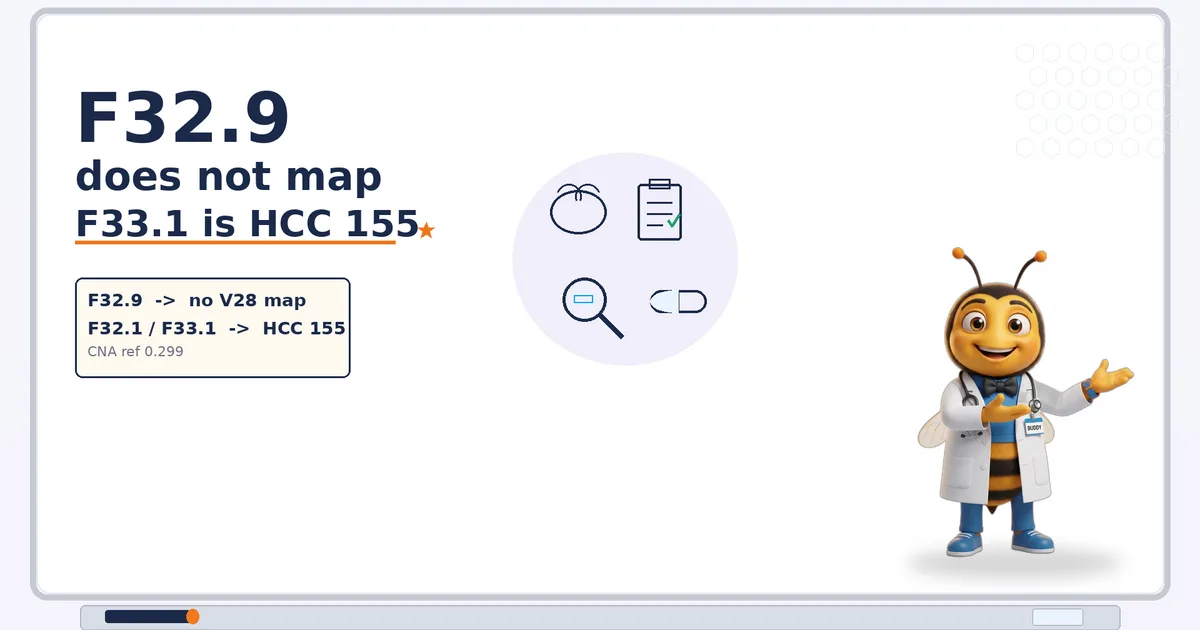
F32.9 and F33.9 are billable and have no CMS-HCC V28 payment HCC. Moderate maps to HCC 155. Severe with psychosis maps to HCC 152.
By the HCC Buddy Coding Team
Updated: August 24, 2026
Quick Answer
F32.9 and F33.9 are billable ICD-10-CM codes. Under CMS-HCC V28 for payment year 2026 they have no payment HCC. The mapped set is narrow: F32.1, F32.2, F33.1, and F33.2 map to HCC 155. F32.3 and F33.3 map to HCC 152. Mild, remission, other-specified, and unspecified depression codes are verified valid-no-mapping results in that model.
If the note supports moderate or severe major depression and the assigned code is unspecified, that is a documentation and query problem, not a missing map. Do not promote F32.9 to F32.1 from a screening score or a medication list.
*Release: FY2026 ICD-10-CM period 2, April 1, 2026 through September 30, 2026. CMS-HCC V28, payment year 2026, is at full weight for non-PACE organizations. Community Non-Dual Aged (CNA) coefficients are shown only where the current CMS source files support them. Interaction terms are applied only inside the RAF tool, so this article does not publish a standalone interaction coefficient.*
At a glance
Billable F32 and F33 codes, FY2026 period 2 identity plus CMS-HCC V28 mapping:
| Code | Official description | Billable | V28 CMS-HCC | CNA coefficient |
|---|---|---|---|---|
| F32.0 | Major depressive disorder, single episode, mild | Yes | None (verified no-HCC-mapping) | None |
| F32.1 | Major depressive disorder, single episode, moderate | Yes | HCC 155 | 0.299 |
| F32.2 | Major depressive disorder, single episode, severe without psychotic features | Yes | HCC 155 | 0.299 |
| F32.3 | Major depressive disorder, single episode, severe with psychotic features | Yes | HCC 152 | 0.484 |
| F32.4 | Major depressive disorder, single episode, in partial remission | Yes | None (verified no-HCC-mapping) | None |
| F32.5 | Major depressive disorder, single episode, in full remission | Yes | None (verified no-HCC-mapping) | None |
| F32.81 | Premenstrual dysphoric disorder | Yes | None (verified no-HCC-mapping) | None |
| F32.89 | Other specified depressive episodes | Yes | None (verified no-HCC-mapping) | None |
| F32.9 | Major depressive disorder, single episode, unspecified | Yes | None (verified no-HCC-mapping) | None |
| F32.A | Depression, unspecified | Yes | None (verified no-HCC-mapping) | None |
| F33.0 | Major depressive disorder, recurrent, mild | Yes | None (verified no-HCC-mapping) | None |
| F33.1 | Major depressive disorder, recurrent, moderate | Yes | HCC 155 | 0.299 |
| F33.2 | Major depressive disorder, recurrent severe without psychotic features | Yes | HCC 155 | 0.299 |
| F33.3 | Major depressive disorder, recurrent, severe with psychotic symptoms | Yes | HCC 152 | 0.484 |
| F33.40 | Major depressive disorder, recurrent, in remission, unspecified | Yes | None (verified no-HCC-mapping) | None |
| F33.41 | Major depressive disorder, recurrent, in partial remission | Yes | None (verified no-HCC-mapping) | None |
| F33.42 | Major depressive disorder, recurrent, in full remission | Yes | None (verified no-HCC-mapping) | None |
| F33.8 | Other recurrent depressive disorders | Yes | None (verified no-HCC-mapping) | None |
| F33.9 | Major depressive disorder, recurrent, unspecified | Yes | None (verified no-HCC-mapping) | None |
F32, F32.8, F33, and F33.4 exist in the FY2026 order file as non-billable headings. F33.4 still has to be coded to F33.40, F33.41, or F33.42.
HCC 155 is labeled "Major Depression, Moderate or Severe, without Psychosis." HCC 152 is labeled "Psychosis, Except Schizophrenia." Those labels and the CNA values above come from the CMS V28 PY2026 relative-factor file. Other enrollment segments use different coefficients in that same file. Do not treat 0.299 or 0.484 as a universal RAF.
Only moderate or severe major depression maps to HCC 155
The V28 payment map does not follow the word "depression." It follows the ICD-10-CM code.
Moderate and severe without psychosis, single episode or recurrent, map to HCC 155. Severe with psychotic features (F32.3) or psychotic symptoms (F33.3) map to HCC 152, not 155. That is the official CMS-HCC V28 assignment in the 2026 Final ICD-10-CM Mappings file, confirmed by MCP mapping receipts for each listed code.
Mild, in-remission, other-specified, and unspecified codes in this family are not "unknown." They are verified valid-no-mapping rows under V28. F32.9 is the usual miss because it is billable, it looks complete, and it still contributes nothing to a V28 CMS-HCC score.
Unspecified is allowed. It is also a dead V28 map.
FY2026 Official Guidelines Section I.A.9.b say unspecified codes are for use when the record is insufficient to assign a more specific code. Section I.B.18 adds that unspecified codes should be reported when they most accurately reflect what is known for that encounter, and that it is inappropriate to select a more specific code the record does not support.
That is why F32.9 and F33.9 remain correct ICD-10-CM answers when severity was never documented. They are still verified no-HCC-mapping under V28. The coding question and the risk-adjustment question are not the same question.
Tabular inclusion terms split the unspecified pair:
- F32.9 includes "Major depression NOS."
- F32.A includes "Depression NOS" and "Depressive disorder NOS."
If the provider wrote only "depression," F32.A is the unspecified depression code, not a hidden path to HCC 155. If the provider wrote major depressive disorder and did not state mild, moderate, or severe, F32.9 or F33.9 is the unspecified major-depression code. Neither maps.
Single episode and recurrent are Excludes1 neighbors
F32 is "Depressive episode." Its Excludes1 notes name bipolar disorder (F31.-), manic episode (F30.-), and recurrent depressive disorder (F33.-). Official Guidelines Section I.A.12.a define Excludes1 as a pure excludes note: "NOT CODED HERE!" The excluded code is not reported at the same time as the code above the note unless the two conditions are unrelated.
F32 and F33 are not a menu. One current major-depressive episode is either a single episode or a recurrent disorder. If the assessment says "major depressive disorder, moderate" and the record does not settle single versus recurrent, query that point. Both F32.1 and F33.1 map to HCC 155, so the RAF line is the same. The code is still wrong if the episode type is wrong. See Excludes1 versus Excludes2.
F33 includes recurrent seasonal affective disorder among its inclusion terms. F32.81 (premenstrual dysphoric disorder) is a different billable code under F32.8. It has no V28 CMS-HCC.
Psychosis moves the map to HCC 152
F32.3 and F33.3 are not higher-weight versions of HCC 155. They leave the major-depression-without-psychosis category and map to HCC 152, Psychosis, Except Schizophrenia.
The official V28 hierarchy file places HCC 152 above HCC 154 and HCC 155. If a psychosis HCC and a moderate-depression HCC are both submitted, HCC 155 does not also pay. That is a hierarchy fact from the registered CMS file, not a sequencing preference.
F33.3 uses the official wording "severe with psychotic symptoms." F32.3 uses "severe with psychotic features." Use the tabular title. Do not "fix" the wording.
Related family: bipolar is HCC 154 unless psychosis is coded
F32 Excludes1 already points at F31.-. Bipolar disorder is not coded from the F32 or F33 family.
A checked example: F31.32, bipolar disorder, current episode depressed, moderate, maps to HCC 154, Bipolar Disorders without Psychosis. The CNA coefficient in the V28 factor file is 0.351. F31.5, bipolar disorder, current episode depressed, severe, with psychotic features, maps to HCC 152, the same psychosis category as F32.3 and F33.3.
HCC 154 supersedes HCC 155 in the official V28 hierarchy. A bipolar code and a major-depression code are not stacked for payment when the hierarchy applies, and F32 already forbids coding the two families together for the same condition.
This article does not inventory the full F31 tree. Look up the documented bipolar code. Several F31 remission codes have an empty V28 column in the official Final mapping file.
Historical V24 reference
The current CMS 2026 Final ICD-10-CM Mappings file contains the generic CMS-HCC V28 column. It does not contain a generic CMS-HCC V24 column. HCC Buddy uses the CMS 2025 Midyear/Final ICD-10-CM Mappings file for its historical CMS-HCC V24, payment year 2025 reference. It does not infer a V24 mapping for FY2026 codes that are absent from that historical file.
The V28 map above applies to CY2026 non-PACE payment. Use the official mapping and model for the payment year and program under review. PACE uses a CY2026 blend and cannot be represented by one V28 or V24 mapping and coefficient.
This article does not publish a V24 coefficient in this section, and it does not turn a missing historical row into "no HCC."
Documentation and the query trigger
Official Guidelines Section I.B.2 require diagnosis codes at the highest number of characters available and at the highest specificity documented in the record. The provider, not the coder, establishes the diagnosis. A joint effort between provider and coder is required to get the documentation complete enough to code (guidelines introduction and Section I.B.18).
What that means on a depression chart:
- Severity (mild, moderate, severe) and episode type (single versus recurrent) have to be in the provider documentation for the encounter you are coding.
- A PHQ-9 score is a screening result. It does not select the ICD-10 severity character.
- An antidepressant on the medication list is not a major-depressive-disorder code.
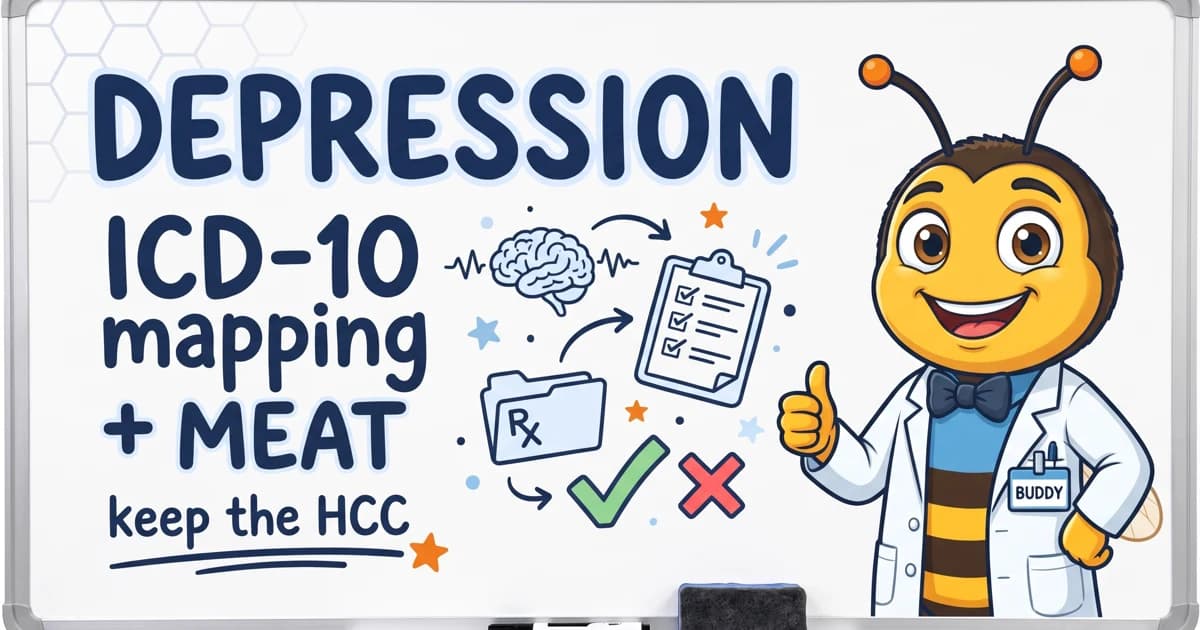
- MEAT is an optional documentation-review mnemonic, not a CMS regulation or reportability rule. Verify the depressive-disorder diagnosis against the full record, official coding guidance, and applicable encounter, program, and payer requirements.
Query when the record is internally inconsistent or incomplete, not to harvest a coefficient. HCC Buddy educational query language, not a CMS form:
"The assessment lists depression with current treatment. Please document whether this is major depressive disorder or another depressive diagnosis, the current severity (mild, moderate, or severe), and whether the episode is single or recurrent."
If the provider cannot specify severity, keep the unspecified code. That is the guideline-compliant answer. It is also a V28 valid-no-mapping result. See provider query templates.
Primary sources
- CDC/NCHS and CMS FY2026 ICD-10-CM files and April 1, 2026 update: cms.gov/medicare/coding-billing/icd-10-codes. CMS April 1 order ZIP SHA-256 4fd9d8b37f02ab42827c7e7be30595c005b0cc3a6bae7a515e3f4c86b6918688. Tabular XML SHA-256 fbbb7f6ee319eb0259e43d369ec50bc15af9a2c983d4440b936b3d70a53f7624.
- ICD-10-CM Official Guidelines for Coding and Reporting, FY2026, April 1, 2026 update: CDC/NCHS April 1 2026 guidelines PDF. Text artifact SHA-256 3b346d46750808e40e98abdcf0b640d80f5abdef2613d972028f48128c21a7f7.
- CMS 2026 model software and ICD-10 mappings: 2026-model-software-icd-10-mappings. Current 2026 Final ICD-10-CM Mappings SHA-256 9c260b06d0dd280622dff809c9af65d3a3067aba32dc7e4063a20656a031f885. V28 relative factors SHA-256 dab4dec2b68b0570500d184adadac4b5c25e84b34dd48883e9baa767bd35b598. V28 hierarchy SHA-256 f5cd98c6b44fb0e13292b059b09723f7275792dc468b12cbc4afc29043eccfb2.
- Historical CMS-HCC V24 reference: 2025-model-software ICD-10 mappings. Official 2025 Midyear/Final mapping CSV member SHA-256 719bd3842ddccb1cdd8c63aa2b36325bee1a4183d07f9a6eed0c49426411b5c6.
Disclaimer
HCC Buddy is not affiliated with, endorsed by, or approved by CMS, CDC, NCHS, AHA, AHIMA, or WHO. This page is original HCC Buddy education for risk-adjustment coders. It does not replace the official classification, the Official Guidelines, payer policy, or coder judgment. Every mapping and coefficient above is scoped to FY2026 period 2 and CMS-HCC V28 payment year 2026 CNA unless a different source is named. Re-check the official file for the date of service in front of you. HCC Buddy does not store PHI.
Written by the HCC Buddy Coding Team.
Frequently Asked Questions
Does F32.9 map to an HCC under V28?
No. F32.9 is billable, and the FY2026 period 2 MCP receipt plus the official 2026 Final ICD-10-CM Mappings file both return no CMS-HCC V28 category. The mapping status is verified no-HCC-mapping, not an incomplete file. F33.9 and F32.A have the same V28 result.
Which depression codes map to HCC 155?
F32.1, F32.2, F33.1, and F33.2. Those are the moderate and severe-without-psychosis major-depression codes. The official V28 label for HCC 155 is "Major Depression, Moderate or Severe, without Psychosis." The CNA coefficient in the PY2026 V28 factor file is 0.299. Other segments differ.
Why do F32.3 and F33.3 map to HCC 152 instead of HCC 155?
Because the official V28 map places severe major depression with psychotic features or psychotic symptoms in HCC 152, Psychosis, Except Schizophrenia, not in the major-depression-without-psychosis category. The CNA coefficient for HCC 152 is 0.484. HCC 152 supersedes HCC 155 in the official V28 hierarchy file.
Can a PHQ-9 score be used to assign F32.1?
No. Official Guidelines require the highest specificity documented by the provider, and they forbid assigning a more specific code the record does not support. A PHQ-9 value is not an ICD-10-CM severity character. If the provider documents moderate major depressive disorder, code that. If they document only a score, query or keep unspecified.
Related Tools
ICD-10 Encoder
Look up depression codes and see the current HCC mapping
Drug Reference
Cross-reference antidepressants to documented diagnosis codes
RAF Calculator
CMS-HCC V28 Payment Year 2026 scoring with complete member context. No score is shown unless the required source and calculation checks pass.

HCC Buddy Coding Team
Editorial
Every HCC Buddy article is checked against the current CMS-HCC model and the active FY ICD-10-CM tabular release before it publishes.
Get HCC Coding Tips in Your Inbox
Join our newsletter for coding tips, guideline updates, and tool announcements.