
BIA-ALCL ICD-10 Coding: C84.7A, Z98.86, and HCC 19
C84.7A carries a use additional code note for breast implant status. Which Z code goes with it, when C84.7B applies, and what captures in V28.
By the HCC Buddy Coding Team
Updated: July 21, 2026
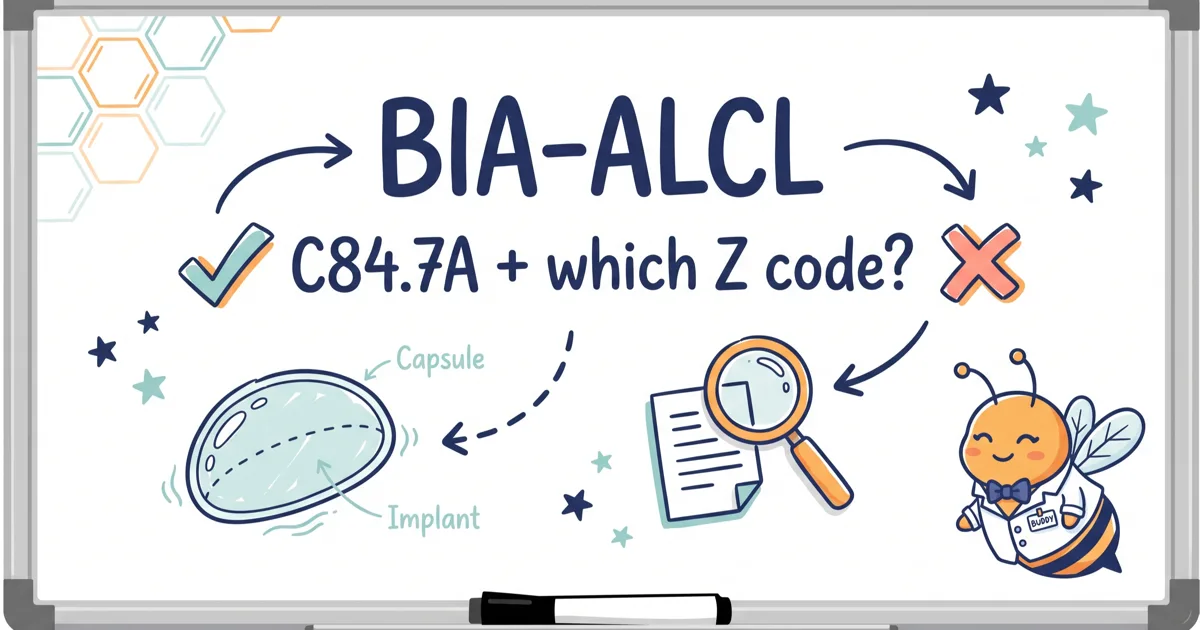
BIA-ALCL ICD-10 coding is a two-code job, and the second code is where charts go wrong. C84.7A, Anaplastic large cell lymphoma, ALK-negative, breast, is the code for breast implant associated anaplastic large cell lymphoma. Under it sits a use additional code note pointing at two Z codes that are mutually exclusive by Excludes1: Z98.82 breast implant status, and Z98.86 personal history of breast implant removal. Picking between them is a documentation question, not a preference. This post covers that pair, the remission code most encoders still do not surface, the chapter 19 trap the Official Guidelines close by name, and what the whole encounter is worth in CMS-HCC V28.
*Current as of July 2026. Code entries and instructional notes below are quoted from the FY2026 ICD-10-CM tabular published at cms.gov/medicare/coding-billing/icd-10-codes and the FY2026 ICD-10-CM Official Guidelines for Coding and Reporting; HCC assignments and weights come from the CMS-HCC V28 model for payment year 2026. Verify against current CMS sources and your payer's edits before you rely on it.*
The Quick Answer
| Documented scenario | Codes, in order |
|---|---|
| BIA-ALCL, implant still in place | C84.7A, then Z98.82 |
| BIA-ALCL, implant explanted | C84.7A, then Z98.86 |
| BIA-ALCL in remission | C84.7B, plus the applicable Z98.82 or Z98.86 |
| BIA-ALCL treated, no evidence of disease, no further treatment | Z85.72 personal history of non-Hodgkin lymphomas |
| Any of the above with a chapter 19 implant-complication code | Stop. The guideline forbids it |
What C84.7A Actually Is
C84.7A, Anaplastic large cell lymphoma, ALK-negative, breast, is billable and carries the inclusion term "Breast implant associated anaplastic large cell lymphoma (BIA-ALCL)." It has been in the classification since October 1, 2021, so it is not new, but it is uncommon enough that it lives outside most coders' muscle memory.
The clinical shape explains the coding shape. BIA-ALCL develops in the fibrous capsule that forms around a breast implant rather than in breast parenchyma or lymph node tissue, which is why it sits in the C84.7 anaplastic large cell lymphoma, ALK-negative subcategory next to the anatomic-site codes (C84.70 unspecified site, C84.71 head and neck nodes, C84.79 extranodal and solid organ sites) rather than in the C50 breast cancer category. Coders reaching for a C50 code here have the wrong chapter neighborhood entirely.
The FY2026 Official Guidelines address it directly at Section I.C.2.s: "Assign code C84.7A, Anaplastic large cell lymphoma, ALK-negative, breast, for BIA-ALCL or C84.7B, Anaplastic large cell lymphoma, ALK-negative, in remission, for BIA-ALCL in remission. Do not assign a complication code from chapter 19."
That last sentence is the one to underline. A lymphoma that arises around a device looks, to an experienced coder, like a device complication, and chapter 19's T85.4- breast prosthesis complication codes sit right there. The guideline shuts that door by name. Code the malignancy, add the implant status Z code, and leave chapter 19 alone.
Z98.82 or Z98.86: One or the Other, Never Both
The use additional code note under C84.7A reads: "code to identify: breast implant status (Z98.82), personal history of breast implant removal (Z98.86)." Two codes are listed, but they cannot both be true. Z98.82 carries an Excludes1 for breast implant removal status (Z98.86), and Excludes1 means never both on the same encounter for the same condition.
So the note is a fork, and the record decides which branch:
- Implant in place at the encounter — Z98.82, breast implant status.
- Implant removed — Z98.86, personal history of breast implant removal.
Explantation with capsulectomy is standard management for BIA-ALCL, which means a patient's status code often flips from Z98.82 to Z98.86 partway through the treatment year. Coding an encounter from a template or a prior-year problem list is how a chart ends up reporting an implant the patient no longer has. Read the operative history for the encounter you are actually coding.
One more wrinkle worth knowing: bilateral implants where only one side was removed. Neither Z code carries laterality, so a patient with a retained contralateral implant still has implant status to report. Where the record is genuinely ambiguous about what remains in place, that is a provider query, not a coin flip.
C84.7B: The Remission Code Coders Miss
C84.7B, Anaplastic large cell lymphoma, ALK-negative, in remission, joined the classification effective October 1, 2024 (FY2025). It is newer than C84.7A by three years, and that gap is exactly why it gets missed: encoder favorites lists and cheat sheets built when C84.7A arrived have no entry for it.
Remission is a provider determination. "In remission" has to be documented by the provider; a coder cannot infer it from a clean scan or a completed course of therapy. If the record is unclear about whether remission has been achieved, query. The Official Guidelines set that expectation explicitly for leukemia and multiple myeloma at Section I.C.2.n, and the same discipline applies here.
Remission is also not the same thing as history of. When the malignancy has been previously excised or eradicated from its site, there is no further treatment directed to that site, and there is no evidence of any existing primary malignancy at that site, the guidelines move you to a Z85 personal history code. For this disease that is Z85.72, Personal history of non-Hodgkin lymphomas, whose inclusion term covers conditions classifiable to C82-C85. A patient in documented remission still has an active malignancy code; a patient with a documented history of does not. Our guide on acute versus history of coding works through that distinction across conditions.
What Captures in V28
Here is the risk-adjustment picture for the whole encounter, from the CMS-HCC V28 model for payment year 2026:
| Code | V28 CMS-HCC | PY2026 community (CNA) RAF |
|---|---|---|
| C84.7A BIA-ALCL | HCC 19, Myelodysplastic Syndromes, Multiple Myeloma, and Other Cancers | 1.798 |
| C84.7B ALCL in remission | HCC 19 | 1.798 |
| Z98.82 breast implant status | None | 0.000 |
| Z98.86 history of implant removal | None | 0.000 |
| Z85.72 personal history of non-Hodgkin lymphomas | None | 0.000 |
Institutional weight for HCC 19 is 0.957. In the V28 hierarchy, HCC 19 supersedes HCC 20, 21, 22, and 23, and it participates in the model's cancer disease-interaction group. Under the legacy V24 model both C84.7 codes mapped to HCC 10, Lymphoma and Other Cancers, at 0.675 community, so this is one of the categories where V28 pays materially more than its predecessor rather than less.
Three things follow from that table. First, C84.7A and C84.7B carry identical weight, so documented remission does not cost the plan anything; there is no incentive to avoid the more accurate code. Second, the Z codes contribute nothing to a Part C RAF score, which does not make them optional. They answer a use additional code instruction, and a missing one is a coding error whether or not it moves a number. Our rundown of status Z codes that do map to HCC V28 covers the ones that carry weight. Third, once the patient moves to Z85.72, the RAF contribution goes to zero, correctly, because the malignancy is no longer active. Chasing a resolved cancer's weight is how charts fail RADV.
Documentation Notes Before You Finalize
- The provider needs to document BIA-ALCL, or anaplastic large cell lymphoma of the breast, in words. "Implant capsule mass" or a suspicious seroma pending pathology does not get you to C84.7A.
- Confirm implant status for the encounter you are coding, not for the year. Z98.82 and Z98.86 both being reported on one claim is an Excludes1 edit waiting to fire.
- Remission needs the provider's statement, and history of needs the treatment to actually be complete with no evidence of disease.
- A mapping or coefficient does not establish active malignancy. Verify the provider's current diagnosis, the full record, and the condition-specific ICD-10-CM guidance before assigning an active cancer code.
- Watch for chapter 19 codes drifting in from the surgical side of the record. The guideline prohibition is specific and an auditor will know it.
Frequently Asked Questions
What is the ICD-10-CM code for BIA-ALCL?
BIA-ALCL codes to C84.7A, Anaplastic large cell lymphoma, ALK-negative, breast. The code carries "Breast implant associated anaplastic large cell lymphoma (BIA-ALCL)" as an inclusion term, and FY2026 Official Guidelines Section I.C.2.s directs its assignment by name. It has been valid since October 1, 2021. A use additional code note requires a second code for implant status: Z98.82 if the implant is in place, or Z98.86 if it has been removed.
Do you code Z98.82 or Z98.86 with C84.7A?
Whichever one the record supports, never both. Z98.82, breast implant status, applies when the implant is still in place. Z98.86, personal history of breast implant removal, applies after explantation, which is common in BIA-ALCL management. Z98.82 carries an Excludes1 note for Z98.86, so the two can never be reported together. Because status changes when the implant comes out, check the operative history for the specific encounter rather than carrying the prior code forward.
Can you assign a breast implant complication code for BIA-ALCL?
No. FY2026 ICD-10-CM Official Guidelines Section I.C.2.s states plainly: "Do not assign a complication code from chapter 19." BIA-ALCL is coded as the malignancy it is, C84.7A, with the applicable implant status Z code. The chapter 19 breast prosthesis complication codes in T85.4- are not part of the assignment, even though the lymphoma develops in the capsule surrounding a device.
What is the difference between C84.7A and C84.7B?
C84.7B, Anaplastic large cell lymphoma, ALK-negative, in remission, is used when the provider documents that BIA-ALCL has achieved remission; C84.7A is used for active disease. C84.7B took effect October 1, 2024, three years after C84.7A, so it is frequently missing from encoder favorites and cheat sheets. Remission has to be the provider's documented determination, not a coder inference, and it differs from personal history of, which moves you to Z85.72.
Does BIA-ALCL map to an HCC?
Yes. Both C84.7A and C84.7B map to CMS-HCC V28 category 19, Myelodysplastic Syndromes, Multiple Myeloma, and Other Cancers, with a community (CNA) weight of 1.798 and an institutional weight of 0.957 for payment year 2026. HCC 19 supersedes HCC 20, 21, 22, and 23 in the hierarchy. The associated Z codes, Z98.82, Z98.86, and Z85.72, carry no CMS-HCC and contribute nothing to a Part C RAF score.
Look Up the Notes While You Are in the Chart
The inclusion term, the use additional code fork, the Excludes1 between the two Z codes, and the V28 mapping are four separate lookups in a code book and one screen in a tool. The HCC Buddy encoder shows the instructional notes and V28 mapping for C84.7A, C84.7B, and both Z codes as you read the note, and the ICD-10 to HCC mapping tool confirms what captures before you finalize. Rare codes are where old habits show up in an audit sample. Code the lymphoma, check what is still in the patient, skip chapter 19.
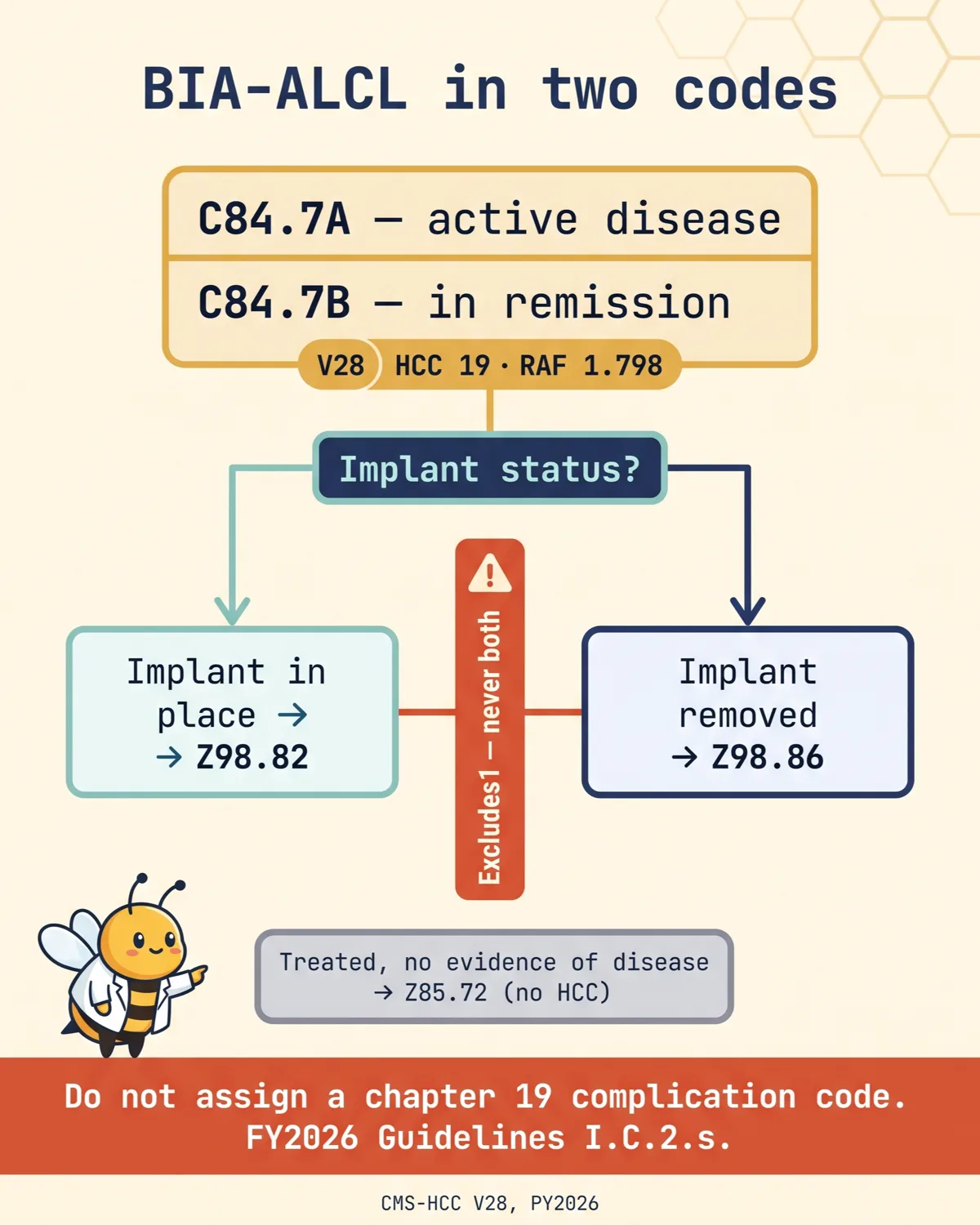
Infographic Brief
Concept: "BIA-ALCL in two codes" decision card, single column, portrait 1200x1500 for social and blog inline.
Data points to render:
1. Top block: C84.7A active disease and C84.7B in remission, both labeled "V28 HCC 19, community RAF 1.798."
2. Fork below: "Implant in place → Z98.82" and "Implant removed → Z98.86," with a red Excludes1 barrier drawn between the two branches.
3. Side rail: "Treated, no evidence of disease, no further treatment → Z85.72, no HCC."
4. Bottom banner in warning color: "Do not assign a chapter 19 complication code. FY2026 Guidelines I.C.2.s."
Layout suggestion: Warm palette on cream background, honeycomb motif in the corner, codes in monospace, Buddy the Bee pointing at the Excludes1 barrier. Every RAF figure footnoted "CMS-HCC V28, PY2026."
Frequently asked questions
What is the ICD-10-CM code for BIA-ALCL?
BIA-ALCL codes to C84.7A, Anaplastic large cell lymphoma, ALK-negative, breast. The code carries "Breast implant associated anaplastic large cell lymphoma (BIA-ALCL)" as an inclusion term, and FY2026 Official Guidelines Section I.C.2.s directs its assignment by name. It has been valid since October 1, 2021. A use additional code note requires a second code for implant status: Z98.82 if the implant is in place, or Z98.86 if it has been removed.
Do you code Z98.82 or Z98.86 with C84.7A?
Whichever one the record supports, never both. Z98.82, breast implant status, applies when the implant is still in place. Z98.86, personal history of breast implant removal, applies after explantation, which is common in BIA-ALCL management. Z98.82 carries an Excludes1 note for Z98.86, so the two can never be reported together. Because status changes when the implant comes out, check the operative history for the specific encounter rather than carrying the prior code forward.
Can you assign a breast implant complication code for BIA-ALCL?
No. FY2026 ICD-10-CM Official Guidelines Section I.C.2.s states plainly: "Do not assign a complication code from chapter 19." BIA-ALCL is coded as the malignancy it is, C84.7A, with the applicable implant status Z code. The chapter 19 breast prosthesis complication codes in T85.4- are not part of the assignment, even though the lymphoma develops in the capsule surrounding a device.
What is the difference between C84.7A and C84.7B?
C84.7B, Anaplastic large cell lymphoma, ALK-negative, in remission, is used when the provider documents that BIA-ALCL has achieved remission; C84.7A is used for active disease. C84.7B took effect October 1, 2024, three years after C84.7A, so it is frequently missing from encoder favorites and cheat sheets. Remission has to be the provider's documented determination, not a coder inference, and it differs from personal history of, which moves you to Z85.72.
Does BIA-ALCL map to an HCC?
Yes. Both C84.7A and C84.7B map to CMS-HCC V28 category 19, Myelodysplastic Syndromes, Multiple Myeloma, and Other Cancers, with a community (CNA) weight of 1.798 and an institutional weight of 0.957 for payment year 2026. HCC 19 supersedes HCC 20, 21, 22, and 23 in the hierarchy. The associated Z codes, Z98.82, Z98.86, and Z85.72, carry no CMS-HCC and contribute nothing to a Part C RAF score.
Related Tools
ICD-10 Encoder
Look up C84.7A with its inclusion term, the use additional code note, and the Z98.82 Excludes1 in one view.
ICD-10 to HCC Mapping
Confirm C84.7A and C84.7B both capture HCC 19 and that the Z codes capture nothing.
RAF Calculator
CMS-HCC V28 Payment Year 2026 scoring with complete member context. No score is shown unless the required source and calculation checks pass.

HCC Buddy Coding Team
Editorial
Every HCC Buddy article is checked against the current CMS-HCC model and the active FY ICD-10-CM tabular release before it publishes.
Get HCC Coding Tips in Your Inbox
Join our newsletter for coding tips, guideline updates, and tool announcements.