
April 2026 ICD-10-CM Update: Excludes & Sequencing Changes
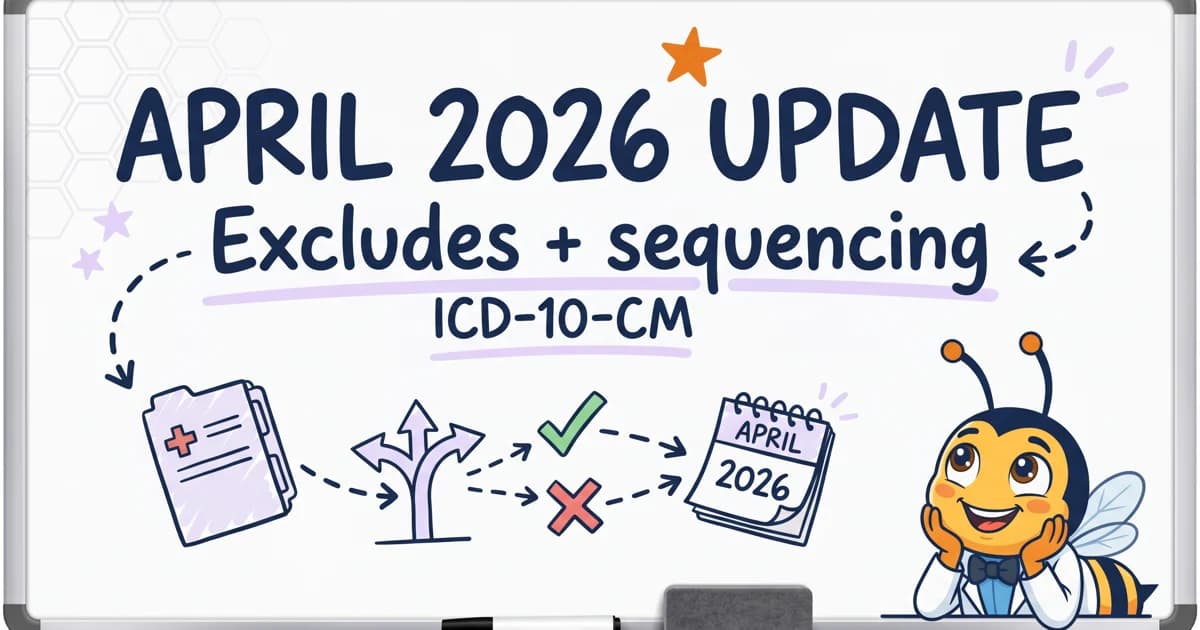
April 2026 ICD-10-CM update changes Excludes1 to Excludes2 and rewrites sequencing across 14 chapters. What coders need to do before the effective date.
By the HCC Buddy Coding Team
Updated: March 22, 2026
No New Codes, but Major Coding Implications
The Centers for Medicare and Medicaid Services (CMS) has released the April 1, 2026, update to the International Classification of Diseases, 10th Revision, Clinical Modification (ICD-10-CM) code set, and at first glance it looks uneventful. There are zero new diagnosis codes, zero deletions, and zero code revisions. But if you stop reading there, you will miss changes that could directly affect claim accuracy, sequencing logic, and Hierarchical Condition Category (HCC) capture for the rest of fiscal year 2026.
The real substance of this update lives in the instructional notes -- the Excludes1, Excludes2, Code first, Use additional code, and Code also annotations that tell coders which combinations are allowed, which are prohibited, and how to sequence them. CMS has made changes across 14 chapters of the Tabular List, and several of those changes reverse long-standing coding restrictions that every experienced coder has internalized.
If you code for risk adjustment, inpatient, or outpatient settings, April 1 is only ten days away. Here is what is changing and how to prepare.
The Excludes1 to Excludes2 Shift: Why It Matters
The single most impactful pattern in this update is the conversion of multiple Excludes1 notes to Excludes2 notes. Understanding the difference between these two note types is fundamental to applying the changes correctly.
An Excludes1 note means "not coded here." When two codes are linked by an Excludes1 note, they should never appear together on the same claim. The note signals that the two conditions are mutually exclusive -- if the patient has one, they cannot have the other, or that the code you are looking at already includes the excluded condition.
An Excludes2 note means "not included here." The two conditions are separate and distinct. If the provider documents both conditions, you may report both codes. The Excludes2 note simply clarifies that the second condition is not part of the first code's definition.
When CMS converts an Excludes1 to an Excludes2, it is not adding new codes. It is allowing combinations that were previously prohibited. For coders, this means more flexibility -- but also more responsibility to evaluate whether both conditions are truly documented and clinically supported.
Key Changes You Need to Know
Here are the most significant instructional note changes taking effect on April 1, 2026.
Respiratory failure and postprocedural respiratory failure. The Excludes1 note that previously prevented assigning J96 (Respiratory failure, not elsewhere classified) alongside J95.82 (Postprocedural respiratory failure) has been changed to an Excludes2 note. This is a meaningful clinical scenario: a patient may have pre-existing acute or chronic respiratory failure and then develop a separate postprocedural respiratory failure during the same admission. After April 1, coders may report both codes together when the documentation supports two distinct conditions. For risk adjustment coders, both J96.1x (Chronic respiratory failure) and J96.2x (Acute and chronic respiratory failure) map to HCC 213 under the V28 model -- verify via the CMS 2026 risk-adjustment model software and ICD-10 mappings release -- so capturing the correct specificity matters.
Hemangioma, lymphangioma, and related neoplasms. Under category D18 (Hemangioma and lymphangioma, any site), the Excludes1 notes for benign neoplasm of glomus jugulare (D35.6), nevi from subcategories D22, and vascular nevus (Q82.5) have been changed to Excludes2 notes. This means a patient can now have a documented hemangioma and a separate documented benign neoplasm coded on the same encounter. The same change applies under D49 (Neoplasms of unspecified behavior).
Headache and migraine. The Excludes1 note that prevented reporting R51.9 (Headache, unspecified) alongside codes from category G43 (Migraine) has been changed to an Excludes2 note. Clinically, a patient may experience migraines as a chronic condition while also presenting with a new, unrelated headache. After April 1, if both are documented, both may be coded.
Vitamin B12 deficiency anemia and other B vitamin deficiencies. The Excludes1 note that excluded E53.8 from being reported with codes in category B51 (Vitamin B12 deficiency anemia) has been deleted and replaced with an Excludes2 note for codes in category E53. This allows coders to report both a B12 deficiency anemia and a separate B-group vitamin deficiency when supported by the record.
Sequencing Instruction Changes: Code First Becomes Code Also
Beyond the Excludes note conversions, this update also changes several "Code first" and "Use additional code" instructions to "Code also" instructions. This is a subtle but important shift that affects sequencing.
Under the previous instructions, if you saw "Code first" the underlying condition, you had a mandatory sequencing order. The underlying condition went first, and the manifestation went second. A "Use additional code" note similarly dictated that the current code came first with the additional code sequenced after it.
A "Code also" instruction removes that mandatory sequence. Both codes should be reported, but the sequencing depends on the circumstances of the encounter -- which condition was the primary reason for the visit, which drove the most resource utilization, or which was principally responsible for the admission.
One notable example involves hypertensive emergency (I16.1). Under the previous "Use additional code" note, organ dysfunction such as cerebral infarction was automatically sequenced second to the hypertensive emergency. After April 1, the "Code also" note means the coder must evaluate the encounter to determine whether hypertensive emergency or the organ dysfunction should be sequenced as the principal or first-listed diagnosis based on the clinical circumstances.
For risk adjustment coders, sequencing does not change which HCCs are captured -- all documented and coded conditions are evaluated for HCC mapping regardless of position. But for inpatient coders and anyone working in a setting where the principal diagnosis drives Diagnosis Related Group (DRG) assignment or payment, this change is significant.
What This Means for Risk Adjustment and HCC Capture
If you work in Medicare Advantage (MA) risk adjustment, the Excludes1 to Excludes2 changes deserve close attention for two reasons.
More accurate condition capture. When two conditions were blocked by an Excludes1 note, coders had to choose one or the other, even when both were clinically present. The Excludes2 conversion allows both conditions to be reported. If either maps to an HCC, the conversion could result in more complete and accurate risk score calculation -- not through upcoding, but through coding what is genuinely documented.
Audit defensibility. The source-checked unique payable mapping counts are 9,927 for the historical PY2025 V24 reference and 8,019 for CY2026 V28. That difference does not mean every removed code lacked specificity. Check the exact code, model, payment year, and documentation before drawing a payment conclusion.
The golden rule has not changed: if the provider documented it, assessed it, and managed it during the encounter, code it. If they did not, leave it alone. The April 1 update does not lower the documentation bar -- it simply removes artificial coding barriers that did not reflect clinical reality.
How to Prepare Before April 1
With the effective date less than two weeks away, here are practical steps to get ready.
Review the full list of note changes. CMS has published the updated Tabular List files on the CMS ICD-10 website. Download the April 1, 2026, update and review every Excludes note conversion and sequencing instruction change in the 14 affected chapters.
Update your reference materials. If you use printed or internal reference sheets that note Excludes1 restrictions, update them to reflect the new Excludes2 designations. Outdated reference materials are one of the most common sources of coding errors after mid-year updates.
Brief your coding team. Even experienced coders may not realize these changes are coming, because the absence of new codes makes the update easy to overlook. A short team huddle or email highlighting the key Excludes1 to Excludes2 conversions and the Code also changes can prevent errors starting April 1.
Verify code combinations using current tools. Before submitting claims with newly allowed code combinations, confirm that both conditions are documented and supported. You can look up any ICD-10-CM code and its current HCC mapping using the encoder to verify that your code selections are valid under the V28 model. The CRC reference page is also useful for understanding how condition categories interact under the V28 hierarchy.
Stay Current, Stay Accurate
Mid-year ICD-10-CM updates are easy to miss precisely because they rarely include new codes. But instructional note changes can be just as consequential -- they change what you are allowed to code, how you sequence it, and which combinations are valid on a claim. The April 1, 2026, update is a textbook example: no new codes, but real changes to how you apply the ones that already exist. Major rule changes affecting coding usually land first as proposed and final rules in the Federal Register, which is the single best place to monitor for upstream shifts before they hit your workflow.
> RAF Calculator: The RAF Calculator supports CMS-HCC V28 for Payment Year 2026 and requires complete member context. HCC Buddy shows a score only after the server confirms the required source and calculation checks. If a check is unavailable or does not pass, no score is shown.
If you are not already using them in your daily workflow, create a free account and see how real-time code verification fits into your process.
Related Tools
ICD-10 Encoder
Look up any ICD-10-CM code and see its current HCC mapping under V28.
CRC Reference
Browse all active HCC condition categories and hierarchy rules under V28.
RAF Calculator
CMS-HCC V28 Payment Year 2026 scoring with complete member context. No score is shown unless the required source and calculation checks pass.

HCC Buddy Coding Team
Editorial
Every HCC Buddy article is checked against the current CMS-HCC model and the active FY ICD-10-CM tabular release before it publishes.
Get HCC Coding Tips in Your Inbox
Join our newsletter for coding tips, guideline updates, and tool announcements.