
I21.A9 and I21.A1 Type 2 MI Map to V28 HCC 228; I97.190 and I25.2 Do Not
I21.A9 (type 3, 4, and 5 MI) and I21.A1 (type 2 MI) map to CMS-HCC V28 HCC 228 for 2026 DOS. The I97.190 code first code, I25.2, and I5A do not map.
By the HCC Buddy Coding Team
Updated: October 21, 2026
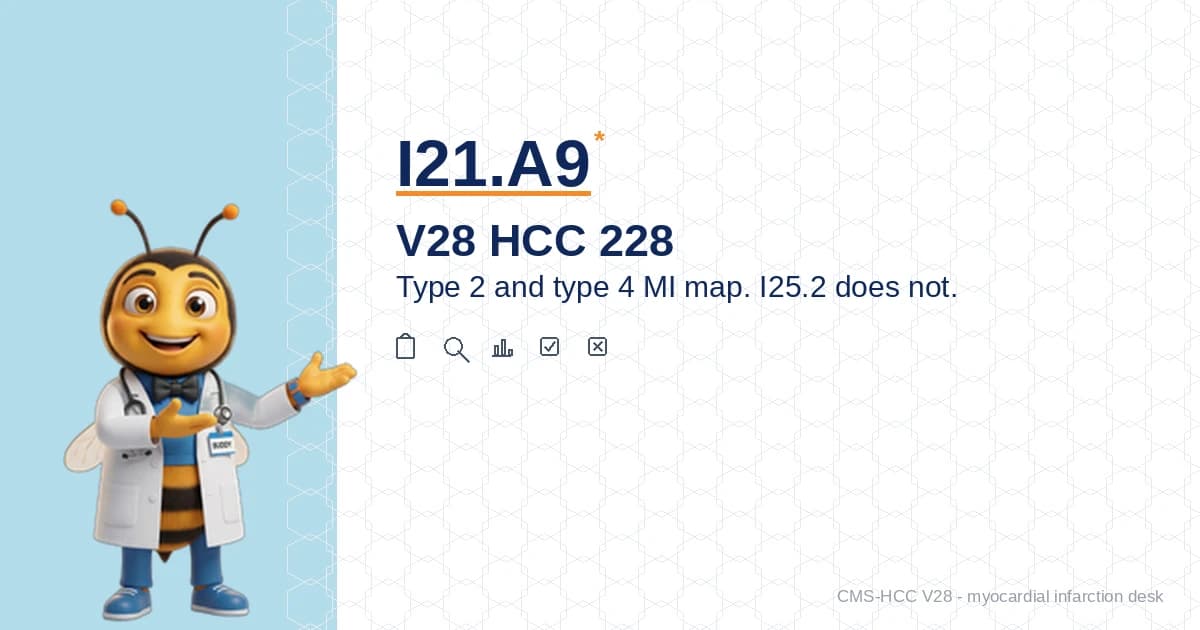
If you searched I21.A9, its code first note, or type 2 MI next to V28, here is the short answer. For 2026 dates of service, I21.A9 (Other myocardial infarction type) and I21.A1 (Myocardial infarction type 2) are billable codes that map to CMS-HCC V28 HCC 228 (Acute Myocardial Infarction) in the CMS 2027 Initial ICD-10-CM Mappings (payment year 2027). The PY2026 V28 CSV, for 2025 dates of service, gives the same result with rows `I21A9,228.0,,,` and `I21A1,228.0,,,`, and the live cards show a community non-dual aged (CNA) reference of 0.252.
The codes listed in the I21.A9 notes are a different story. I97.190 and I97.790, the two codes named in its code first note, show No V28 HCC for 2026 dates of service, and so do the stent and bypass graft complication codes named in its code also note. Old myocardial infarction, I25.2, does not map either. The HCC comes from the I21.A code, so the job is to code the type correctly and keep it inside the four-week window.
As of October 21, 2026, the public ICD leaf cards default to the FY2027 ICD-10-CM edition and read the V28 result from the CMS 2027 Initial ICD-10-CM Mappings (payment year 2027, 2026 dates of service). For every code in this desk, that card result agrees with the PY2026 V28 CSV and the live HCC hubs. The I20-I25, I5A, and I97 code lists and descriptors did not change between the FY2026 and FY2027 order files.
This page is the coder-desk walk for type 2 and other-type myocardial infarction under CMS-HCC V28. It does not rewrite the acute vs history of guide, which covers the broader move from an acute code to a history code. Use that guide for the general pattern and this desk for the I21.A- details.
Desk table: the I21.A codes and I21.B
| Code | Official descriptor | V28 result | CSV (no decimal) |
|---|---|---|---|
| I21.A | Other type of myocardial infarction | Nonbillable heading | no CSV row |
| I21.A1 | Myocardial infarction type 2 | HCC 228 | `I21A1,228.0,,,` |
| I21.A9 | Other myocardial infarction type | HCC 228 | `I21A9,228.0,,,` |
| I21.B | Myocardial infarction with coronary microvascular dysfunction | HCC 228 | `I21B,228.0,,,` |
The live HCC 228 hub lists 18 ICD-10-CM codes with a CNA reference of 0.252: the 13 billable I21 codes and the 5 billable I22 codes. CNA references are community non-dual aged values on the live cards and hubs. They are not member totals, and segment coefficients vary.
What I21.A9 covers
The I21.A9 card lists six inclusion terms: "Myocardial infarction associated with revascularization procedure", "Myocardial infarction type 3", "Myocardial infarction type 4a", "Myocardial infarction type 4b", "Myocardial infarction type 4c", and "Myocardial infarction type 5". Guideline I.C.9.e.5 says the same thing in one sentence: "Acute myocardial infarctions type 3, 4a, 4b, 4c and 5 are assigned to code I21.A9, Other myocardial infarction type."
The FY2027 Alphabetic Index agrees. Infarct, myocardium, type 3, type 4, and type 5 each index to I21.A9, and so does Infarct, myocardium, associated with revascularization procedure. The number the provider writes is what picks the code, so a note that says only "MI" or "acute MI" does not reach I21.A9.
The code first note: I97.190 and I97.790
The I21.A9 card carries a code first note: "postprocedural myocardial infarction following cardiac surgery (I97.190), or postprocedural myocardial infarction during cardiac surgery (I97.790)". The note says "if applicable", so it applies only when the provider documents the infarction as a complication of cardiac surgery.
| Code | Official descriptor | V28 result | CSV (no decimal) |
|---|---|---|---|
| I97.190 | Other postprocedural cardiac functional disturbances following cardiac surgery | Does not map | no CSV row |
| I97.790 | Other intraoperative cardiac functional disturbances during cardiac surgery | Does not map | no CSV row |
| I97.191 | Other postprocedural cardiac functional disturbances following other surgery | Does not map | no CSV row |
| I97.791 | Other intraoperative cardiac functional disturbances during other surgery | Does not map | no CSV row |
The Index leads to the same place. Infarct, myocardium, postprocedural, following cardiac surgery indexes to I97.190, and Infarct, myocardium, intraoperative, during cardiac surgery indexes to I97.790. The postprocedural and intraoperative entries each carry a see also note to Infarct, myocardium, associated with revascularization procedure, and the following cardiac surgery entry adds a see also note to Infarct, myocardium, type 4 or type 5. The I97.190 card carries its own note: "code, if applicable, for type 4 or type 5 myocardial infarction, to further specify disorder".
Three practical points:
1. Sequence the I97 code first when the note applies. Section I.A.13 says code first and use additional code notes are also used as sequencing rules for codes that are not part of an etiology/manifestation pair. When the note applies, report I97.190 or I97.790 first and I21.A9 after it. Guideline I.C.9.e.5 also tells coders to follow the code also and code first notes for complications and for postprocedural myocardial infarctions during or following cardiac surgery.
2. The provider has to link the infarction to the surgery. Guideline I.B.16 says "Code assignment is based on the provider's documentation of the relationship between the condition and the care or procedure" and "There must be a cause-and-effect relationship between the care provided and the condition". If the record does not make that link clear, query the provider.
3. Surgery other than cardiac surgery has its own Index path. The I21.A9 note names only the cardiac surgery codes. Infarct, myocardium, postprocedural, following other surgery indexes to I97.191, and intraoperative, during other surgery indexes to I97.791. The I97.19 and I97.79 subcategories both carry "code, if applicable, to further specify disorder".
For scoring, none of the I97 codes maps. A documented type 4 or type 5 infarction reported with I21.A9 is what carries HCC 228.
The code also note: stent, graft, and PCI complications
The I21.A9 card also carries a code also note for "complication, if known and applicable, such as:" stent occlusion (T82.897-), stent stenosis (T82.855-), stent thrombosis (T82.867-), cardiac arrest due to underlying cardiac condition (I46.2), complication of percutaneous coronary intervention (PCI) (I97.89), and occlusion of coronary artery bypass graft (T82.218-).
| Code | Official descriptor | V28 result | CSV (no decimal) |
|---|---|---|---|
| T82.897A | Other specified complication of cardiac prosthetic devices, implants and grafts, initial encounter | Does not map | no CSV row |
| T82.855A | Stenosis of coronary artery stent, initial encounter | Does not map | no CSV row |
| T82.867A | Thrombosis due to cardiac prosthetic devices, implants and grafts, initial encounter | Does not map | no CSV row |
| T82.218A | Other mechanical complication of coronary artery bypass graft, initial encounter | Does not map | no CSV row |
| I97.89 | Other postprocedural complications and disorders of the circulatory system, not elsewhere classified | Does not map | no CSV row |
| I46.2 | Cardiac arrest due to underlying cardiac condition | HCC 213 | `I462,213.0,,,` |
The T82 codes need a seventh character for the encounter; the initial encounter leaves are shown above. Code the complication when the provider documents it, as the note directs. Only one of these codes maps on its own: I46.2 maps to HCC 213 (Cardio-Respiratory Failure and Shock), CNA reference 0.370. HCC 213 is not in the HCC 228 hierarchy, so the two can both count. HCC 211 and HCC 212 supersede HCC 213. See the HCC 213 desk.
Type 2 MI: I21.A1
The I21.A1 card lists two inclusion terms, "Myocardial infarction due to demand ischemia" and "Myocardial infarction secondary to ischemic imbalance". Its code first note reads "if applicable, the underlying cause, such as:" anemia (D50.0-D64.9), chronic obstructive pulmonary disease (J44.-), paroxysmal tachycardia (I47.0-I47.9), and shock (R57.0-R57.9). Under Section I.A.13, when a code first note applies and the underlying condition is present, the underlying condition is sequenced first, if known. Each underlying cause has its own V28 result, so check its card.
Guideline I.C.9.e.5 gives three rules that settle most type 2 questions:
- "Do not assign code I24.89, Other forms of acute ischemic heart disease, for the demand ischemia."
- "If a type 2 AMI is described as NSTEMI or STEMI, only assign code I21.A1."
- "Codes I21.01-I21.4 should only be assigned for type 1 AMIs."
The Index follows the same logic. Infarct, myocardium, type 2, due to demand ischemia, due to ischemic imbalance, and secondary to demand ischemia all index to I21.A1. Ischemia, demand, with myocardial infarction and resulting in myocardial infarction also index to I21.A1. The I24.8 subcategory carries Excludes1: myocardial infarction due to demand ischemia (I21.A1).
Demand ischemia, troponin, and myocardial injury without an MI
Not every chart with ischemia or an abnormal troponin supports an I21 code. These are the Index paths when the provider does not diagnose an infarction:
| Code | Official descriptor | V28 result | CSV (no decimal) |
|---|---|---|---|
| I24.89 | Other forms of acute ischemic heart disease | HCC 229 | `I2489,229.0,,,` |
| I5A | Non-ischemic myocardial injury (non-traumatic) | Does not map | no CSV row |
| R79.89 | Other specified abnormal findings of blood chemistry | Does not map | no CSV row |
- Ischemia, demand with no infarction indexes to I24.89, which maps to HCC 229 (Unstable Angina and Other Acute Ischemic Heart Disease), CNA reference 0.240. Once the provider documents a type 2 MI, the code is I21.A1 and I24.89 is not added.
- Injury, myocardial indexes to I5A. The I5A card carries Excludes1: acute myocardial infarction (I21.-) and Excludes2: other acute ischemic heart diseases (I24.-), and a code first note for the underlying cause, if known and applicable.
- Elevated, troponin indexes to R79.89. For inpatient reporting, Section III.B says abnormal findings "are not coded and reported unless the provider indicates their clinical significance."
A lab value is not a diagnosis. When troponin results, ECG findings, and the assessment point in different directions, a compliant provider query is the fix. See provider query templates.
Type 1, NSTEMI, and the unspecified code
All of these map to HCC 228, but the code still has to match the documentation:
| Code | Official descriptor | V28 result | CSV (no decimal) |
|---|---|---|---|
| I21.4 | Non-ST elevation (NSTEMI) myocardial infarction | HCC 228 | `I214,228.0,,,` |
| I21.3 | ST elevation (STEMI) myocardial infarction of unspecified site | HCC 228 | `I213,228.0,,,` |
| I21.9 | Acute myocardial infarction, unspecified | HCC 228 | `I219,228.0,,,` |
- Infarct, myocardium, non-ST elevation indexes to I21.4, and the I21.4 card lists "Type 1 non-ST elevation myocardial infarction" as an inclusion term. A note that says NSTEMI with no type goes to I21.4, not I21.9.
- Guideline I.C.9.e.2 says I21.9 "is the default for unspecified acute myocardial infarction or unspecified type."
- Infarct, myocardium, type 1 with no site or ST statement indexes to I21.9, with a see also note to the entries by site, or by ST elevation or non-ST elevation. Check those entries before you settle on I21.9.
Subsequent MI: when I22 applies and when it does not
Category I22 is for a new type 1 or unspecified infarction within four weeks of a prior one. Guideline I.C.9.e.4 says "A code from category I22 must be used in conjunction with a code from category I21." It then limits I22 to type 1:
- "Do not assign code I22 for subsequent myocardial infarctions other than type 1 or unspecified."
- "For subsequent type 2 AMI assign only code I21.A1. For subsequent type 4 or type 5 AMI, assign only code I21.A9."
- "Codes from category I22 should only be assigned if both the initial and subsequent myocardial infarctions are type 1 or unspecified."
The I22 card carries matching Excludes1 notes for "subsequent myocardial infarction, type 2 (I21.A1)" and "subsequent myocardial infarction of other type (type 3) (type 4) (type 5) (I21.A9)". When a second infarction is a different type, assign the I21 codes for each type and no I22 code. For scoring, every I21 and I22 code lands in HCC 228, so the category counts once.
| Code | Official descriptor | V28 result | CSV (no decimal) |
|---|---|---|---|
| I22.2 | Subsequent non-ST elevation (NSTEMI) myocardial infarction | HCC 228 | `I222,228.0,,,` |
| I22.9 | Subsequent ST elevation (STEMI) myocardial infarction of unspecified site | HCC 228 | `I229,228.0,,,` |
The four-week window and I25.2
I21.A1 and I21.A9 sit inside category I21, so they inherit its window. The I21 card includes "myocardial infarction specified as acute or with a stated duration of 4 weeks (28 days) or less from onset" and carries Excludes2: old myocardial infarction (I25.2).
Guideline I.C.9.e.1 sets out the window. For encounters while the infarction is four weeks old or less, and when it meets the definition of an other diagnosis, "codes from category I21 may continue to be reported." After four weeks, if the patient is still receiving care related to the infarction, "the appropriate aftercare code should be assigned, rather than a code from category I21." And "For old or healed myocardial infarctions not requiring further care, code I25.2, Old myocardial infarction, may be assigned."
| Code | Official descriptor | V28 result | CSV (no decimal) |
|---|---|---|---|
| I25.2 | Old myocardial infarction | Does not map | no CSV row |
The Index sends Infarct, myocardium, healed or old, past, and diagnosed on ECG, but presenting no symptoms to I25.2. The four-week rule is the same whether the infarction was type 1, type 2, or type 4. See acute vs history of.
Complications within the 28-day period: I23 and I24.1
Category I23 covers certain current complications following STEMI and NSTEMI "(within the 28 day period)", and these codes map to HCC 229, not HCC 228:
| Code | Official descriptor | V28 result | CSV (no decimal) |
|---|---|---|---|
| I23.7 | Postinfarction angina | HCC 229 | `I237,229.0,age >= 15,,` |
| I24.1 | Dressler's syndrome | HCC 229 | `I241,229.0,,,` |
The I23.7 row carries an age edit (age 15 or older) in the CSV. The I21 category carries Excludes2: postmyocardial infarction syndrome (I24.1), and the I24.1 card lists "Postmyocardial infarction syndrome" as an inclusion term. Because HCC 228 supersedes HCC 229, an I23 or I24 code reported in the same year as a supported I21 code does not add a second cardiac HCC.
Hierarchy: what HCC 228 replaces
- HCC 228 supersedes HCC 229. The live HCC 228 hub shows "Supersedes: HCC 229", and the HCC 229 hub shows HCC 228 as the only category that trumps it. The HCC 229 hub lists 25 codes with a CNA reference of 0.240.
- Nothing supersedes HCC 228. HCC 228 appears in only one V28 hierarchy row, as the higher category over HCC 229.
- HCC 213 stands apart. It sits in its own hierarchy with HCC 211 and HCC 212, so an I46.2 code adds to HCC 228 when both are documented and supported.
Hierarchy changes the score, not the coding. Continue reporting each condition that meets the applicable encounter and coding requirements. HCC suppression does not itself remove a reportable diagnosis. In outpatient and office visits, a reportable condition is a current one that coexists at the visit and affects care (Section IV.J), not one documented only as probable, suspected, or another uncertain term (Section IV.H). Inpatient stays follow Section III. See hierarchy and trumping.
MEAT still applies
For an I21.A1 or I21.A9 code, the note should support:
- M Monitor: the symptoms, findings, or recovery the provider is following
- E Evaluate: the ECG, imaging, catheterization, or lab results reviewed at the visit
- A Assess: myocardial infarction with the type stated (type 2 with its cause, or type 3, 4a, 4b, 4c, or 5), and its timing from onset
- T Treat: the current medication plan, a referral, a procedure plan, or a documented follow-up plan
MEAT is a review mnemonic, not a universal CMS coding rule. Follow the applicable coding, encounter, program, and payer requirements. See MEAT.
Audit and query traps
1. Reporting the I21.A heading on a claim. It is nonbillable; report I21.A1 or I21.A9.
2. Coding a type 2 infarction documented as NSTEMI with I21.4. The guideline says to assign only I21.A1.
3. Adding I24.89 for the demand ischemia next to I21.A1.
4. Coding I21.A9 from "MI" or "acute MI" with no type documented. The default is I21.9.
5. Leaving off I97.190 or I97.790 when the provider documents a type 4 or type 5 infarction as a complication of cardiac surgery, or adding them when the provider does not link the infarction to the surgery.
6. Assigning I22 for a subsequent type 2, type 4, or type 5 infarction.
7. Coding an I21 code from a troponin value, or from myocardial injury (I5A), without a provider diagnosis of infarction.
8. Carrying an I21 code past four weeks, or coding I21 from "history of MI" or a problem-list label.
9. Expecting I23 or I24 codes to add a second HCC next to a supported I21 code. HCC 228 supersedes HCC 229.
10. Using a CNA reference as a member RAF total.
11. Inventing Coding Clinic quotes, competitor comparisons, or PHI examples.
Two-minute check
1. Does the provider document a myocardial infarction, and is it four weeks old or less from onset?
2. Pick the type: type 1 by site or ST status (I21.0- to I21.4), unspecified (I21.9), type 2 (I21.A1), type 3, 4a, 4b, 4c, or 5 (I21.A9), or with coronary microvascular dysfunction (I21.B).
3. For type 2, code the underlying cause first, if applicable. When the applicable code first note and provider documentation support a cardiac surgery complication, sequence I97.190 for an infarction following cardiac surgery or I97.790 for an infarction during cardiac surgery before I21.A9.
4. Add any documented complication from the I21.A9 code also note.
5. Expect HCC 228, which supersedes HCC 229. I46.2 adds HCC 213.
6. Confirm the map on the live card and the CSV row. Confirm MEAT for this year.
Related desks and tools
- Live cards: I21.A9, I21.A1, I21.B, I21.4, I21.9, I22.2, I97.190, I97.790, I24.89, I5A, I25.2, I46.2
- Hubs: HCC 228, HCC 229, HCC 213
- Lookup: ICD-10 to HCC, Encoder
- Evidence habits: MEAT, acute vs history of, Excludes1 vs Excludes2, provider query templates, hierarchy and trumping, problem lists
- Nearby: I25.10 CAD desk, HCC 213 desk
Sources
- Live HCC Buddy ICD-10-CM cards (FY2027 Tabular display) and the V28 HCC 228, 229, and 213 hubs, fetched October 21, 2026
- FY2027 ICD-10-CM order file billable flags and FY2027 Alphabetic Index
- CMS, FY2027 ICD-10-CM Official Guidelines for Coding and Reporting, Sections I.A.13, I.B.16, I.C.9.e, III, III.B, IV.H, and IV.J
- PY2026 V28 mapping, hierarchy, and relative factor files on HCC Buddy main
- CMS, ICD-10 codes (FY2027 ICD-10-CM code files, effective October 1, 2026)
- CMS, 2026 Model Software/ICD-10 Mappings (PY2026 V28 mappings, hierarchies, and relative factors)
- CMS, 2027 Model Software/ICD-10 Mappings (2027 Initial ICD-10-CM Mappings, payment year 2027, 2026 dates of service, shown on the live cards)
V28 mappings come from the cited live code pages, the CMS 2027 Initial ICD-10-CM Mappings, and the PY2026 V28 CSV. Coefficients are source-labeled references, not member totals. Not medical advice. Not a Coding Clinic reprint.
Current as of October 21, 2026. Always confirm the mapping for the payment year that matches your dates of service, and the live HCC hub, before you lock a map claim.
Frequently asked questions
Does I21.A9 map to an HCC in V28?
Yes. I21.A9, Other myocardial infarction type, is billable and maps to CMS-HCC V28 HCC 228 (Acute Myocardial Infarction) for 2026 dates of service in the CMS 2027 Initial ICD-10-CM Mappings (payment year 2027), CNA reference 0.252. The PY2026 V28 CSV, for 2025 dates of service, has the same result: I21A9,228.0,,,.
What does I21.A9 include?
The I21.A9 card lists myocardial infarction associated with revascularization procedure and myocardial infarction types 3, 4a, 4b, 4c, and 5. Guideline I.C.9.e.5 assigns types 3, 4a, 4b, 4c, and 5 to I21.A9.
What is the code first note on I21.A9?
When applicable, code first postprocedural myocardial infarction following cardiac surgery (I97.190) or during cardiac surgery (I97.790). The provider must document the link to the surgery. Neither I97 code maps in V28; the HCC comes from I21.A9.
Does type 2 MI (I21.A1) map to HCC 228?
Yes. I21.A1, Myocardial infarction type 2, maps to V28 HCC 228 for 2026 dates of service in the 2027 Initial ICD-10-CM Mappings. The PY2026 CSV row is I21A1,228.0,,,. Code the underlying cause first, if applicable, and do not add I24.89 for the demand ischemia.
How do I code a type 2 MI documented as NSTEMI?
Guideline I.C.9.e.5 says that if a type 2 AMI is described as NSTEMI or STEMI, only assign I21.A1. Codes I21.01-I21.4 are for type 1 infarctions.
Does demand ischemia without an MI map?
Yes. Demand ischemia with no infarction indexes to I24.89, which maps to V28 HCC 229, CNA reference 0.240. HCC 228 supersedes HCC 229, so I24.89 does not add a second HCC next to a supported I21 code.
Does old MI (I25.2) map in V28?
No. I25.2, Old myocardial infarction, has no V28 HCC for 2026 dates of service. Category I21, including I21.A1 and I21.A9, covers an infarction four weeks (28 days) old or less from onset.
Related Tools
I21.A9 card
Other myocardial infarction type (types 3, 4a, 4b, 4c, and 5). Billable. V28 HCC 228, CNA 0.252.
I21.A1 card
Myocardial infarction type 2. Billable. V28 HCC 228, CNA 0.252.
I21.B card
Myocardial infarction with coronary microvascular dysfunction. Billable. V28 HCC 228.
I21.4 card
Non-ST elevation (NSTEMI) myocardial infarction. Billable. V28 HCC 228.
I21.9 card
Acute myocardial infarction, unspecified. Billable. V28 HCC 228.
I97.190 card
Other postprocedural cardiac functional disturbances following cardiac surgery. Billable. No V28 HCC.
I97.790 card
Other intraoperative cardiac functional disturbances during cardiac surgery. Billable. No V28 HCC.
I24.89 card
Other forms of acute ischemic heart disease. Billable. V28 HCC 229, CNA 0.240.
I5A card
Non-ischemic myocardial injury (non-traumatic). Billable. No V28 HCC.
I25.2 card
Old myocardial infarction. Billable. No V28 HCC.
I46.2 card
Cardiac arrest due to underlying cardiac condition. Billable. V28 HCC 213, CNA 0.370.
HCC 228 hub
Acute Myocardial Infarction. CNA ref 0.252. 18 codes. Supersedes HCC 229.
HCC 229 hub
Unstable Angina and Other Acute Ischemic Heart Disease. CNA ref 0.24. Trumped by HCC 228.
ICD-10 to HCC
Look up one diagnosis against the current V28 map.
Encoder
Look up I21, I22, I24, and I25 codes with live V28 status.

HCC Buddy Coding Team
Editorial
Every HCC Buddy article is checked against the current CMS-HCC model and the active FY ICD-10-CM tabular release before it publishes.
Get HCC Coding Tips in Your Inbox
Join our newsletter for coding tips, guideline updates, and tool announcements.