
I71.23 Aortic Aneurysm: No V28 HCC; Ruptured and Dissection Map to HCC 264
I71.23, descending thoracic aortic aneurysm without rupture, has no V28 HCC. Every ruptured aneurysm and dissection code in I71 maps to HCC 264.
By the HCC Buddy Coding Team
Updated: October 29, 2026

If you searched I71.23, "descending thoracic aortic aneurysm ICD-10," or "infrarenal AAA ICD-10," here is the short answer. I71.23 (Aneurysm of the descending thoracic aorta, without rupture) is a billable code with no CMS-HCC V28 HCC. The PY2026 V28 CSV on HCC Buddy main has no row for it, the V28 column of the CMS 2027 Initial ICD-10-CM Mappings (payment year 2027, 2026 dates of service) is blank for it, and the live card reads No V28 HCC for 2026 dates of service.
The ruptured version is different. I71.13 (Aneurysm of the descending thoracic aorta, ruptured) maps to V28 HCC 264 (Vascular Disease with Complications), and so does I71.33 (Infrarenal abdominal aortic aneurysm, ruptured). In category I71, every aortic dissection code and every ruptured aneurysm code maps to HCC 264, and every aneurysm code "without rupture" has no V28 HCC. So the words that decide the HCC are "ruptured" and "dissection," not the segment of the aorta.
The I71 codes, descriptors, and Tabular notes are the same in the FY2026 and FY2027 files, and the FY2027 Tabular and Index addenda have no entries for them.
Desk table: category I71
| Code | Official descriptor | V28 result | CSV (no decimal) |
|---|---|---|---|
| I71.00 | Dissection of unspecified site of aorta | HCC 264 | 1 row, CC 264.0 |
| I71.010 | Dissection of ascending aorta | HCC 264 | 1 row, CC 264.0 |
| I71.011 | Dissection of aortic arch | HCC 264 | 1 row, CC 264.0 |
| I71.012 | Dissection of descending thoracic aorta | HCC 264 | 1 row, CC 264.0 |
| I71.019 | Dissection of thoracic aorta, unspecified | HCC 264 | 1 row, CC 264.0 |
| I71.02 | Dissection of abdominal aorta | HCC 264 | 1 row, CC 264.0 |
| I71.03 | Dissection of thoracoabdominal aorta | HCC 264 | 1 row, CC 264.0 |
| I71.10 | Thoracic aortic aneurysm, ruptured, unspecified | HCC 264 | 1 row, CC 264.0 |
| I71.11 | Aneurysm of the ascending aorta, ruptured | HCC 264 | 1 row, CC 264.0 |
| I71.12 | Aneurysm of the aortic arch, ruptured | HCC 264 | 1 row, CC 264.0 |
| I71.13 | Aneurysm of the descending thoracic aorta, ruptured | HCC 264 | 1 row, CC 264.0 |
| I71.20 | Thoracic aortic aneurysm, without rupture, unspecified | Does not map | no CSV row |
| I71.21 | Aneurysm of the ascending aorta, without rupture | Does not map | no CSV row |
| I71.22 | Aneurysm of the aortic arch, without rupture | Does not map | no CSV row |
| I71.23 | Aneurysm of the descending thoracic aorta, without rupture | Does not map | no CSV row |
| I71.30 | Abdominal aortic aneurysm, ruptured, unspecified | HCC 264 | 1 row, CC 264.0 |
| I71.31 | Pararenal abdominal aortic aneurysm, ruptured | HCC 264 | 1 row, CC 264.0 |
| I71.32 | Juxtarenal abdominal aortic aneurysm, ruptured | HCC 264 | 1 row, CC 264.0 |
| I71.33 | Infrarenal abdominal aortic aneurysm, ruptured | HCC 264 | 1 row, CC 264.0 |
| I71.40 | Abdominal aortic aneurysm, without rupture, unspecified | Does not map | no CSV row |
| I71.41 | Pararenal abdominal aortic aneurysm, without rupture | Does not map | no CSV row |
| I71.42 | Juxtarenal abdominal aortic aneurysm, without rupture | Does not map | no CSV row |
| I71.43 | Infrarenal abdominal aortic aneurysm, without rupture | Does not map | no CSV row |
| I71.50 | Thoracoabdominal aortic aneurysm, ruptured, unspecified | HCC 264 | 1 row, CC 264.0 |
| I71.51 | Supraceliac aneurysm of the thoracoabdominal aorta, ruptured | HCC 264 | 1 row, CC 264.0 |
| I71.52 | Paravisceral aneurysm of the thoracoabdominal aorta, ruptured | HCC 264 | 1 row, CC 264.0 |
| I71.60 | Thoracoabdominal aortic aneurysm, without rupture, unspecified | Does not map | no CSV row |
| I71.61 | Supraceliac aneurysm of the thoracoabdominal aorta, without rupture | Does not map | no CSV row |
| I71.62 | Paravisceral aneurysm of the thoracoabdominal aorta, without rupture | Does not map | no CSV row |
| I71.8 | Aortic aneurysm of unspecified site, ruptured | HCC 264 | 1 row, CC 264.0 |
| I71.9 | Aortic aneurysm of unspecified site, without rupture | Does not map | no CSV row |
I71, I71.0, I71.01, I71.1, I71.2, I71.3, I71.4, I71.5, and I71.6 are nonbillable headings, and the live cards say so.
Neighbors coders mix up
| Code | Official descriptor | V28 result | CSV (no decimal) |
|---|---|---|---|
| I72.3 | Aneurysm of iliac artery | Does not map | no CSV row |
| I72.4 | Aneurysm of artery of lower extremity | Does not map | no CSV row |
| I72.8 | Aneurysm of other specified arteries | Does not map | no CSV row |
| I72.9 | Aneurysm of unspecified site | Does not map | no CSV row |
| I74.01 | Saddle embolus of abdominal aorta | HCC 264 | 1 row, CC 264.0 |
| I74.10 | Embolism and thrombosis of unspecified parts of aorta | HCC 264 | 1 row, CC 264.0 |
| I74.11 | Embolism and thrombosis of thoracic aorta | HCC 264 | 1 row, CC 264.0 |
| I77.810 | Thoracic aortic ectasia | Does not map | no CSV row |
| I77.811 | Abdominal aortic ectasia | Does not map | no CSV row |
| I77.819 | Aortic ectasia, unspecified site | Does not map | no CSV row |
| I79.0 | Aneurysm of aorta in diseases classified elsewhere | Does not map | no CSV row |
| Z95.828 | Presence of other vascular implants and grafts | Does not map | no CSV row |
| Z86.79 | Personal history of other diseases of the circulatory system | Does not map | no CSV row |
The CSV rows behind the answer
Each mapped I71 code has one row in the PY2026 V28 CSV, with no age or sex condition. For the two codes in the short answer the rows are:
- `I7113,264.0,,,`
- `I7133,264.0,,,`
The columns are ICD10, CC, MCE_AGE_CONDITION, AGE_EDIT_CONDITION, and SEX_EDIT_CONDITION. There is no row that starts with I7120, I7121, I7122, I7123, I7140, I7141, I7142, I7143, I7160, I7161, I7162, or I719, and no row for any I72, I77.81, or I79.0 code. The 19 I71 rows sit together in the file, from I7100 to I718.
The CMS 2026 Final and 2027 Initial ICD-10-CM Mappings agree. They list 264 in the CMS-HCC V28 column for the 19 dissection and ruptured codes and leave that column blank for the 12 codes without rupture. In the ESRD V21, ESRD V24, and CMS-HCC V22 columns, the same file lists category 107 for the dissection and ruptured codes and 108 for the codes without rupture. This post covers the CMS-HCC V28 result only.
CNA reference from the PY2026 V28 relative factors: HCC 264 0.455, and in the COMMUNITY_ND column of the same file, 0.52. These are community segment values, not member totals, and the segment a member is scored in depends on that member's enrollment data.
Where HCC 264 sits in the hierarchy
In the V28 hierarchy file, the row `HCC263,HCC264,HCC383,HCC409,,,` shows that HCC 263 (Atherosclerosis of Arteries of the Extremities with Ulceration or Gangrene) supersedes HCC 264. The row `HCC264,,,,,,` shows HCC 264 supersedes nothing. So a ruptured aneurysm or a dissection stays in HCC 264 unless the same member also has HCC 263 for the year, and then only HCC 263 counts.
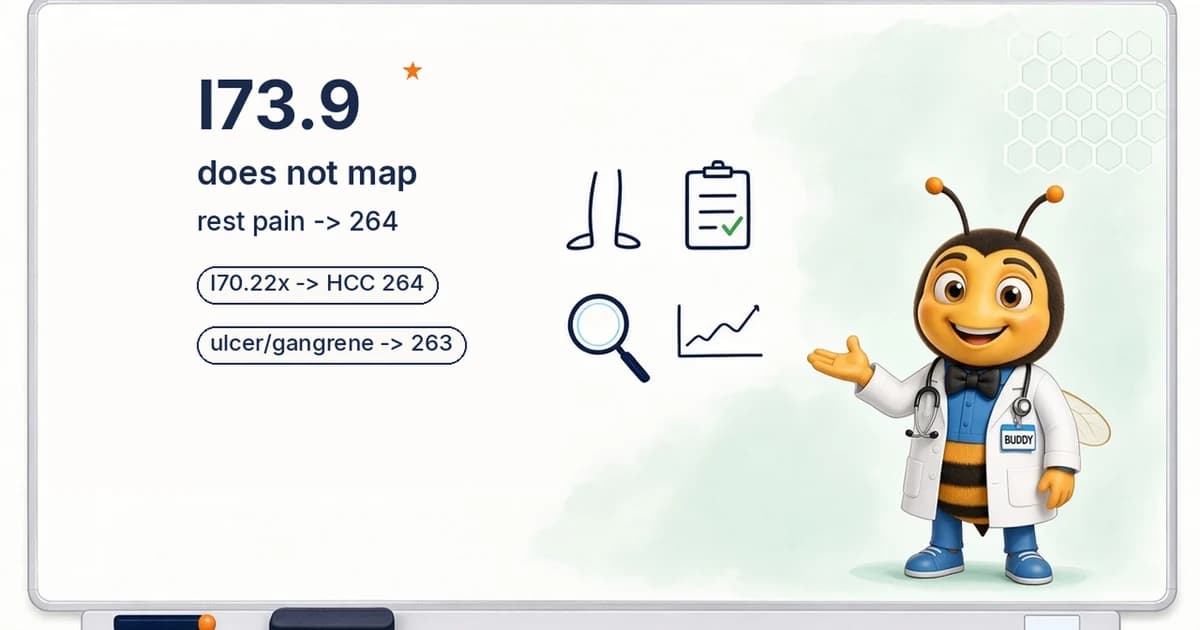
The HCC 264 hub lists 71 codes. Besides the 19 I71 codes, they include the arterial embolism and thrombosis codes in I74 and the atherosclerosis of native and bypass graft arteries of the extremities with rest pain codes in I70, such as I70.221 (Atherosclerosis of native arteries of extremities with rest pain, right leg). Aneurysm codes without rupture are not on the list.
How the Index routes aortic aneurysm
In the FY2027 Alphabetic Index, Aneurysm, aorta, aortic defaults to I71.9 (Aortic aneurysm of unspecified site, without rupture), and each site sends you to a code "without rupture" unless the subterm ruptured is there:
- thorax, thoracic, descending: I71.23, and ruptured: I71.13
- abdominal: I71.40, and ruptured: I71.30
- infrarenal, listed under the main term entry Aneurysm, abdominal (aorta): I71.43, and ruptured: I71.33
- arch: I71.22, and ruptured: I71.12
- ascending: I71.21, and ruptured: I71.11
- thoracoabdominal: I71.60, and ruptured: I71.50
Two Index details trip people up. Aneurysm, aorta, descending with no further site goes to I71.9, not I71.23, so "descending aortic aneurysm" with no mention of the chest still needs the site from the provider. And Aneurysm, aorta, dissecting says to see Dissection, aorta, which defaults to I71.00 and lists abdominal (I71.02), thoracic (I71.019), aortic arch (I71.011), ascending aorta (I71.010), descending thoracic aorta (I71.012), and thoracoabdominal (I71.03).
The Index does not list a "type A" or "type B" subterm under Dissection, aorta. Code the site the provider documents, and query if the site is not clear.
Rupture is a documentation word
The HCC turns on whether the provider documents the aneurysm as ruptured. Do not infer rupture from an imaging report, a symptom, or an emergency transfer. Section I.B.14 says "Code assignment is based on the documentation by the patient's provider". For inpatient reporting, Section III.B says abnormal findings "are not coded and reported unless the provider indicates their clinical significance." If a radiology report describes a rupture or a dissection and the provider's note does not, ask the provider. Outpatient encounters for diagnostic tests only work differently: Section IV.K says that when a physician has interpreted the test and the final report is available at the time of coding, you code any confirmed or definitive diagnosis documented in that interpretation. A finding the report only suggests is still not a diagnosis.
The same goes for the other direction. An aneurysm documented as "stable," "small," or under surveillance is still an aneurysm without rupture, and it stays in I71.2-, I71.4-, I71.6-, or I71.9 with no V28 HCC.
Lookalikes: ectasia, other aneurysms, thrombus, and manifestation codes
Aortic ectasia. The Index entry Dilatation, aorta says to see Ectasia, aorta, which goes to I77.81- (I77.810 Thoracic aortic ectasia, I77.811 Abdominal aortic ectasia, I77.819 Aortic ectasia, unspecified site). The Index adds that ectasia with aneurysm goes to Aneurysm, aorta, and I77.81 has an Excludes1 note for "aortic aneurysm and dissection (I71.-)". None of the I77.81 codes has a V28 HCC.
Iliac and other artery aneurysms. Category I72, Other aneurysm, has an Includes note for "aneurysm (cirsoid) (false) (ruptured)", so a ruptured iliac aneurysm is still I72.3 (Aneurysm of iliac artery), and the Index lists iliac aneurysm, ruptured or not, at I72.3. No I72 code has a V28 HCC. I72 also has an Excludes2 note for "aneurysm (of) aorta (I71.-)".
Aortic thrombus. Thrombosis, aorta, aortic goes to I74.10 (Embolism and thrombosis of unspecified parts of aorta), with thoracic at I74.11 and saddle at I74.01. These codes do map to HCC 264. Code them only when the provider documents aortic thrombosis or embolism as a diagnosis.
Manifestation code. I79.0 (Aneurysm of aorta in diseases classified elsewhere) has a Code first note for "underlying disease". Section I.A.13 says codes with "in diseases classified elsewhere" in the title "are never permitted to be used as first listed or principal diagnosis codes." I79.0 has no V28 HCC.
Code first notes in I71. Category I71 says to code first, if applicable, syphilitic aortic aneurysm (A52.01) and traumatic aortic aneurysm (S25.09, S35.09). This post does not cover the V28 result for those codes; check their own cards.
Repaired aneurysms and history
One search that lands on the I71.23 page is "icd 10 code for history of thoracic aortic aneurysm." The answer depends on what the provider documents.
- If the provider documents an aneurysm that is present now, code it from I71 with the site and rupture status the provider gives.
- If the provider documents that the condition was treated and no longer exists, Section IV.J says: "Do not code conditions that were previously treated and no longer exist." The same section allows history codes (categories Z80 to Z87) as secondary codes "if the historical condition or family history has an impact on current care or influences treatment." In the Index, History, personal, disease or disorder, circulatory system goes to Z86.79 (Personal history of other diseases of the circulatory system).
- If the provider documents a graft, Presence, graft, vascular NEC goes to Z95.828 (Presence of other vascular implants and grafts).
Neither Z86.79 nor Z95.828 has a V28 HCC. Whether an aneurysm is still present after a repair is a clinical call for the provider, not the coder. If the note is unclear, query.
MEAT for an aortic aneurysm or dissection code
For an I71 code, the note should support the condition at the documented site, with rupture status, not just a problem list line:
- M Monitor: the course of the aneurysm or dissection as the provider follows it over time
- E Evaluate: the imaging or exam results the provider reviewed at the visit
- A Assess: the condition named as current, with the site and whether it is ruptured or a dissection
- T Treat: a treatment the provider documents for the condition, a referral to a vascular specialist, or a documented follow-up plan
MEAT is a review mnemonic, not a universal CMS coding rule. Follow the applicable coding, encounter, program, and payer requirements. See MEAT.
Reporting rules that apply
In outpatient and office visits, Section IV.J says: "Code all documented conditions that coexist at the time of the encounter/visit and that require or affect patient care, treatment or management." Section IV.H says not to code diagnoses documented as "probable", "suspected," or with other terms of uncertainty, and to code "to the highest degree of certainty for that encounter/visit". A suspected dissection that the provider has not confirmed is not coded as a dissection.
Section I.C.21.c.4 says personal history codes "explain a patient's past medical condition that no longer exists and is not receiving any treatment". Section I.C.21.c.3 says "A status code is distinct from a history code."
Audit and query traps
1. Expecting HCC 264 for I71.23, I71.43, or any other aneurysm code without rupture. Only dissection and ruptured codes in I71 map.
2. Picking a ruptured code from an imaging report, a symptom, or a transfer note without the provider documenting rupture.
3. Coding "descending aortic aneurysm" as I71.23 when the provider does not say thoracic. The Index sends descending with no site to I71.9.
4. Coding a dissection as an aneurysm, or the reverse. The Index sends Aneurysm, aorta, dissecting to Dissection, aorta.
5. Coding a ruptured iliac aneurysm in I71. Iliac aneurysms, ruptured or not, are I72.3.
6. Coding aortic ectasia or dilatation as an aneurysm without the provider documenting an aneurysm.
7. Carrying an I71 code forward after the provider documents that the aneurysm was repaired and no longer exists.
8. Coding I79.0 first or alone. It is a manifestation code.
9. Using a CNA reference as a member RAF total, or forgetting that HCC 263 supersedes HCC 264.
10. Inventing Coding Clinic quotes, competitor comparisons, or PHI examples.
Two-minute check
1. Is it an aneurysm, a dissection, ectasia, or thrombosis, in the provider's words?
2. Which segment of the aorta? Thoracic (ascending, arch, descending), abdominal (pararenal, juxtarenal, infrarenal), thoracoabdominal, or unspecified?
3. Does the provider document rupture? If not, it is "without rupture."
4. Expect HCC 264 for dissection, ruptured aneurysm, and aortic embolism or thrombosis codes. Expect no V28 HCC for I71.2-, I71.4-, I71.6-, I71.9, I72.-, I77.81-, I79.0, Z86.79, or Z95.828.
5. Is the aneurysm current, or documented as repaired and gone?
6. Confirm the map on the live card and the CSV row. Confirm MEAT for this year.
Related desks and tools
- Live cards: I71.23, I71.13, I71.33, I71.43, I71.012, I71.03, I71.9, I72.3, I74.10, I77.810, Z95.828
- Hub: HCC 264
- Lookup: ICD-10 to HCC, Encoder
- Evidence habits: MEAT, Excludes1 vs Excludes2, provider query templates, acute vs history of, problem lists
- Nearby: PAD desk, codes that do not map, FY2027 code changes
Sources
- Live HCC Buddy ICD-10-CM cards (FY2027 Tabular display) and the V28 HCC 264 hub, fetched October 29, 2026
- FY2026 and FY2027 ICD-10-CM order file billable flags, the FY2026 and FY2027 Tabular, the FY2027 Alphabetic Index, and the FY2027 Tabular and Index addenda
- CMS, FY2027 ICD-10-CM Official Guidelines for Coding and Reporting, Sections I.A.13, I.B.14, I.C.21.c.3, I.C.21.c.4, III.B, IV.H, and IV.J
- PY2026 V28 mapping, hierarchy, and relative factor files on HCC Buddy main
- CMS, ICD-10 codes (FY2027 ICD-10-CM code files and addendum, effective October 1, 2026)
- CMS, 2026 Model Software/ICD-10 Mappings (PY2026 V28 mappings, hierarchies, relative factors, and the 2026 Final ICD-10-CM Mappings)
- CMS, 2027 Model Software/ICD-10 Mappings (2027 Initial ICD-10-CM Mappings, payment year 2027, 2026 dates of service, shown on the live cards)
V28 mappings come from the cited live code pages and the PY2026 V28 CSV. Coefficients are source-labeled references, not member totals. Not medical advice. Not a Coding Clinic reprint.
Current as of October 29, 2026. Always confirm the PY2026 V28 CSV and the live code card before you lock a map claim.
Frequently asked questions
Does I71.23 map to an HCC in V28?
No. I71.23, Aneurysm of the descending thoracic aorta, without rupture, has no row in the PY2026 V28 CSV, the V28 column of the CMS 2027 Initial ICD-10-CM Mappings is blank for it, and the live card reads No V28 HCC for 2026 dates of service.
Does a ruptured thoracic aortic aneurysm map to an HCC in V28?
Yes. I71.10, I71.11, I71.12, and I71.13, the ruptured thoracic aortic aneurysm codes, each have one row in the PY2026 V28 CSV pointing to CC 264, and the live cards show HCC 264, Vascular Disease with Complications, with a CNA reference of 0.455.
Does an infrarenal abdominal aortic aneurysm map to an HCC?
Only when it is ruptured. I71.33, Infrarenal abdominal aortic aneurysm, ruptured, maps to V28 HCC 264. I71.43, Infrarenal abdominal aortic aneurysm, without rupture, has no V28 HCC.
Does aortic dissection map to an HCC in V28?
Yes. All seven billable dissection codes in I71.0, from I71.00 to I71.03, map to V28 HCC 264. In the Index, Aneurysm, aorta, dissecting says to see Dissection, aorta.
What code is used for a history of thoracic aortic aneurysm?
It depends on the provider's documentation. A current aneurysm is coded from I71. If the provider documents that it was treated and no longer exists, Section IV.J says not to code it, and history codes may be used as secondary codes when the history affects current care. The Index sends a personal history of a circulatory disease to Z86.79 and a vascular graft to Z95.828. Neither has a V28 HCC.
What if the note says descending aortic aneurysm without saying thoracic?
In the FY2027 Index, Aneurysm, aorta, descending with no further site goes to I71.9, Aortic aneurysm of unspecified site, without rupture. Descending thoracic goes to I71.23. Ask the provider for the site rather than picking one.
Did anything change for aortic aneurysm codes in FY2027?
No. The I71 codes, descriptors, and Tabular notes are the same in the FY2026 and FY2027 files, and the FY2027 Tabular and Index addenda have no entries for them.
Related Tools
I71.23 card
Aneurysm of the descending thoracic aorta, without rupture. Billable. No V28 HCC for 2026 dates of service.
I71.13 card
Aneurysm of the descending thoracic aorta, ruptured. Billable. V28 HCC 264.
I71.33 card
Infrarenal abdominal aortic aneurysm, ruptured. Billable. V28 HCC 264.
I71.43 card
Infrarenal abdominal aortic aneurysm, without rupture. Billable. No V28 HCC for 2026 dates of service.
I71.012 card
Dissection of descending thoracic aorta. Billable. V28 HCC 264.
I71.03 card
Dissection of thoracoabdominal aorta. Billable. V28 HCC 264.
I71.9 card
Aortic aneurysm of unspecified site, without rupture. Billable. No V28 HCC for 2026 dates of service.
I72.3 card
Aneurysm of iliac artery. Billable. No V28 HCC for 2026 dates of service.
I74.10 card
Embolism and thrombosis of unspecified parts of aorta. Billable. V28 HCC 264.
I77.810 card
Thoracic aortic ectasia. Billable. No V28 HCC for 2026 dates of service.
HCC 264 hub
Vascular Disease with Complications. CNA ref 0.455. 71 mapped codes, including 19 in I71.
ICD-10 to HCC
Look up one diagnosis against the current V28 map.
Encoder
Look up I71 aortic aneurysm and dissection codes with live V28 status.

HCC Buddy Coding Team
Editorial
Every HCC Buddy article is checked against the current CMS-HCC model and the active FY ICD-10-CM tabular release before it publishes.
Get HCC Coding Tips in Your Inbox
Join our newsletter for coding tips, guideline updates, and tool announcements.