
H35.3211 Wet AMD Maps to V28 HCC 300: Eye, Stage, and Dry AMD Codes
H35.3211, wet AMD of the right eye with active CNV, maps to CMS-HCC V28 HCC 300. All 16 H35.32 codes map; dry AMD (H35.31) and H35.30 do not.
By the HCC Buddy Coding Team
Updated: October 28, 2026
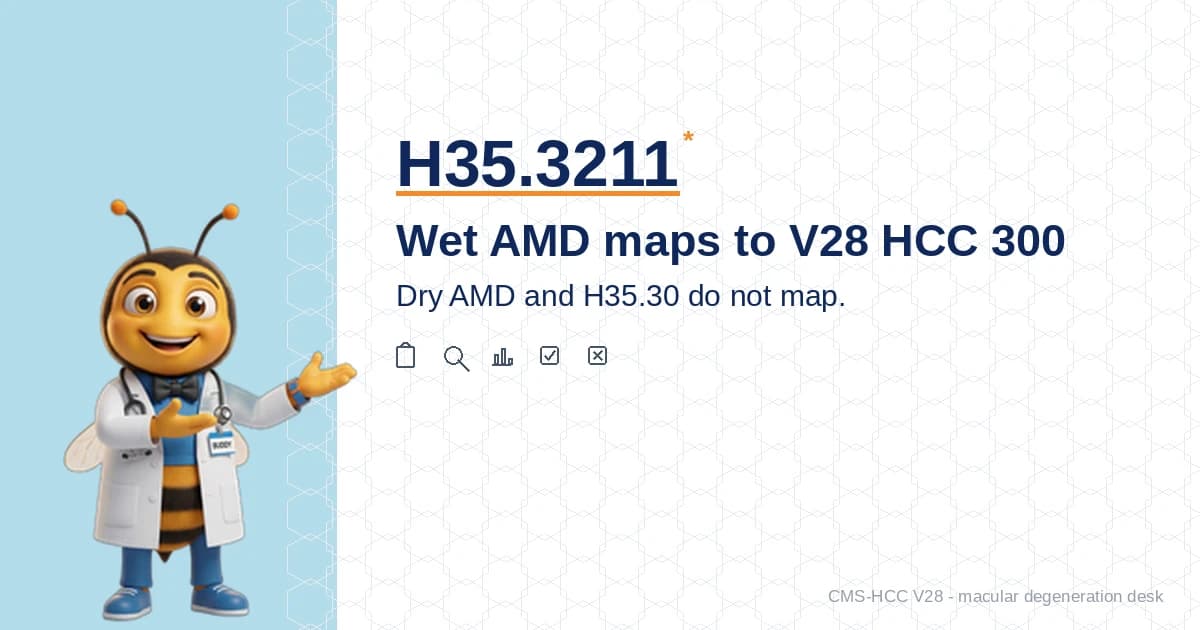
If you searched H35.3211, "neovascular AMD with active CNV OD," or "wet AMD right eye ICD-10," here is the short answer. H35.3211 (Exudative age-related macular degeneration, right eye, with active choroidal neovascularization) is a billable code that maps to CMS-HCC V28 HCC 300 (Exudative Macular Degeneration). The PY2026 V28 CSV on HCC Buddy main carries two rows for it, both pointing to HCC 300, the V28 column of the CMS 2027 Initial ICD-10-CM Mappings (payment year 2027, 2026 dates of service) lists 300, and the live card reads HCC 300 : Exudative Macular Degeneration, with a community non-dual aged (CNA) reference of 0.596.
The same is true for every billable code in subcategory H35.32. All 16 wet AMD codes map to HCC 300, whatever the eye and whatever the stage, including the unspecified eye and stage unspecified codes. The dry AMD codes in H35.31 and H35.30 (Unspecified macular degeneration) have no V28 HCC. So the word that decides the HCC is "wet" or "exudative," not the eye or the stage.
The H35.3 codes, descriptors, seventh characters, and Tabular notes are the same in the FY2026 and FY2027 files, and the FY2027 Tabular and Index addenda have no entries for them.
Desk table: H35.3211 and the codes around it
| Code | Official descriptor | V28 result | CSV (no decimal) |
|---|---|---|---|
| H35.30 | Unspecified macular degeneration | Does not map | no CSV row |
| H35.31 | Nonexudative age-related macular degeneration | Nonbillable heading | no CSV row |
| H35.3110 | Nonexudative age-related macular degeneration, right eye, stage unspecified | Does not map | no CSV row |
| H35.3111 | Nonexudative age-related macular degeneration, right eye, early dry stage | Does not map | no CSV row |
| H35.3112 | Nonexudative age-related macular degeneration, right eye, intermediate dry stage | Does not map | no CSV row |
| H35.3113 | Nonexudative age-related macular degeneration, right eye, advanced atrophic without subfoveal involvement | Does not map | no CSV row |
| H35.3114 | Nonexudative age-related macular degeneration, right eye, advanced atrophic with subfoveal involvement | Does not map | no CSV row |
| H35.3130 | Nonexudative age-related macular degeneration, bilateral, stage unspecified | Does not map | no CSV row |
| H35.3134 | Nonexudative age-related macular degeneration, bilateral, advanced atrophic with subfoveal involvement | Does not map | no CSV row |
| H35.32 | Exudative age-related macular degeneration | Nonbillable heading | no CSV row |
| H35.3210 | Exudative age-related macular degeneration, right eye, stage unspecified | HCC 300 | 2 rows, CC 300.0 |
| H35.3211 | Exudative age-related macular degeneration, right eye, with active choroidal neovascularization | HCC 300 | 2 rows, CC 300.0 |
| H35.3212 | Exudative age-related macular degeneration, right eye, with inactive choroidal neovascularization | HCC 300 | 2 rows, CC 300.0 |
| H35.3213 | Exudative age-related macular degeneration, right eye, with inactive scar | HCC 300 | 2 rows, CC 300.0 |
| H35.3220 | Exudative age-related macular degeneration, left eye, stage unspecified | HCC 300 | 2 rows, CC 300.0 |
| H35.3221 | Exudative age-related macular degeneration, left eye, with active choroidal neovascularization | HCC 300 | 2 rows, CC 300.0 |
| H35.3222 | Exudative age-related macular degeneration, left eye, with inactive choroidal neovascularization | HCC 300 | 2 rows, CC 300.0 |
| H35.3223 | Exudative age-related macular degeneration, left eye, with inactive scar | HCC 300 | 2 rows, CC 300.0 |
| H35.3230 | Exudative age-related macular degeneration, bilateral, stage unspecified | HCC 300 | 2 rows, CC 300.0 |
| H35.3231 | Exudative age-related macular degeneration, bilateral, with active choroidal neovascularization | HCC 300 | 2 rows, CC 300.0 |
| H35.3232 | Exudative age-related macular degeneration, bilateral, with inactive choroidal neovascularization | HCC 300 | 2 rows, CC 300.0 |
| H35.3233 | Exudative age-related macular degeneration, bilateral, with inactive scar | HCC 300 | 2 rows, CC 300.0 |
| H35.3290 | Exudative age-related macular degeneration, unspecified eye, stage unspecified | HCC 300 | 2 rows, CC 300.0 |
| H35.3291 | Exudative age-related macular degeneration, unspecified eye, with active choroidal neovascularization | HCC 300 | 2 rows, CC 300.0 |
| H35.3292 | Exudative age-related macular degeneration, unspecified eye, with inactive choroidal neovascularization | HCC 300 | 2 rows, CC 300.0 |
| H35.3293 | Exudative age-related macular degeneration, unspecified eye, with inactive scar | HCC 300 | 2 rows, CC 300.0 |
| H35.051 | Retinal neovascularization, unspecified, right eye | Does not map | no CSV row |
| H31.011 | Macula scars of posterior pole (postinflammatory) (post-traumatic), right eye | Does not map | no CSV row |
| H35.33 | Angioid streaks of macula | Does not map | no CSV row |
| H35.361 | Drusen (degenerative) of macula, right eye | Does not map | no CSV row |
The left eye, bilateral, and unspecified eye dry AMD codes (H35.312-, H35.313-, H35.319-) follow the same pattern as the right eye rows above: the CSV has no H35.31 row at all.
The two CSV rows and the age condition
Each wet AMD code appears twice in the CSV. For H35.3211 the rows are:
- `H353211,300.0,age >= 15,age >= 21,`
- `H353211,300.0,age >= 15,age < 21,`
The columns are ICD10, CC, MCE_AGE_CONDITION, AGE_EDIT_CONDITION, and SEX_EDIT_CONDITION. Both rows point to CC 300, so the age edit split does not change the category. The MCE age condition of "age >= 15" is a Medicare Code Editor age criterion. In the CMS V28 Python software on HCC Buddy main, the switch_edits setting is described as indicating "the use of MCE (Medicare Code Editor) age criteria when performing the ICD-10 mappings", and it is set to True by default. The live card says the same thing in plain words: "This code has a CMS age requirement: applies when age >= 15".
CNA references from the PY2026 V28 relative factors: HCC 300 0.596, and in the COMMUNITY_ND column of the same file, 0.366. These are community segment values, not member totals, and the segment a member is scored in depends on that member's enrollment data.
In the V28 hierarchy file, `HCC300,,,,,,` shows HCC 300 supersedes nothing, and no other row lists HCC 300 as a secondary HCC. Wet AMD does not drop out because of another HCC, and it does not push one out.
What the seventh character means
Subcategory H35.32 says: "One of the following 7th characters is to be assigned to codes in subcategory H35.32 to designate the stage of the disease:"
- 0 stage unspecified
- 1 with active choroidal neovascularization
- 2 with inactive choroidal neovascularization, which also covers "with involuted or regressed neovascularization"
- 3 with inactive scar
The sixth character gives the eye: 1 for the right eye, 2 for the left eye, 3 for bilateral, and 9 for the unspecified eye. So H35.3211 reads as wet AMD, right eye, active choroidal neovascularization.
In V28, the stage and the eye do not change the HCC. They still matter, because the code has to match the record. Pick the stage the provider documents for that visit. Do not infer active or inactive disease from a treatment schedule or from an older note.
Dry AMD uses its own set of seventh characters in H35.31: 0 stage unspecified, 1 early dry stage, 2 intermediate dry stage, 3 advanced atrophic without subfoveal involvement (the Tabular adds "advanced dry stage" under it), and 4 advanced atrophic with subfoveal involvement. None of those codes has a V28 row.
Laterality: what the guideline says
Section I.B.13 of the FY2027 guidelines covers this. It says: "If the side is not identified in the medical record, assign the code for the unspecified side." It also says: "When laterality is not documented by the patient's provider, code assignment for the affected side may be based on medical record documentation from other clinicians." And when the record conflicts: "If there is conflicting medical record documentation regarding the affected side, the patient's provider should be queried for clarification."
The unspecified eye codes, H35.3290 to H35.3293, still map to HCC 300. That is not a reason to use them. The same section says: "Codes for "unspecified" side should rarely be used, such as when the documentation in the record is insufficient to determine the affected side and it is not possible to obtain clarification."
How the Index routes macular degeneration
In the FY2027 Alphabetic Index, the main term Degeneration, macula, macular carries the nonessential modifiers acquired, age-related, and senile, and defaults to H35.30. The H35.30 Tabular entry lists "Age-related macular degeneration" as an inclusion term. So "AMD" or "ARMD" with no type documented lands on H35.30, which has no V28 HCC. The subterms do the work:
- exudative and wet age-related: H35.32- (HCC 300)
- nonexudative, dry age-related, and atrophic age-related: H35.31- (no V28 HCC)
- drusen: H35.36- (no V28 HCC)
- angioid streaks: H35.33 (no V28 HCC)
The Index also sends Kuhnt-Junius degeneration to H35.32-. The Tabular inclusion terms match the Index: H35.32 lists "Wet age-related macular degeneration", and H35.31 lists "Atrophic age-related macular degeneration" and "Dry age-related macular degeneration".
If the note says only "macular degeneration" or "AMD" and the rest of the record suggests a type, the type has to come from the provider. Ask rather than pick.
Two lookalikes: neovascularization and macular scar
Choroidal neovascularization is part of the H35.32 code title, as the seventh character 1 or 2. Under the main term Neovascularization, the Index lists retina at H35.05- (for example H35.051, Retinal neovascularization, unspecified, right eye), which has no V28 HCC. If a note describes neovascularization without naming exudative AMD, do not assume H35.32-. Follow the Index for the condition the provider documents, or query.
Inactive scar is the seventh character 3 in H35.32, and it stays in HCC 300. A macular scar that is not documented as wet AMD is a different code. The Index entry Scar, macula says to see Scar, chorioretinal, posterior pole, which is H31.01- (for example H31.011, Macula scars of posterior pole (postinflammatory) (post-traumatic), right eye), with no V28 HCC. Read what the provider says the scar is from.
Wet AMD and diabetic eye disease
Category H35 carries an Excludes2 note for "diabetic retinal disorders (E08.311-E08.359, E09.311-E09.359, E10.311-E10.359, E11.311-E11.359, E13.311-E13.359)". The Tabular defines Excludes2 this way: "When an Excludes2 note appears under a code it is acceptable to use both the code and the excluded code together." So a patient can have both wet AMD and a diabetic retinal disorder, and each is coded when the provider documents it.
The diabetic codes carry their own V28 results. For example, E11.3311 (Type 2 diabetes mellitus with moderate nonproliferative diabetic retinopathy with macular edema, right eye) has two CSV rows, `E113311,37.0,,,` and `E113311,298.0,,,`, so it maps to HCC 37 and HCC 298 (Severe Diabetic Eye Disease, Retinal Vein Occlusion, and Vitreous Hemorrhage, CNA reference 0.336). The hierarchy row `HCC298,,,,,,` shows HCC 298 supersedes nothing, and no row lists HCC 298 or HCC 300 under the other. Macular edema from diabetes is not wet AMD. Code what the provider documents. See the diabetes guide.
The codes that map to HCC 300
The HCC 300 hub lists 16 codes, and they are exactly the 16 billable H35.32 codes in the table: four eyes (right, left, bilateral, unspecified) times four stages (unspecified, active choroidal neovascularization, inactive choroidal neovascularization, inactive scar). No other code in the PY2026 V28 CSV maps to HCC 300.
In the CMS 2026 Final and 2027 Initial ICD-10-CM Mappings, the same 16 codes carry category 124 in the ESRD V21, ESRD V24, and CMS-HCC V22 columns, and 300 in the CMS-HCC V28 column. The H35.30 and H35.31 codes are not in that file. This post covers the CMS-HCC V28 result only.
MEAT for a wet AMD code
For an H35.32 code, the note should support wet AMD in the documented eye and stage, not just a history line:
- M Monitor: the course of the condition in each eye, as the provider follows it over time
- E Evaluate: the exam or imaging results the provider reviewed at the visit
- A Assess: wet or exudative AMD named as current, with the eye and the stage
- T Treat: a treatment the provider documents for the condition, a referral to an eye specialist, or a documented follow-up plan
MEAT is a review mnemonic, not a universal CMS coding rule. Follow the applicable coding, encounter, program, and payer requirements. See MEAT.
Reporting rules that apply
In outpatient and office visits, Section IV.J says: "Code all documented conditions that coexist at the time of the encounter/visit and that require or affect patient care, treatment or management." It also says: "Do not code conditions that were previously treated and no longer exist." Section IV.H says not to code diagnoses documented as "probable", "suspected," or with other terms of uncertainty, and to code "to the highest degree of certainty for that encounter/visit". For inpatient reporting, Section III.B says abnormal findings "are not coded and reported unless the provider indicates their clinical significance." An imaging report on its own is not the same as a documented diagnosis.
Section I.B.14 adds: "Code assignment is based on the documentation by the patient's provider". Laterality is one of the listed exceptions where other clinicians' documentation may be used.
Audit and query traps
1. Coding H35.30 or a dry AMD code and expecting HCC 300. Only H35.32 codes map.
2. Moving "AMD" to an H35.32 code without the provider documenting wet or exudative disease.
3. Using an unspecified eye code when the record names the eye, or picking an eye when the record conflicts instead of querying.
4. Choosing the active or inactive seventh character from a treatment schedule or an old note instead of the provider's statement for this visit.
5. Coding a macular scar as H35.32- with seventh character 3 when the provider does not tie it to wet AMD, or coding H31.01- when the provider documents wet AMD with inactive scar.
6. Coding neovascularization without AMD as H35.32-.
7. Dropping a documented diabetic retinal disorder because wet AMD is coded, or the reverse. The H35 Excludes2 note allows both.
8. Coding a diagnosis from an imaging report alone without provider documentation.
9. Using a CNA reference as a member RAF total.
10. Inventing Coding Clinic quotes, competitor comparisons, or PHI examples.
Two-minute check
1. Does the provider call it wet, exudative, dry, nonexudative, atrophic, or only "macular degeneration"?
2. Which eye or eyes? If the record conflicts, query.
3. What stage does the provider document for this visit?
4. Expect HCC 300 for any H35.32 code. Expect no V28 HCC for H35.30, H35.31-, H35.33, H35.36-, H35.05-, or H31.01-.
5. If diabetic eye disease is documented too, code it from E08 to E13 and check its own V28 result.
6. Confirm the map on the live card and the CSV row. Confirm MEAT for this year.
Related desks and tools
- Live cards: H35.3211, H35.3221, H35.3231, H35.3223, H35.3210, H35.3290, H35.30, H35.3110, H35.3114, H31.011, E11.3311
- Hubs: HCC 300, HCC 298
- Lookup: ICD-10 to HCC, Encoder
- Evidence habits: MEAT, Excludes1 vs Excludes2, provider query templates, hierarchy and trumping, problem lists
- Nearby: codes that do not map, diabetes guide, FY2027 code changes
Sources
- Live HCC Buddy ICD-10-CM cards (FY2027 Tabular display) and the V28 HCC 298 and 300 hubs, fetched October 28, 2026
- FY2026 and FY2027 ICD-10-CM order file billable flags, the FY2026 and FY2027 Tabular, the FY2027 Alphabetic Index, and the FY2027 Tabular and Index addenda
- CMS, FY2027 ICD-10-CM Official Guidelines for Coding and Reporting, Sections I.B.13, I.B.14, III.B, IV.H, and IV.J
- PY2026 V28 mapping, hierarchy, and relative factor files, and the CMS V28 Python software package, on HCC Buddy main
- CMS, ICD-10 codes (FY2027 ICD-10-CM code files and addendum, effective October 1, 2026)
- CMS, 2026 Model Software/ICD-10 Mappings (PY2026 V28 mappings, hierarchies, relative factors, software, and the 2026 Final ICD-10-CM Mappings)
- CMS, 2027 Model Software/ICD-10 Mappings (2027 Initial ICD-10-CM Mappings, payment year 2027, 2026 dates of service, shown on the live cards)
V28 mappings come from the cited live code pages and the PY2026 V28 CSV. Coefficients are source-labeled references, not member totals. Not medical advice. Not a Coding Clinic reprint.
Current as of October 28, 2026. Always confirm the PY2026 V28 CSV and the live code card before you lock a map claim.
Frequently asked questions
Does H35.3211 map to an HCC in V28?
Yes. H35.3211, Exudative age-related macular degeneration, right eye, with active choroidal neovascularization, maps to CMS-HCC V28 HCC 300, Exudative Macular Degeneration. The PY2026 V28 CSV has two rows for it, both to CC 300, and the live card shows HCC 300 with a CNA reference of 0.596.
Does dry macular degeneration map to an HCC?
No. None of the H35.31 nonexudative (dry) AMD codes has a row in the PY2026 V28 CSV, and H35.30, Unspecified macular degeneration, has no row either. Only the 16 billable H35.32 exudative (wet) AMD codes map, all to HCC 300.
Does the eye or the stage change the HCC?
No. All four eyes (right, left, bilateral, unspecified) and all four stages (stage unspecified, active choroidal neovascularization, inactive choroidal neovascularization, inactive scar) map to HCC 300. The code still has to match what the provider documents.
What code is AMD with no type documented?
In the FY2027 Index, Degeneration, macula, with the nonessential modifier age-related, defaults to H35.30, and the H35.30 Tabular entry lists Age-related macular degeneration as an inclusion term. H35.30 has no V28 HCC. Wet or exudative goes to H35.32-, and dry, nonexudative, or atrophic goes to H35.31-.
What if the eye is not documented?
Section I.B.13 says to assign the code for the unspecified side if the side is not identified, that laterality may come from other clinicians' documentation, and that conflicting documentation should be queried. It also says unspecified side codes should rarely be used.
Can wet AMD and diabetic retinopathy be coded together?
Yes, when the provider documents both. Category H35 has an Excludes2 note for diabetic retinal disorders, and the Tabular says an Excludes2 note means it is acceptable to use both codes together. The diabetic codes have their own V28 results, for example E11.3311 maps to HCC 37 and HCC 298.
Did anything change for macular degeneration codes in FY2027?
No. The H35.3 codes, descriptors, seventh characters, and Tabular notes are the same in the FY2026 and FY2027 files, and the FY2027 Tabular and Index addenda have no entries for them.
Related Tools
H35.3211 card
Exudative age-related macular degeneration, right eye, with active choroidal neovascularization. Billable. V28 HCC 300.
H35.3221 card
Wet AMD, left eye, with active choroidal neovascularization. Billable. V28 HCC 300.
H35.3231 card
Wet AMD, bilateral, with active choroidal neovascularization. Billable. V28 HCC 300.
H35.3223 card
Wet AMD, left eye, with inactive scar. Billable. V28 HCC 300.
H35.3290 card
Wet AMD, unspecified eye, stage unspecified. Billable. V28 HCC 300.
H35.30 card
Unspecified macular degeneration (includes age-related macular degeneration). Billable. No V28 HCC for 2026 dates of service.
H35.3110 card
Dry AMD, right eye, stage unspecified. Billable. No V28 HCC for 2026 dates of service.
H31.011 card
Macula scars of posterior pole, right eye. Billable. No V28 HCC.
HCC 300 hub
Exudative Macular Degeneration. CNA ref 0.596. 16 mapped codes, all in H35.32.
HCC 298 hub
Severe Diabetic Eye Disease, Retinal Vein Occlusion, and Vitreous Hemorrhage. CNA ref 0.336.
ICD-10 to HCC
Look up one diagnosis against the current V28 map.
Encoder
Look up H35.3 macular degeneration codes with live V28 status.

HCC Buddy Coding Team
Editorial
Every HCC Buddy article is checked against the current CMS-HCC model and the active FY ICD-10-CM tabular release before it publishes.
Get HCC Coding Tips in Your Inbox
Join our newsletter for coding tips, guideline updates, and tool announcements.