
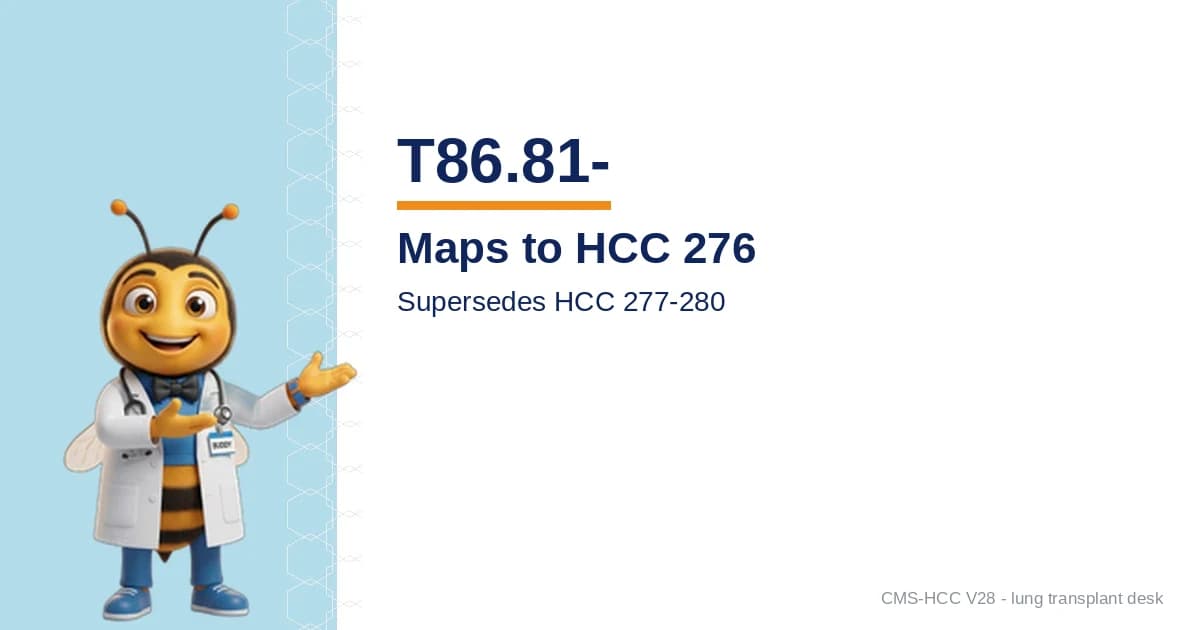
T86.81- Lung Transplant Complications Map to HCC 276 in V28. HCC 276 Supersedes 277-280.
T86.810-T86.819, Z94.2, and Z48.24 map to V28 HCC 276 (CNA 2.531). T86.81 is nonbillable; HCC 276 supersedes respiratory HCCs 277-280.
By the HCC Buddy Coding Team
Updated: October 14, 2026
If you searched T86.810, lung transplant rejection, additional code, or Z94.2 next to V28, you are looking at a transplant cluster where every billable lung-transplant leaf lands in one V28 category, and that category sits above four respiratory HCCs in the hierarchy.
The T86.81 heading (Complications of lung transplant) is a nonbillable heading. Its five billable leaves all map to HCC 276 (Lung Transplant Status/Complications) on the live cards: T86.810 rejection, T86.811 failure, T86.812 infection, T86.818 other complications, and T86.819 unspecified complication. Each shows a community non-dual aged reference of 2.531. Z94.2 (Lung transplant status) and Z48.24 (Encounter for aftercare following lung transplant) map to the same category.
The live HCC 276 hub lists 17 ICD-10-CM codes for this category. The category reference is not a member RAF total.
In the V28 hierarchy, HCC 276 supersedes HCC 277 (Cystic Fibrosis), HCC 278 (Idiopathic Pulmonary Fibrosis and Lung Involvement in Systemic Sclerosis), HCC 279 (Severe Persistent Asthma), and HCC 280 (COPD, Interstitial Lung Disorders, and Other Chronic Lung Disorders). Nothing supersedes HCC 276.
As of October 14, 2026, the public ICD leaf cards default to the FY2027 ICD-10-CM edition and read the V28 result from the CMS 2027 Initial ICD-10-CM Mappings (payment year 2027, 2026 dates of service). For every code mapped in this desk, that card result agrees with the PY2026 V28 CSV and the live HCC hubs.
This page is the coder-desk walk for lung transplant complications under CMS-HCC V28. It does not rewrite the T86.41 liver transplant rejection desk, the T86.85- intestine transplant desk, or the stem cell desks (D89.81- GVHD, M31.11 HSCT-TMA); link those when the transplanted organ is the liver or intestine, or the graft is stem cells or bone marrow. For J44.81 bronchiolitis obliterans / BOS under COPD, see the J44.89 asthma-COPD overlap desk and the COPD guide. Link only; this desk owns the transplant leaf.
Desk table: verified maps (2026-10-14)
| Code | Official descriptor | V28 result | Coeff ref | CSV (no decimal) |
|---|---|---|---|---|
| T86.81 | Complications of lung transplant | Nonbillable heading | - | no CSV row |
| T86.810 | Lung transplant rejection | HCC 276 | 2.531 | `T86810,276.0,,,` |
| T86.811 | Lung transplant failure | HCC 276 | 2.531 | `T86811,276.0,,,` |
| T86.812 | Lung transplant infection | HCC 276 | 2.531 | `T86812,276.0,,,` |
| T86.818 | Other complications of lung transplant | HCC 276 | 2.531 | `T86818,276.0,,,` |
| T86.819 | Unspecified complication of lung transplant | HCC 276 | 2.531 | `T86819,276.0,,,` |
| Z94.2 | Lung transplant status | HCC 276 | 2.531 | `Z942,276.0,,,` |
| Z48.24 | Encounter for aftercare following lung transplant | HCC 276 | 2.531 | `Z4824,276.0,,,` |
| J4A.0 | Restrictive allograft syndrome | HCC 276 | 2.531 | `J4A0,276.0,,,` |
| J4A.8 | Other chronic lung allograft dysfunction | HCC 276 | 2.531 | `J4A8,276.0,,,` |
| J4A.9 | Chronic lung allograft dysfunction, unspecified | HCC 276 | 2.531 | `J4A9,276.0,,,` |
| J44.9 | Chronic obstructive pulmonary disease, unspecified | HCC 280, age 18 or older (superseded by 276) | 0.319 | `J449,280.0,,age >= 18,` |
| J44.81 | Bronchiolitis obliterans and bronchiolitis obliterans syndrome | HCC 280, age 18 or older (superseded by 276) | 0.319 | `J4481,280.0,,age >= 18,` |
| T86.31 | Heart-lung transplant rejection | HCC 221 and HCC 276 | 1.053 / 2.531 | `T8631,221.0,,,` + `T8631,276.0,,,` |
| C80.2 | Malignant neoplasm associated with transplanted organ | HCC 23 | 0.186 | `C802,23.0,,,` |
| D47.Z1 | Post-transplant lymphoproliferative disorder (PTLD) | HCC 21 | 0.671 | `D47Z1,21.0,,,` |
Coeff refs are the community non-dual aged references shown on the live cards and hubs. Not member totals. Segment coefficients vary. The J44 rows are hierarchy examples, not a full list of HCC 280 codes; confirm any other code on its own card. In the V28 CSV both J44 rows carry an `age >= 18` edit, so they map to HCC 280 only for beneficiaries age 18 or older; the HCC 276 rows have no age edit. J4A.- rows are companion CLAD codes that also live in HCC 276; they are not a substitute for a documented T86.81- leaf.
The T86.81, T86.8, T86.3, and Z48.2 headings are nonbillable. Report a leaf. None of the T86.81- leaves, Z94.2, or Z48.24 takes a 7th character.
Pick the T86.81- leaf from the documentation
All five billable leaves map to HCC 276. Specificity still matters for the claim and the record:
- T86.810 when the provider documents lung transplant rejection.
- T86.811 when the provider documents lung transplant failure.
- T86.812 when the provider documents an infection of the lung transplant.
- T86.818 when the provider documents another named complication of the lung transplant.
- T86.819 when a complication of the lung transplant is documented without more detail.
A transplant complication code needs the provider to document the complication and its link to the transplant, and the complication must affect the function of the transplanted organ. The FY2027 ICD-10-CM Official Guidelines (Section I.C.19.g.3.a) say a transplant complication code "is only assigned if the complication affects the function of the transplanted organ," and that pre-existing conditions or conditions that develop after the transplant "are not coded as complications unless they affect the function of the transplanted organs." A condition in a transplant recipient is not automatically a transplant complication. When the record suggests a link but the assessment does not state it, a compliant provider query is the fix. See provider query templates.
Heart-lung is a different subcategory. T86.81 carries Excludes1: complication of heart-lung transplant (T86.3-). When the provider documents a heart-lung transplant complication, use a T86.3- leaf (for example T86.31), not a T86.81- leaf. Those heart-lung leaves dual-map to HCC 221 and HCC 276 on the live cards and in the CSV. That dual map is the contrast only; this desk does not walk every T86.3- path.
Use additional code: the condition resulting from the complication
Many searches that reach the lung transplant cards ask about "additional code" / "required". The note comes from the T80-T88 section and is inherited by every T86.81- leaf: use additional code(s) "to identify the specified condition resulting from the complication". The same section also asks for a code for an adverse drug effect, if applicable (T36-T50 with fifth or sixth character 5), and a code for devices involved and details of circumstances (Y62-Y82).
The same guideline section says "two codes are required to fully describe a transplant complication: the appropriate code from category T86 and a secondary code that identifies the complication." Do not stop at the T86.81- leaf when the complication can be identified.
In practice:
1. T86.81- leaf first for the documented lung transplant complication, with the sepsis exception below.
2. Then the secondary code that identifies the complication. Assign it whenever the guideline's two-code rule applies. Find that code through the Alphabetic Index and the Tabular. This desk does not pick it for you.
3. Then any adverse effect or device and circumstance codes the notes call for, when they apply.
Sepsis exception. The transplant guideline points to Section I.C.1.d.4 for sequencing of sepsis due to infection in a transplanted organ. Under I.C.1.d.4, when the reason for admission is sepsis or severe sepsis and a localized infection, the code(s) for the underlying systemic infection are assigned first and the localized infection code is secondary. Do not automatically put T86.812 first in that case.
For T86.812, the card also carries code to specify infection. Add the documented organism or infection code the Index supports. Check that companion on its own card for V28 status.
Chronic lung allograft dysfunction (J4A.-) and J44.81
J4A.0, J4A.8, and J4A.9 (chronic lung allograft dysfunction / restrictive allograft syndrome) also map to HCC 276. The J4A category carries Code first notes for lung transplant rejection (T86.810), other complications of lung transplant (T86.818), and the matching heart-lung leaves, plus Code also bronchiolitis obliterans syndrome (J44.81) when applicable.
J44.81 itself maps to HCC 280 (age 18 or older), not HCC 276, and its card carries Code first notes that name T86.810 and T86.818. When both a mapped HCC 276 code and J44.81 appear in the same year, HCC 276 supersedes HCC 280. Still report every condition the provider documents. For the COPD / BOS leaf walk, use the J44.89 desk. Do not treat this page as a rewrite of that desk.
Other transplant complications the T86 note names
The T86 category note on every T86.81- card also says to code other transplant complications, such as graft-versus-host disease (D89.81-), malignancy associated with organ transplant (C80.2), and post-transplant lymphoproliferative disorders (PTLD) (D47.Z1).
- C80.2 carries Code first complication of transplanted organ (T86.-) and Use additional code to identify the specific malignancy. It maps to HCC 23 on its card.
- D47.Z1 carries Code first complications of transplanted organs and tissue (T86.-). It maps to HCC 21 on its card.
Both sit in the V28 cancer group, a separate hierarchy from HCC 276. When documented, each adds its own category in the cancer group, ranked by that group's hierarchy. Neither replaces the T86.81- leaf. For GVHD, see the D89.81- desk.
What this means for V28
- Every billable T86.81- leaf maps to HCC 276. Picking T86.819 instead of T86.810 does not change the V28 category. It does change how specific the diagnosis looks on the claim.
- Two HCC 276 codes in a year still count as one HCC 276. A T86.810 encounter and a later Z94.2 or Z48.24 encounter do not stack.
- HCC 276 supersedes HCC 277, 278, 279, and 280. If a documented COPD code (J44.9, HCC 280 for age 18 or older), BOS code (J44.81, HCC 280 for age 18 or older), or another code in that respiratory group appears in the same year as a mapped HCC 276 code, only HCC 276 counts from that group. Still report every condition the provider documents. The hierarchy changes the score, not the coding.
- No category supersedes HCC 276. It is the top of its hierarchy row.
- Z48.24 lung aftercare maps. That is different from intestine aftercare Z48.298, which shows no V28 HCC. An aftercare code does not stand in for a documented complication.
- Heart-lung leaves dual-map. T86.3- codes, Z94.3, and Z48.280 map to both HCC 221 and HCC 276. Do not code a T86.81- leaf for a heart-lung transplant (Excludes1).
- C80.2 and D47.Z1 map outside HCC 276. They sit in the cancer hierarchy (HCC 23 and HCC 21).
See hierarchy and trumping for how supersedes rules apply across a year of claims.
Status and aftercare codes
Z94.2 (Lung transplant status) maps to HCC 276 with the same 2.531 reference. The Z94 category on the card has Excludes1: complications of transplanted organ or tissue - see Alphabetical Index. When the provider documents a lung transplant complication coded with a T86.81- leaf, do not add Z94.2 for the same transplant. When there is no complication and the provider documents the transplant status, Z94.2 is the status code. See status Z codes that map.
Z48.24 (Encounter for aftercare following lung transplant) also maps to HCC 276. It is an encounter reason for aftercare, not a complication code. Do not use it in place of a documented T86.81- leaf when the provider documents a complication.
MEAT for mapped HCC 276
HCC 276 still needs a supported diagnosis in an eligible encounter in the year. A note that says "history of lung transplant" with no current assessment does not support a T86.81- leaf by itself.
For a T86.81- code, the note should support:
- M Monitor: graft function, spirometry, imaging, or other findings the provider is following for the transplant complication when documented
- E Evaluate: labs, imaging, biopsy, or exam findings reviewed at the visit, and the provider's link between the finding and the lung transplant
- A Assess: an explicit complication (rejection, failure, infection, other, or unspecified) of the lung transplant and its current status
- T Treat: a medication change, a therapy plan, or a documented follow-up plan for the complication
For Z94.2 or Z48.24, the note should show the provider is accounting for the transplant status or aftercare at that visit, not just listing it.
MEAT is a review mnemonic, not a universal CMS coding rule. Follow the applicable coding, encounter, program, and payer requirements. See MEAT, acute vs history of, and problem lists.
Audit and query traps
1. Reporting T86.81 or T86.8. Both are nonbillable headings.
2. Coding a T86.81- leaf for a condition in a transplant recipient without a documented link to the transplant, or when the condition does not affect the function of the transplanted lung.
3. Coding a T86.81- leaf when the provider documented a heart-lung transplant complication (T86.3-). Excludes1.
4. Stopping at the T86.81- leaf without the secondary code that identifies the complication.
5. Adding Z94.2 next to a T86.81- complication code for the same transplant.
6. Expecting T86.810 plus Z94.2, or two T86.81- leaves, to count as more than one HCC 276.
7. Counting HCC 277, 278, 279, or 280 on top of HCC 276. HCC 276 supersedes all four.
8. Dropping a documented COPD, CF, IPF, or severe persistent asthma code from the claim because the hierarchy supersedes it.
9. Treating J44.81 (HCC 280) as if it replaced the T86.81- leaf. J44.81 Code first notes point back to the transplant complication when applicable.
10. Assuming lung aftercare Z48.24 does not map (it maps to HCC 276), or using it as a stand-in for a documented complication.
11. Using the 2.531 CNA reference as a member RAF total.
12. Inventing Coding Clinic quotes, competitor CTAs, or PHI examples.
Two-minute check
1. Did the provider document a complication of the lung transplant (not heart-lung), link it to the transplant, and does it affect the function of the transplanted lung? If unclear, query.
2. Pick the T86.81- leaf: rejection (.810), failure (.811), infection (.812), other (.818), or unspecified (.819).
3. Add the secondary code that identifies the complication, from the Index. For infection, specify the infection. Check each companion card for V28 status. If sepsis is the reason for admission, follow I.C.1.d.4 sequencing.
4. Add J4A.-, J44.81, C80.2, or D47.Z1 only when documented, with their own notes.
5. No Z94.2 next to a T86.81- complication for the same transplant.
6. Expect only HCC 276 from the 276 / 277 / 278 / 279 / 280 group. Still code every documented condition.
7. Confirm the HCC on the live card and in the V28 CSV. Confirm MEAT for this year.
Related desks and tools
- Live cards: T86.810, T86.811, T86.812, T86.818, T86.819, T86.81, Z94.2, Z48.24, J4A.0, J44.81, T86.31
- Hubs: HCC 276, HCC 277, HCC 280, HCC 221
- Lookup: ICD-10 to HCC, Encoder
- Evidence habits: MEAT, acute vs history of, Excludes1 vs Excludes2, provider query templates, hierarchy and trumping
- Nearby desks: T86.41 liver transplant rejection, T86.85- intestine transplant, D89.81- GVHD, M31.11 HSCT-TMA, status Z codes that map, J44.89 asthma-COPD overlap, COPD guide
Sources
- Live HCC Buddy ICD-10-CM cards (FY2027 Tabular display) and the V28 HCC 276, 277, 278, 279, 280, and 221 hubs, fetched October 14, 2026
- FY2027 ICD-10-CM order file billable flags, on HCC Buddy main
- PY2026 V28 mapping, hierarchy, and relative factor files on HCC Buddy main
- CMS, 2026 Model Software/ICD-10 Mappings (V28 mappings, hierarchies, and relative factors)
- CMS, ICD-10 codes (2027 ICD-10-CM files and the FY2027 ICD-10-CM Official Guidelines for Coding and Reporting, Section I.C.19.g.3.a and Section I.C.1.d.4)
V28 mappings come from the cited live code pages and the PY2026 V28 CSV. Coefficients are source-labeled references, not member totals. Not medical advice. Not a Coding Clinic reprint.
Current as of October 14, 2026. Always confirm the PY2026 V28 CSV and the live HCC hub before you lock a map claim.
Frequently asked questions
Does T86.810 map to an HCC in V28?
Yes. T86.810, Lung transplant rejection, maps to CMS-HCC V28 HCC 276, Lung Transplant Status/Complications, with a CNA reference of 2.531 (2026 dates of service). CSV row T86810,276.0,,,.
Do failure, infection, and other lung transplant complications map the same way?
Yes. T86.811, T86.812, T86.818, and T86.819 all map to HCC 276. T86.81 itself is a nonbillable heading.
What does "use additional code" mean on T86.810?
The T80-T88 section note asks for code(s) to identify the specified condition resulting from the complication, plus adverse effect (T36-T50) and device and circumstance (Y62-Y82) codes when they apply. The FY2027 guidelines require two codes to fully describe a transplant complication: the T86.81- leaf and a secondary code that identifies the complication. When sepsis is the reason for admission, follow the I.C.1.d.4 sequencing rule.
Can Z94.2 be coded with T86.810?
Not for the same transplant. The Z94 category has Excludes1: complications of transplanted organ or tissue. Both map to HCC 276, so adding Z94.2 would not add a category anyway.
Does lung transplant aftercare map?
Yes. Z48.24 maps to HCC 276 in the PY2026 V28 CSV and on the live card. It is an aftercare encounter code, not a substitute for a documented complication.
What happens to HCCs 277-280 when HCC 276 is present?
HCC 276 supersedes HCC 277 (Cystic Fibrosis), HCC 278 (IPF / lung involvement in systemic sclerosis), HCC 279 (Severe Persistent Asthma), and HCC 280 (COPD and other chronic lung disorders). Only HCC 276 counts from that group. Still code every documented condition.
Related Tools
T86.810 card
Lung transplant rejection. Billable. V28 HCC 276, CNA 2.531.
T86.811 card
Lung transplant failure. Billable. V28 HCC 276, CNA 2.531.
T86.812 card
Lung transplant infection. Billable. V28 HCC 276, CNA 2.531.
T86.818 card
Other complications of lung transplant. Billable. V28 HCC 276.
T86.819 card
Unspecified complication of lung transplant. Billable. V28 HCC 276.
T86.81 card
Complications of lung transplant. Nonbillable heading. Excludes1 T86.3-.
Z94.2 card
Lung transplant status. Billable. V28 HCC 276. Z94 Excludes1 complications.
Z48.24 card
Aftercare following lung transplant. Billable. V28 HCC 276.
J44.81 card
Bronchiolitis obliterans / BOS. Billable. V28 HCC 280 for age 18 and older (superseded by 276).
HCC 276 hub
Lung Transplant Status/Complications. CNA ref 2.531. 17 codes. Supersedes HCC 277-280.
ICD-10 to HCC
Look up one diagnosis against the current V28 map.
Encoder
Look up T86.81- and Z94.2 codes with live V28 status.

HCC Buddy Coding Team
Editorial
Every HCC Buddy article is checked against the current CMS-HCC model and the active FY ICD-10-CM tabular release before it publishes.
Get HCC Coding Tips in Your Inbox
Join our newsletter for coding tips, guideline updates, and tool announcements.