
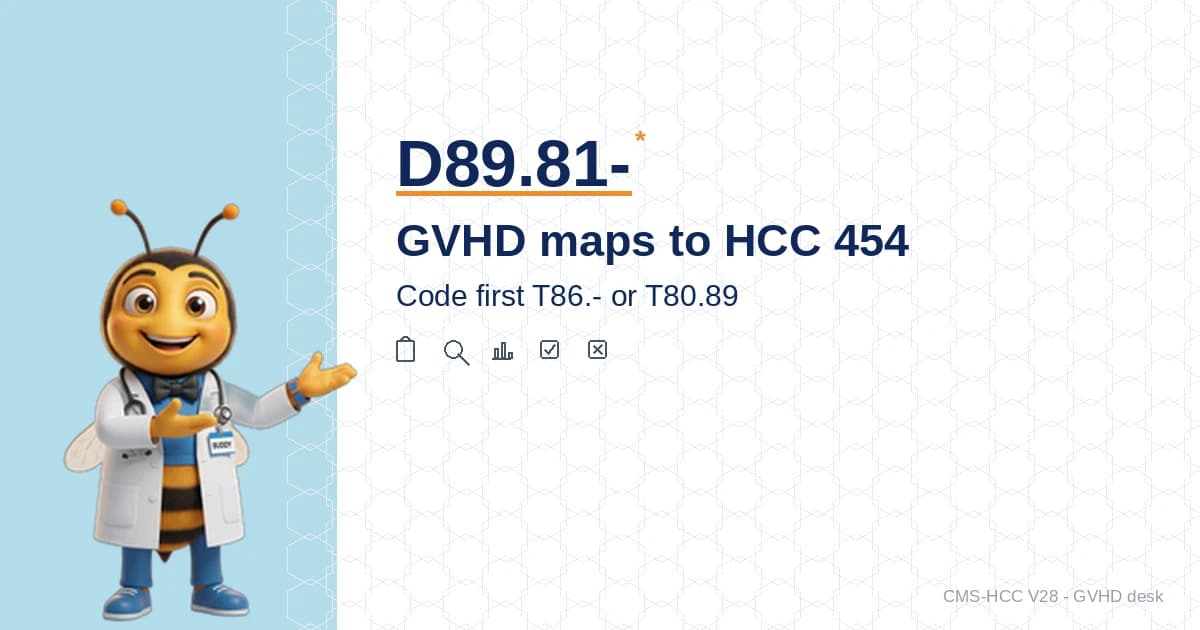
D89.81- GVHD Maps to HCC 454 in V28. Code First T86.- or T80.89.
D89.810 through D89.813 all map to V28 HCC 454. Code first T86.- or T80.89, manifestations, specificity, and status-code traps.
By the HCC Buddy Coding Team
Updated: October 12, 2026
If you searched D89.813, D89.812, D89.810, or GVHD next to Code first, T86, T80.89, or V28, you are looking at a stem-cell transplant cluster where every billable graft-versus-host disease leaf lands in the same CMS-HCC V28 category.
The D89.81 heading (Graft-versus-host disease) is a nonbillable heading. Its four billable leaves all map to HCC 454 (Stem Cell, Including Bone Marrow, Transplant Status/Complications) on the live cards: D89.810 acute, D89.811 chronic, D89.812 acute on chronic, and D89.813 unspecified. Each shows a community non-dual aged reference of 1.068.
The live HCC 454 hub lists all four leaves among its 14 ICD-10-CM codes. The category reference is not a member RAF total.
The D89.81 cards also carry the notes that drive most of the searches that reach those pages: Code first the underlying cause (T86.- or T80.89), and code to identify associated manifestations such as desquamative dermatitis, diarrhea, elevated bilirubin, and hair loss.
As of October 12, 2026, the public ICD leaf cards default to the FY2027 ICD-10-CM edition and read the V28 result from the CMS 2027 Initial ICD-10-CM Mappings (payment year 2027, 2026 dates of service). For every code mapped in this desk, that card result agrees with the PY2026 V28 CSV and the live HCC 454 hub.
This page is the coder-desk walk for graft-versus-host disease under CMS-HCC V28. It does not rewrite the M31.11 HSCT-TMA desk or the T86.41 liver transplant rejection desk; link those when the chart is about TMA or liver rejection instead.
Desk table: verified maps (2026-10-12)
| Code | Official descriptor | V28 result | Coeff ref | CSV (no decimal) |
|---|---|---|---|---|
| D89.81 | Graft-versus-host disease | Nonbillable heading | - | no CSV row |
| D89.810 | Acute graft-versus-host disease | HCC 454 | 1.068 | `D89810,454.0,,,` |
| D89.811 | Chronic graft-versus-host disease | HCC 454 | 1.068 | `D89811,454.0,,,` |
| D89.812 | Acute on chronic graft-versus-host disease | HCC 454 | 1.068 | `D89812,454.0,,,` |
| D89.813 | Graft-versus-host disease, unspecified | HCC 454 | 1.068 | `D89813,454.0,,,` |
| T86.5 | Complications of stem cell transplant | HCC 454 | 1.068 | `T865,454.0,,,` |
| T86.0 | Complications of bone marrow transplant | Nonbillable heading | - | no CSV row |
| T86.00 | Unspecified complication of bone marrow transplant | HCC 454 | 1.068 | `T8600,454.0,,,` |
| T86.01 | Bone marrow transplant rejection | HCC 454 | 1.068 | `T8601,454.0,,,` |
| T86.02 | Bone marrow transplant failure | HCC 454 | 1.068 | `T8602,454.0,,,` |
| T86.03 | Bone marrow transplant infection | HCC 454 | 1.068 | `T8603,454.0,,,` |
| T86.09 | Other complications of bone marrow transplant | HCC 454 | 1.068 | `T8609,454.0,,,` |
| T80.89 | Other complications following infusion, transfusion and therapeutic injection | Nonbillable heading | - | no CSV row |
| T80.89XA | Other complications following infusion, transfusion and therapeutic injection, initial encounter | Does not map | - | no CSV row |
| Z94.81 | Bone marrow transplant status | HCC 454 | 1.068 | `Z9481,454.0,,,` |
| Z94.84 | Stem cells transplant status | HCC 454 | 1.068 | `Z9484,454.0,,,` |
| Z48.290 | Encounter for aftercare following bone marrow transplant | HCC 454 | 1.068 | `Z48290,454.0,,,` |
| M31.11 | Hematopoietic stem cell transplantation-associated thrombotic microangiopathy [HSCT-TMA] | HCC 454 | 1.068 | `M3111,454.0,,,` |
Coeff refs are the community non-dual aged references shown on the live cards (RAF 1.068) and the hub (1.068). Not member totals. Segment coefficients vary. HCC 454 sits in no V28 hierarchy: it does not trump another HCC and is not trumped by one. Two HCC 454 codes in the same year still count as one HCC 454.
The D89.81, T86.0, and T80.89 headings are nonbillable. Report a leaf. D89.810 through D89.813 and T86.5 take no 7th character. T80.89 requires a 7th character (A, D, or S).
Sequencing: Code first T86.- or T80.89
The live D89.81 cards read Code first "underlying cause, such as:" then "complications of transplanted organs and tissue (T86.-)" and "complications of blood transfusion (T80.89)". In practice:
1. Underlying cause first. When GVHD follows a stem cell or bone marrow transplant, sequence a T86 code before the D89.81- leaf. Use T86.5 for complications of stem cell transplant. Use a T86.0- leaf for bone marrow transplant. T86.0 itself is a nonbillable heading. Confirm the leaf with the Alphabetic Index and your policy.
2. When the underlying cause is a blood transfusion complication, the note points to T80.89. T80.89 is a nonbillable heading. Report a 7th-character leaf such as T80.89XA for the initial encounter. The live T80.89XA card shows No V28 HCC for 2026 dates of service, and there is no `T8089XA` row in the V28 CSV. The T80 leaf is there because the Code first note asks for it, not to add an HCC.
3. Then the D89.81- leaf that matches the provider's documentation: acute (D89.810), chronic (D89.811), acute on chronic (D89.812), or unspecified (D89.813).
4. Then each documented associated manifestation. The D89.81 cards say to "code to identify associated manifestations, such as:" desquamative dermatitis (L30.8), diarrhea (R19.7), elevated bilirubin (R17), and hair loss (L65.9). Code only what the provider documents. This desk does not map those manifestation codes; check each code's own card for its V28 status.
The T86 category note also says to code other transplant complications, such as "graft-versus-host disease (D89.81-)". That is the companion direction to the D89.81 Code first note.
The D89 category carries Excludes2: transplant failure and rejection (T86.-). Rejection and failure stay on the T86 leaf (for example T86.01 or T86.02). GVHD stays on the D89.81- leaf, sequenced with the Code first T86 companion when it applies. Excludes2 means both can be reported together when both are documented; it is not an Excludes1 bar.
Specificity: which D89.81- leaf
All four leaves map to the same HCC 454 category. Specificity still matters for the claim and the record:
- D89.810 when the provider documents acute GVHD.
- D89.811 when the provider documents chronic GVHD.
- D89.812 when the provider documents acute on chronic GVHD.
- D89.813 when GVHD is documented without acute, chronic, or acute-on-chronic detail.
Do not "upcode" to acute or chronic without support. A compliant provider query is the fix when the record suggests a type but the assessment is unspecified. See provider query templates.
What this means for V28
- Every billable D89.81- leaf maps to HCC 454. Picking D89.813 instead of D89.810 does not change the V28 category. It does change how specific the diagnosis looks on the claim.
- T86.5 (or a T86.0- leaf) plus a D89.81- leaf still count as one HCC 454. The T86 code is on the claim because the Code first note asks for it, not to add a second category.
- T80.89XA plus a D89.81- leaf yields one HCC 454 from the GVHD code. T80.89XA itself does not map.
- M31.11 (HSCT-TMA) also maps to HCC 454. When both HSCT-TMA and GVHD are documented, both codes can appear; they still count as one HCC 454. See the M31.11 desk for the TMA sequencing path. Do not substitute one diagnosis for the other.
- Non-GVHD D89.8 leaves are outside this desk. Confirm any non-GVHD D89.8x code on its own live card and in the V28 CSV before you claim a map.
Status codes are not companions for the same complication
Z94.81 and Z94.84 also map to HCC 454. The Z94 category on both cards has Excludes1: complications of transplanted organ or tissue - see Alphabetical Index. When the provider documents a transplant complication coded with T86.5 or a T86.0- leaf (and GVHD as D89.81-), do not add the status code for the same transplant. See status Z codes that map.
Z48.290 (Encounter for aftercare following bone marrow transplant) also maps to HCC 454. Use it when the encounter is aftercare, not as a substitute for a documented GVHD complication code.
MEAT for mapped HCC 454
HCC 454 still needs a supported diagnosis in an eligible encounter in the year. A visit note that says "history of GVHD" with no current assessment does not support a D89.81- leaf by itself.
For a D89.81- code, the note should support:
- M Monitor: skin, GI, liver, or other organ findings the provider is following for GVHD when documented
- E Evaluate: labs, biopsy, or exam findings reviewed at the visit, and the provider's link between GVHD and the transplant or transfusion when that link is part of the assessment
- A Assess: an explicit GVHD diagnosis with acuity (acute, chronic, acute on chronic, or unspecified) and current status
- T Treat: a medication change, a therapy plan, or a documented follow-up plan for the GVHD
MEAT is a review mnemonic, not a universal CMS coding rule. Follow the applicable coding, encounter, program, and payer requirements. See MEAT, acute vs history of, and problem lists.
Audit and query traps
1. Reporting D89.81 or T86.0 or T80.89. All three are nonbillable headings.
2. Skipping the Code first T86.- or T80.89 leaf when it applies.
3. Expecting T86.5 plus D89.810 (or any D89.81- leaf) to count as more than one HCC 454.
4. Expecting T80.89XA to add an HCC. It does not map in V28 for 2026 dates of service.
5. Adding Z94.81 or Z94.84 next to a T86 complication code for the same transplant.
6. Coding D89.813 when the provider documented acute, chronic, or acute on chronic GVHD.
7. Leaving documented manifestations off the claim, or adding manifestation codes the provider did not document.
8. Assuming L30.8, R19.7, R17, or L65.9 map. This desk did not verify their V28 status. Check each card.
9. Using the 1.068 CNA reference as a member RAF total.
10. Inventing Coding Clinic quotes, competitor CTAs, or PHI examples.
11. Treating a non-GVHD D89.8 leaf as a GVHD code.
Two-minute check
1. Did the provider document graft-versus-host disease, and did they state acute, chronic, acute on chronic, or leave it unspecified?
2. Is there a documented transplant or transfusion complication that the Code first note applies to? If yes, code that T86 leaf or T80.89X- leaf first.
3. Add the matching D89.81- leaf.
4. Add each documented associated manifestation and check its card for V28 status.
5. No Z94.81 or Z94.84 next to a T86 complication code for the same transplant.
6. Confirm the HCC on the live card and in the V28 CSV. Confirm MEAT for this year.
Related desks and tools
- Live cards: D89.810, D89.811, D89.812, D89.813, D89.81, T86.5, T86.09, T80.89XA, Z94.84, Z48.290
- Hubs: HCC 454
- Lookup: ICD-10 to HCC, Encoder
- Evidence habits: MEAT, acute vs history of, Excludes1 vs Excludes2, provider query templates, hierarchy and trumping
- Nearby desks: M31.11 HSCT-TMA, T86.41 liver transplant rejection, status Z codes that map
Sources
- Live HCC Buddy ICD-10-CM cards (FY2027 Tabular display) and the V28 HCC 454 hub, fetched October 12, 2026
- FY2027 ICD-10-CM order file billable flags, on HCC Buddy main
- PY2026 V28 mapping, hierarchy, and relative factor files on HCC Buddy main
V28 mappings come from the cited live code pages and the PY2026 V28 CSV. Coefficients are source-labeled references, not member totals. Not medical advice. Not a Coding Clinic reprint.
Current as of October 12, 2026. Always confirm the PY2026 V28 CSV and the live HCC hub before you lock a map claim.
Frequently asked questions
Do D89.810 through D89.813 map to an HCC in V28?
Yes. All four billable graft-versus-host disease leaves map to CMS-HCC V28 HCC 454, Stem Cell, Including Bone Marrow, Transplant Status/Complications, with a CNA reference of 1.068. CSV rows D89810 through D89813, each 454.0.
Is D89.81 billable?
No. The live D89.81 card shows a nonbillable heading, and there is no D8981 row in the V28 CSV. Report D89.810, D89.811, D89.812, or D89.813.
What does the D89.81 Code first note mean?
The live D89.81 cards say Code first the underlying cause, such as complications of transplanted organs and tissue (T86.-) or complications of blood transfusion (T80.89). Sequence that companion before the D89.81- leaf, then add codes for documented manifestations.
Do T86.5 and D89.810 count as two HCCs?
No. Both map to HCC 454, so they count as one HCC 454.
Does T80.89XA add an HCC with GVHD?
No. The live T80.89XA card shows No V28 HCC for 2026 dates of service, and there is no T8089XA row in the V28 CSV. The leaf is required for sequencing when the Code first note applies, not for capture.
Does picking D89.813 instead of D89.810 change the V28 category?
No. All four leaves map to HCC 454. Specificity still matters for the claim and the record.
Can I add Z94.81 with a T86 complication code?
No. The Z94 category carries Excludes1: complications of transplanted organ or tissue. Do not add the status code for the same transplant when a T86 complication code applies.
Can I use the 1.068 coefficient as the member RAF?
No. 1.068 is the community non-dual aged reference shown on the live cards for HCC 454. It is not a member RAF total. Segment coefficients vary.
Related Tools
D89.810 card
Acute GVHD. V28 HCC 454, CNA 1.068. Code first T86.- or T80.89.
D89.811 card
Chronic GVHD. V28 HCC 454, CNA 1.068.
D89.812 card
Acute on chronic GVHD. V28 HCC 454, CNA 1.068.
D89.813 card
GVHD, unspecified. V28 HCC 454, CNA 1.068.
T86.5 card
Complications of stem cell transplant. V28 HCC 454, CNA 1.068.
T80.89XA card
Transfusion complication leaf. Billable. No V28 HCC for 2026 dates of service.
HCC 454 hub
Stem Cell, Including Bone Marrow, Transplant Status/Complications. CNA ref 1.068. 14 codes. No hierarchy.
ICD-10 to HCC
Look up one diagnosis against the current V28 map.
Encoder
Look up D89.81 and T86 codes with live V28 status.

HCC Buddy Coding Team
Editorial
Every HCC Buddy article is checked against the current CMS-HCC model and the active FY ICD-10-CM tabular release before it publishes.
Get HCC Coding Tips in Your Inbox
Join our newsletter for coding tips, guideline updates, and tool announcements.