
T81.44XA and T81.12XA Do Not Map in V28. The Sepsis Code Carries HCC 2.
T81.44XA and T81.12XA have no V28 HCC. HCC 2 rides on the sepsis code, usually A40/A41. R65.21 is Excludes1 with T81.12-. Sequencing and the A41.9 question.
By the HCC Buddy Coding Team
Updated: October 8, 2026
If you searched postprocedural sepsis, T81.44XA, or T81.12XA next to A41.9 or V28, you are looking at a sepsis cluster where the T81 code tells the story and a different code carries the CMS-HCC V28 category.
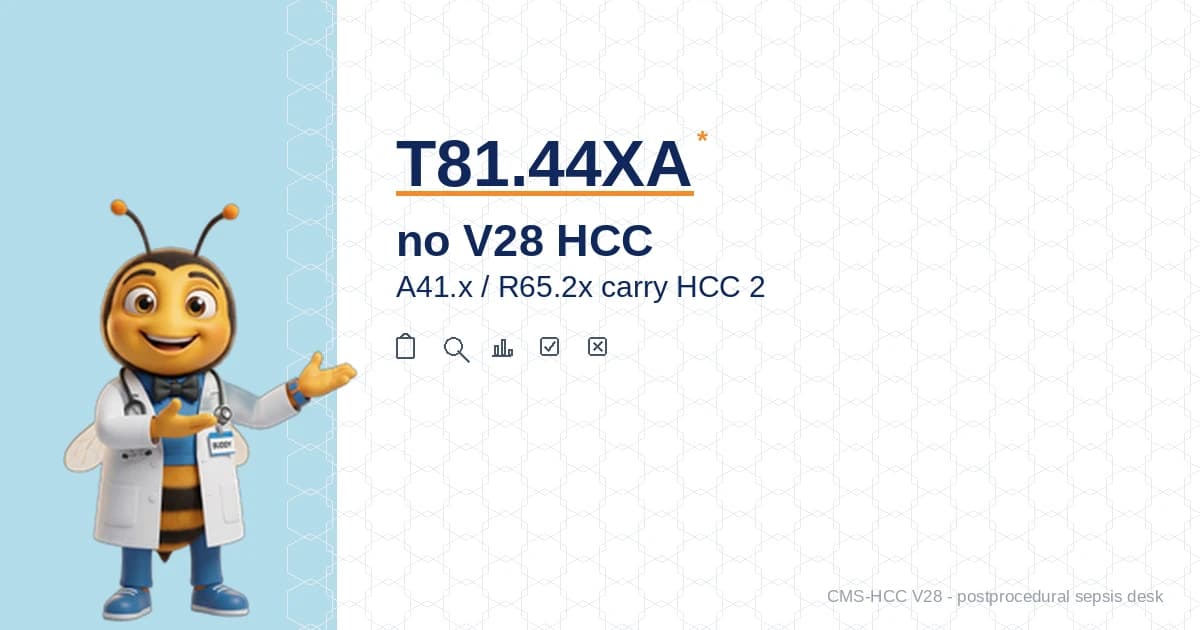
Postprocedural sepsis has its own ICD-10-CM code. It does not have its own V28 HCC. On the live T81.44XA card (Sepsis following a procedure, initial encounter), CMS-HCC V28 reads No V28 HCC for 2026 dates of service. The same is true for T81.12XA (Postprocedural septic shock, initial encounter). The PY2026 V28 CSV has no T81 rows at all.
HCC 2 (Septicemia, Sepsis, Systemic Inflammatory Response Syndrome/Shock) comes from the sepsis code you add, not from the T81 code. That means the code that identifies the sepsis, usually an A40 or A41 organism code, or R65.20 when severe sepsis without septic shock is documented. Sepsis that the Tabular classifies elsewhere has its own code. Candidal sepsis is B37.7, which the A41 heading excludes, and the PY2026 V28 CSV maps B37.7 to both HCC 2 and HCC 6. In postprocedural septic shock, R65.21 is excluded. That leaves the code that identifies the sepsis as the HCC 2 code.
The live HCC 2 hub shows a source-labeled community non-dual aged reference coefficient of 0.5 and 52 ICD rows. That is a category reference, not a member RAF total. Every billable FY2027 A40 leaf (5 codes) and A41 leaf (15 codes) has an HCC 2 row in the PY2026 CSV, and so do R65.20 and R65.21.
As of October 8, 2026, the public ICD leaf cards default to the FY2027 ICD-10-CM edition and read the V28 result from the CMS 2027 Initial ICD-10-CM Mappings (payment year 2027, 2026 dates of service). For every code in this desk, that card result agrees with the PY2026 V28 CSV and the live HCC 2 hub.
This page is the coder-desk walk for postprocedural sepsis and postprocedural septic shock under CMS-HCC V28.
Desk table: verified maps (2026-10-08)
| Code | Official descriptor | V28 result | Coeff ref | CSV (no decimal) |
|---|---|---|---|---|
| T81.41XA | Infection following a procedure, superficial incisional surgical site, initial encounter | Does not map | - | no CSV row |
| T81.42XA | Infection following a procedure, deep incisional surgical site, initial encounter | Does not map | - | no CSV row |
| T81.43XA | Infection following a procedure, organ and space surgical site, initial encounter | Does not map | - | no CSV row |
| T81.49XA | Infection following a procedure, other surgical site, initial encounter | Does not map | - | no CSV row |
| T81.44XA | Sepsis following a procedure, initial encounter | Does not map | - | no CSV row |
| T81.12XA | Postprocedural septic shock, initial encounter | Does not map | - | no CSV row |
| T81.44 | Sepsis following a procedure | Nonbillable heading | - | no CSV row |
| T81.12 | Postprocedural septic shock | Nonbillable heading | - | no CSV row |
| A41.9 | Sepsis, unspecified organism | HCC 2 | 0.500 | `A419,2.0,,,` |
| A41.51 | Sepsis due to Escherichia coli [E. coli] | HCC 2 | 0.500 | `A4151,2.0,,,` |
| A41.01 | Sepsis due to Methicillin susceptible Staphylococcus aureus | HCC 2 | 0.500 | `A4101,2.0,,,` |
| A41.02 | Sepsis due to Methicillin resistant Staphylococcus aureus | HCC 2 | 0.500 | `A4102,2.0,,,` |
| A41.1 | Sepsis due to other specified staphylococcus | HCC 2 | 0.500 | `A411,2.0,,,` |
| A40.9 | Streptococcal sepsis, unspecified | HCC 2 | 0.500 | `A409,2.0,,,` |
| R65.20 | Severe sepsis without septic shock | HCC 2 | 0.500 | `R6520,2.0,,,` |
| R65.21 | Severe sepsis with septic shock | HCC 2 (Excludes1 with T81.12-) | 0.500 | `R6521,2.0,,,` |
Coeff refs are the community non-dual aged references shown on the live cards (RAF 0.500) and the HCC 2 hub (0.5). Not member totals. Segment coefficients vary. HCC 2 sits in no V28 hierarchy: it does not trump another HCC and is not trumped by one. Two HCC 2 codes in the same year still count as one HCC 2.
The T81.44 and T81.12 headings are nonbillable. Report the code with its 7th character: A for the initial encounter, D for a subsequent encounter, S for sequela. T81.44XD and T81.12XD also show no V28 HCC.
Sequencing: sepsis after a surgical site infection
The FY2027 ICD-10-CM Official Guidelines, Section I.C.1.d.5.b, set the order:
1. Site first, if known. A code from T81.41 to T81.43, or T81.49, that identifies the surgical site infection.
2. Then T81.44-. The guideline says to "assign an additional code for sepsis following a procedure (T81.44)."
3. Then the infectious agent. The guideline says to "use an additional code to identify the infectious agent." The live T81.44 card note reads "code to identify the sepsis."
4. Severe sepsis, if documented. Add the R65.2- code and the codes for each acute organ dysfunction. The live T81.4 card note reads "code (R65.2-) to identify severe sepsis, if applicable."
The Tabular points the same way from the sepsis side. The live A41 and A40.9 cards carry a Code first note: "if applicable, postprocedural sepsis (T81.44-)". The live R65.2 heading lists "infection following a procedure (T81.4-)" in its Code first note.
Guideline I.C.1.d.5.a sets the gate before any of this. Code assignment "is based on the provider's documentation of the relationship between the infection and the procedure." No documented link, no T81.4- code.
Postprocedural septic shock: T81.12XA, not R65.21
Guideline I.C.1.d.5.c is direct. Assign the postprocedural sepsis codes above, "followed by code T81.12-, Postprocedural septic shock. Do not assign code R65.21, Severe sepsis with septic shock." Add codes for any acute organ dysfunction.
The live cards agree:
- R65.21 shows Excludes1: postprocedural septic shock (T81.12-).
- T81.12 shows Code first: underlying infection, plus the note "code, to identify any associated acute organ dysfunction, if applicable".
Guideline I.C.1.d.2 also notes that the code for septic shock cannot be assigned as a principal diagnosis.
Here is the V28 consequence. R65.21 maps to HCC 2. T81.12XA does not. When you correctly report T81.12XA in place of R65.21, HCC 2 rests on the code that identifies the sepsis alone, usually an A40 or A41 code.
The A41.9 question
Coders ask whether A41.9 is required with T81.44XA when no organism is documented. Published sources do not answer it the same way.
What the official sources say:
- The live T81.44 card note: "code to identify the sepsis."
- The FY2027 guideline, Section I.C.1.d.5.b: "Use an additional code to identify the infectious agent."
What one published source says: an AHIMA Journal article, "Surgical Site Infection Coding Update," states that assigning A41.9 "does not provide any additional information that is not already included in code T81.44-." The article concludes that no additional code is assigned for unspecified sepsis, and it attributes that position to the first quarter 2017 issue of AHA Coding Clinic. We do not quote or reprint Coding Clinic here. Check the current Coding Clinic guidance and your organization's policy.
Why it matters for V28:
- Organism documented (for example, E. coli): T81.44XA plus A41.51. HCC 2 comes from A41.51.
- Organism not documented, and your policy omits A41.9: T81.44XA carries no V28 HCC. HCC 2 is captured only if R65.20 is supported by documented severe sepsis without septic shock.
- Organism not documented, postprocedural septic shock, and your policy omits A41.9: R65.21 is excluded and T81.12XA has no map. The claim may carry no HCC 2.
Do not add or drop A41.9 to move a score. When culture results point to an organism the provider has not documented, a compliant provider query is the fix. See provider query templates.
MEAT for mapped HCC 2
Sepsis is acute. HCC 2 still needs provider documentation of the condition in an eligible encounter in the year. A follow-up visit note that says "history of postprocedural sepsis" does not support an active A40 or A41 code by itself.
For the sepsis code that carries HCC 2, the note should support:
- M Monitor: vital signs, lactate, or organ function trends when documented
- E Evaluate: culture results, imaging for a source, or the surgical site findings reviewed at the visit
- A Assess: an explicit sepsis diagnosis tied to the procedure, with the organism when known
- T Treat: antibiotics, source control, a return to the operating room, or a documented treatment plan
MEAT is a review mnemonic, not a universal CMS coding rule. Follow the applicable coding, encounter, program, and payer requirements. See MEAT, acute vs history of, and problem lists.
Audit and query traps
1. Coding T81.44XA alone and expecting HCC 2. There is no T81 row in the V28 CSV.
2. Pairing R65.21 with T81.12XA. The R65.21 Excludes1 note names T81.12-.
3. Assuming T81.12XA carries the shock HCC. The live card shows no V28 HCC.
4. Sequencing the A40 or A41 code ahead of the surgical site infection code. Guideline I.C.1.d.5.b puts the site code first, if known.
5. Adding A41.9, or omitting it, to change RAF instead of following documentation and policy.
6. Leaving a documented organism off the claim. The organism code is the HCC 2 code in this scenario.
7. Coding T81.4- without a documented link between the infection and the procedure.
8. Reporting the T81.44 or T81.12 heading. Both are nonbillable. Add the 7th character.
9. Using the T81 path for a central line infection. The T81.4 Excludes2 note sends infection due to infusion, transfusion and therapeutic injection to T80.2-. For a central venous catheter infection, pick the T80.21- code by the documented type (T80.211- bloodstream, T80.212- local, T80.218- other, T80.219- unspecified), then add the encounter 7th character, such as T80.211A for an initial encounter. For a bloodstream infection, see the T80.211A / R78.81 desk.
10. Carrying "postprocedural sepsis" forward from a discharge summary into a later visit with no current assessment.
11. Using the 0.500 CNA reference as a member RAF total.
12. Inventing Coding Clinic quotes, competitor CTAs, or PHI examples.
Two-minute check
1. Did the provider document that the infection or sepsis is due to the procedure?
2. Is the surgical site known? Then the T81.41-, T81.42-, T81.43-, or T81.49- code goes first, with the 7th character for the encounter (A, D, or S).
3. Is T81.44XA (or the correct 7th character) on the claim?
4. Is the organism documented? Then add the code that identifies the sepsis, usually an A40 or A41 code (candidal sepsis is B37.7). Confirm its HCC map on the card.
5. Organism not documented? Follow your A41.9 policy. Do not decide it by RAF.
6. Severe sepsis without septic shock? Add R65.20 and the organ dysfunction codes.
7. Postprocedural septic shock? Add T81.12- with the 7th character for the encounter. Remove R65.21.
8. Confirm the HCC on the live card and in the V28 CSV. Confirm MEAT for this year.
Related desks and tools
- Live cards: T81.44XA, T81.44, T81.12XA, T81.12, T81.4, R65.21, R65.20, A41, A41.9, A41.51
- Hub: HCC 2
- Lookup: ICD-10 to HCC, Encoder
- Evidence habits: MEAT, acute vs history of, Excludes1 vs Excludes2, provider query templates
- Nearby desks: T80.211A / R78.81 CVC bloodstream sequencing, HCC 213 cardio-respiratory failure
Sources
- ICD-10-CM Official Guidelines for Coding and Reporting FY 2027, Sections I.C.1.d.2 and I.C.1.d.5.a to I.C.1.d.5.c
- AHIMA Journal, "Surgical Site Infection Coding Update" (attributed position only)
- Live HCC Buddy ICD-10-CM cards and the V28 HCC 2 hub, fetched October 8, 2026
- PY2026 V28 mapping, hierarchy, and relative factor files on HCC Buddy main
V28 mappings come from the cited live code pages and the PY2026 V28 CSV. Coefficients are source-labeled references, not member totals. Not medical advice. Not a Coding Clinic reprint.
Current as of October 8, 2026. Always confirm the PY2026 V28 CSV and the live HCC hub before you lock a map claim.
Related Tools
T81.44XA card
Sepsis following a procedure, initial encounter. No V28 HCC for 2026 dates of service.
T81.12XA card
Postprocedural septic shock, initial encounter. No V28 HCC. Code first underlying infection.
R65.21 card
Severe sepsis with septic shock. V28 HCC 2. Excludes1 postprocedural septic shock (T81.12-).
R65.20 card
Severe sepsis without septic shock. V28 HCC 2, CNA 0.500.
A41.9 card
Sepsis, unspecified organism. V28 HCC 2, CNA 0.500.
A41.51 card
Sepsis due to E. coli. V28 HCC 2, CNA 0.500.
HCC 2 hub
Septicemia, Sepsis, Systemic Inflammatory Response Syndrome/Shock. CNA ref 0.5. No hierarchy.
ICD-10 to HCC
Look up one diagnosis against the current V28 map.
Encoder
Look up T81.44XA, T81.12XA, and A41 codes with live V28 status.

HCC Buddy Coding Team
Editorial
Every HCC Buddy article is checked against the current CMS-HCC model and the active FY ICD-10-CM tabular release before it publishes.
Get HCC Coding Tips in Your Inbox
Join our newsletter for coding tips, guideline updates, and tool announcements.