
T80.211A Is CVC Bloodstream Infection. R78.81 Is Bacteremia. Neither Maps in V28. Documented Sepsis Is A41 (HCC 2).
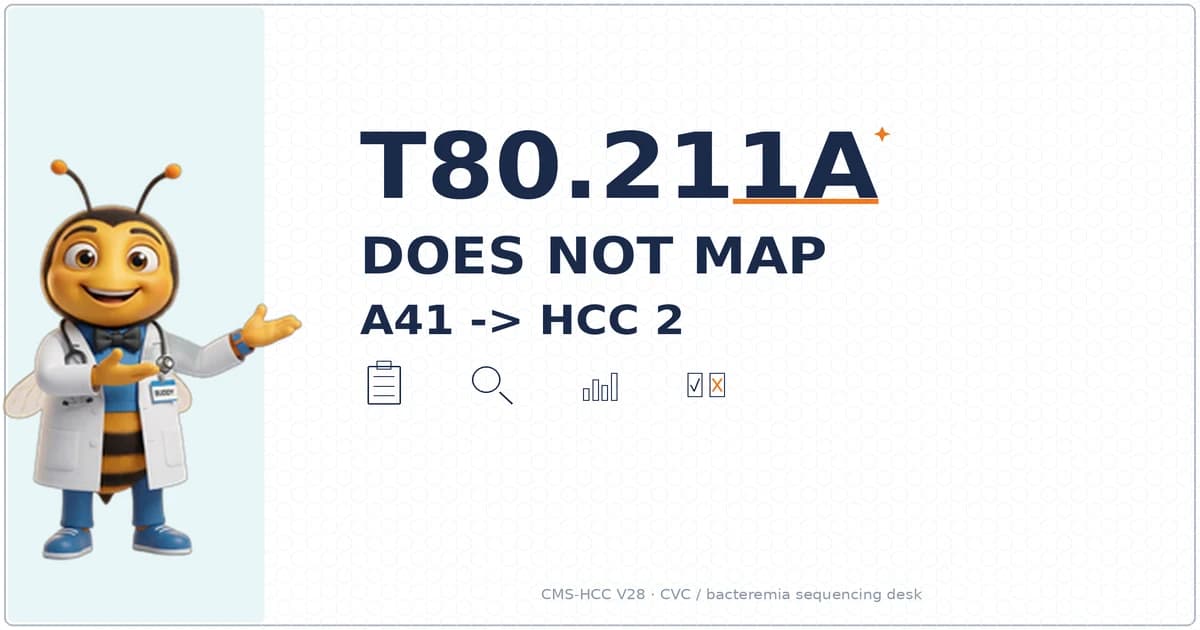
T80.211A (CVC bloodstream infection) and R78.81 (bacteremia) have verified no payable CMS-HCC V28 mapping. Documented sepsis A41.9 / A41.02 map to HCC 2 (source-labeled reference coefficient 0.5). Sequencing desk: Code First T80.211-, Excludes1 on R78.81, MEAT, query traps.
By the HCC Buddy Coding Team
Updated: September 25, 2026
If you searched bloodstream infection due to central venous catheter, R78.81, bacteremia, or T80.211 next to HCC or V28, you are looking at a sequencing cluster that confuses billable infection codes with risk-adjusted sepsis maps under CMS-HCC V28 for payment year 2026.
T80.211A (Bloodstream infection due to central venous catheter, initial encounter) is billable. On the live FY2026 card it shows Not mapped / verified no payable CMS-HCC V28 mapping, and there is no `T80211A` row in the PY2026 V28 CSV. T80.211 is the non-billable HEADER for that family. R78.81 (Bacteremia) is billable with verified no payable CMS-HCC V28 mapping and no `R7881` CSV row. Neither T80.211A nor R78.81 creates V28 payment by itself.
Documented sepsis under A41.9 (Sepsis, unspecified organism) and organism-specific A41 codes such as A41.02 (MRSA sepsis) do map to V28 HCC 2 (Septicemia, Sepsis, Systemic Inflammatory Response Syndrome/Shock), with a source-labeled reference coefficient of 0.5 on the HCC 2 hub. Official Code First guidance on A41 includes sepsis due to central venous catheter (T80.211-). R78.81 Excludes1 points away from sepsis: code to the specified infection when sepsis is documented. Do not invent sepsis from bacteremia alone. Do not treat R78.81 as CVC bloodstream infection.
This page is the coder-desk sequencing walk for that GSC cluster. It is not a rewrite of the E11.52 vs I70.261 sequencing desk. Cross-link when diabetes or PAD sequencing is also in play. Do not revive D59.31. Do not land E80 porphyria here.
Desk table: verified maps and no-maps (2026-09-25)
| Code | Official short | V28 result | Coeff ref | CSV (no decimal) |
|---|---|---|---|---|
| T80.211 | CVC bloodstream infection (HEADER) | none (non-billable header) | n/a | no `T80211` row |
| T80.211A | CVC bloodstream infection, initial | none | n/a | no `T80211A` row |
| R78.81 | Bacteremia | none | n/a | no `R7881` row |
| A41.9 | Sepsis, unspecified organism | HCC 2 | 0.5 | `A419,2.0,,,` |
| A41.01 | MSSA sepsis | HCC 2 | 0.5 | `A4101,2.0,,,` |
| A41.02 | MRSA sepsis | HCC 2 | 0.5 | `A4102,2.0,,,` |
Coefficients are source-labeled reference values from the live HCC 2 hub (community non-dual aged reference 0.5). Not member totals. Segment coefficients vary; look up the hub and calculator for the enrollment segment you need.
What T80.211A is (and is not)
T80.211A is Bloodstream infection due to central venous catheter, initial encounter. It is the billable initial-encounter leaf under the T80.211 HEADER. It is billable. Billable does not mean risk-adjusted under PY2026 community V28.
Do not invent a V28 payment HCC for T80.211A. The live card shows Not mapped / verified no payable mapping in the final FY2026 CMS source. The PY2026 CSV has no `T80211A` (or `T80211`) row. Coding the CVC bloodstream infection when the chart supports it is still correct coding. It is not an HCC 2 substitute.
Subsequent encounter T80.211D and sequela T80.211S follow the same V28 no-map pattern for this desk: look the live card up; do not invent a payment row from this post.
What R78.81 is (and is not)
R78.81 is Bacteremia. It is billable. On the live FY2026 card it has verified no payable CMS-HCC V28 mapping. There is no `R7881` row in the PY2026 V28 CSV.
R78.81 is not CVC bloodstream infection. R78.81 is not sepsis. Live card Excludes1 language points to sepsis: do not code bacteremia together with sepsis; code to the specified infection when sepsis is documented. Do not invent A41 from an R78.81-only note. Providers document; coders code documentation; query when the chart supports sepsis or a more specific infection.
When documented sepsis maps to HCC 2
If the provider documents sepsis, unspecified organism, use A41.9. That maps to V28 HCC 2 (CSV `A419,2.0,,,`). Source-labeled reference coefficient 0.5 on the HCC 2 hub.
If the provider documents MRSA sepsis, use A41.02. That also maps to V28 HCC 2 (CSV `A4102,2.0,,,`).
If the provider documents MSSA sepsis, use A41.01. Same HCC 2 map (CSV `A4101,2.0,,,`).
Other A41 organism-specific codes in this family also map to HCC 2 in the PY2026 CSV (for example A41.1, A41.2, A41.51, A41.9). Always confirm the exact code on the live card and CSV before you claim a map.
Official Code First on A41 includes sepsis due to central venous catheter (T80.211-). When the chart supports CVC-related sepsis, sequence per the official Code First / additional-code instructions on the live A41 card and the applicable coding guidelines for your setting. This desk does not invent Coding Clinic quotes.
Sequencing paths (documentation-driven)
Pick the path from what the chart actually supports. Do not invent sepsis for RAF.
1. Chart supports CVC bloodstream infection, initial encounter, and does not support sepsis -> expect T80.211A. Billable. No V28 payment map.
2. Chart supports bacteremia without sepsis and without a more specific infection that replaces it -> expect R78.81. Billable. No V28 payment map. Excludes1: do not pair with sepsis; code the specified infection when sepsis is documented.
3. Chart supports sepsis, unspecified organism -> A41.9 -> V28 HCC 2 (source-labeled reference coefficient 0.5). Apply Code First / additional-code rules when CVC sepsis (T80.211-) is also documented.
4. Chart supports organism-specific sepsis (for example MRSA) -> matching A41.* (for example A41.02) -> V28 HCC 2. Same Code First note for CVC sepsis when documented.
5. Chart supports both CVC bloodstream infection and documented sepsis -> follow official Code First on A41 for sepsis due to central venous catheter (T80.211-), plus the A41 sepsis code the documentation supports. Do not drop the sepsis code that maps HCC 2 just because T80.211A was also assigned. Do not invent the sepsis half from bacteremia alone.
6. Chart only says bacteremia / positive blood culture language without a sepsis diagnosis -> do not auto-upgrade to A41 for RAF. Query when clinical findings support a sepsis diagnosis your program allows you to query for.
7. Do not treat R78.81 as a synonym for T80.211A. Different codes, different clinical labels, same V28 result (no payment map).
MEAT for mapped HCC 2 sepsis
A mapped A41 code still needs monitoring, evaluation, assessment, or treatment in the eligible encounter year. A problem-list row that says "sepsis" from a prior admission does not carry HCC 2 forward by itself.
For A41.9 / A41.02 / other A41 codes mapping to HCC 2, the note should support:
MEAT is a review mnemonic, not a universal CMS coding rule. Follow the applicable coding, encounter, program, and payer requirements. See MEAT and problem lists.
Audit and query traps
1. Leaving supported sepsis on R78.81 because "bacteremia is close enough." Bacteremia is not sepsis. Excludes1 on R78.81 points to the specified infection when sepsis is documented.
2. Treating T80.211A as if it mapped like A41.9. CVC bloodstream infection is billable and clinically important. It does not create HCC 2 under V28.
3. Inventing a V28 payment HCC for R78.81 or T80.211A. Live cards: no payable V28 mapping. CSV: no `R7881`, `T80211`, or `T80211A` rows.
4. Calling R78.81 the CVC bloodstream infection code. That label belongs to T80.211- / T80.211A, not R78.81.
5. Inventing sepsis (A41) from bacteremia alone to create RAF. Providers document; coders code documentation; query when supported.
6. Ignoring Code First on A41 for sepsis due to central venous catheter (T80.211-) when the chart supports CVC sepsis.
7. Coding the T80.211 HEADER instead of a billable 7th-character leaf (T80.211A / D / S). Headers are not billable.
8. Skipping MEAT for a historical sepsis label with no current assessment or treatment in the eligible year.
9. Rewriting the E11.52 vs I70.261 sequencing desk into this post. Cross-link; keep this CVC / bacteremia / sepsis walk here.
10. Inventing Coding Clinic quotes, competitor CTAs, or member-level RAF totals from the 0.5 hub reference.
11. Assuming billable equals risk-adjusted. T80.211A and R78.81 prove the opposite under V28.
12. Using the HCC 2 source-labeled reference coefficient 0.5 as a member score. It is a category reference, not a total.
Related desks and tools
Current as of September 25, 2026. Always confirm the live card and the PY2026 V28 CSV before you lock a map claim.
Related Tools
T80.211A card
CVC bloodstream infection, initial. Billable. No V28 map.
T80.211 card
CVC bloodstream infection HEADER. Non-billable.
R78.81 card
Bacteremia. Billable. No V28 map.
A41.9 card
Sepsis, unspecified organism. V28 HCC 2.
A41.02 card
MRSA sepsis. V28 HCC 2.
A41.01 card
MSSA sepsis. V28 HCC 2.
HCC 2 hub
Septicemia / sepsis / SIRS. Source-labeled reference coefficient 0.5.
ICD-10 to HCC
Look up one diagnosis against the current V28 map.
Encoder
Search the exact ICD-10-CM code with live V28 status.

HCC Buddy Coding Team
Editorial
Every HCC Buddy article is checked against the current CMS-HCC model and the active FY ICD-10-CM tabular release before it publishes.
Get HCC Coding Tips in Your Inbox
Join our newsletter for coding tips, guideline updates, and tool announcements.