
M86.8X- Other Osteomyelitis in FY2027: New Side Codes and Pending V28 Status
FY2027 split M86.8X7 into M86.8X71, M86.8X72 and M86.8X79. See which code fits, when M86.9 applies, and why the new codes have no published V28 map yet.
By the HCC Buddy Coding Team
Updated: November 24, 2026
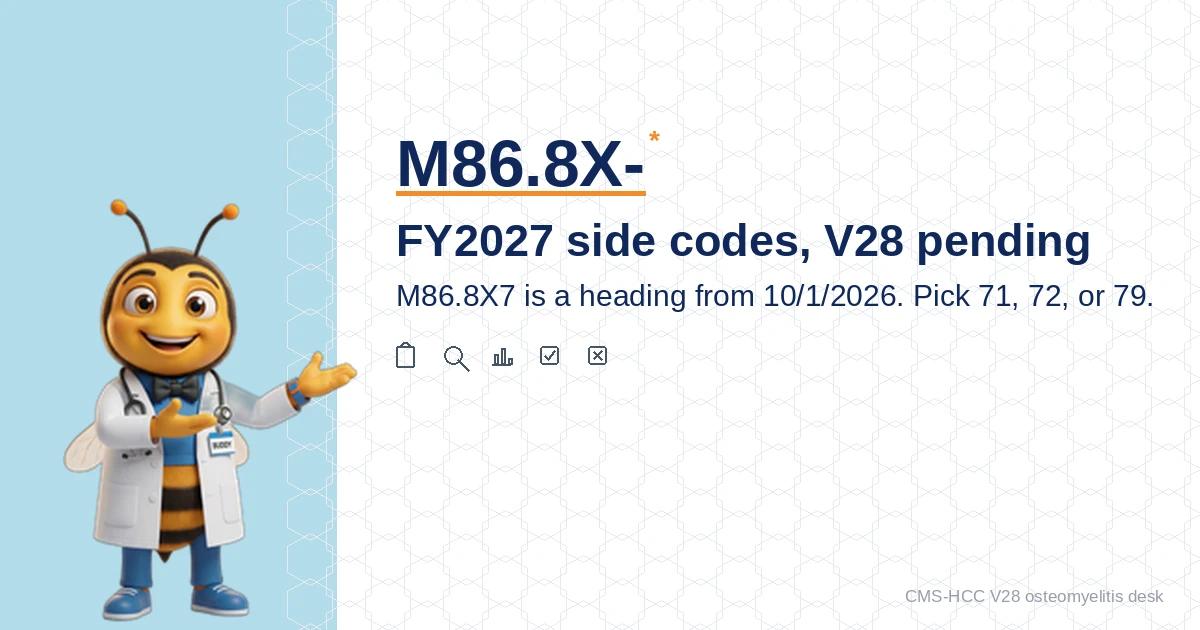
If you searched M86.8X72, M86.8X7, or osteomyelitis of the left foot ICD-10, here is the short answer. For dates of service on or after October 1, 2026, FY2027 ICD-10-CM made M86.8X7 (Other osteomyelitis, ankle and foot) a nonbillable heading. Its billable codes are now M86.8X71 (right ankle and foot), M86.8X72 (left ankle and foot), and M86.8X79 (unspecified ankle and foot). The same split happened at every site from M86.8X1 through M86.8X8.
The new codes do not have a published CMS-HCC V28 category yet. They are not in the PY2026 V28 mappings, and they are not in the CMS 2027 Initial ICD-10-CM Mappings, which CMS labels "Includes ICD-10 codes valid in FY2025 and FY2026." Our live code cards show them as pending. This guide covers which code to pick, what is and is not published for V28, and why "osteomyelitis of the left foot" often belongs somewhere other than M86.8X-.
The short version
| Code | What it is | Billable for 10/1/2026 and later | V28 status |
|---|---|---|---|
| M86.8X1 to M86.8X8 | Other osteomyelitis, by site | No, now headings | HCC 92 for dates of service through 9/30/2026 |
| M86.8X71, M86.8X72, M86.8X79 | Other osteomyelitis, right, left, or unspecified ankle and foot | Yes, new | Pending. No row in either V28 file |
| M86.8X80, M86.8X81, M86.8X89 | Other osteomyelitis, skull; face and sinuses; other site | Yes, new | Pending. No row in either V28 file |
| M86.8X0, M86.8X9 | Other osteomyelitis, multiple sites; unspecified sites | Yes, unchanged | HCC 92 |
| M86.9 | Osteomyelitis, unspecified | Yes, unchanged | HCC 92 |
| M86.171, M86.172, M86.179 | Other acute osteomyelitis, right, left, or unspecified ankle and foot | Yes, unchanged | HCC 92 |
| M86.671, M86.672, M86.679 | Other chronic osteomyelitis, right, left, or unspecified ankle and foot | Yes, unchanged | HCC 92 |
HCC 92 is Bone/Joint/Muscle/Severe Soft Tissue Infections/Necrosis. Every "HCC 92" row comes from the PY2026 V28 mappings file, which has the same rows as the PY2027 initial V28 mapping, and each one matches the live code card. "Pending" means the code has no row in either file, and the live card says CMS has not published its PY2027 category.
What FY2027 changed
The FY2027 order file, effective October 1, 2026, flags M86.8X1 through M86.8X8 as headings and adds 24 billable codes under them. The seven limb sites (shoulder, upper arm, forearm, hand, thigh, lower leg, and ankle and foot) each get a right, a left, and an unspecified code. M86.8X8 (other site) splits by location instead: M86.8X80 for the skull, M86.8X81 for the face and sinuses, and M86.8X89 for any other site. The Tabular lists Pott's puffy tumor as an inclusion term at M86.8X81.
Two codes did not change. M86.8X0 (multiple sites) and M86.8X9 (unspecified sites) are billable in both the FY2026 and FY2027 order files. For the full list of FY2027 additions, see our FY2027 code changes post.
The date of service decides which code set applies. A visit on September 30, 2026 or earlier still uses M86.8X7. A visit on October 1, 2026 or later cannot use M86.8X7, because a heading is not a complete code. Pick the child code with the documented side.
What is and is not published for V28
Here is what each file says, so you can check it yourself.
1. The old codes map through September 30, 2026. Lines 5770 to 5777 of the PY2026 V28 mappings file list M868X1 through M868X8 at HCC 92. For example, line 5776 reads `M868X7,92.0,,,`. The CMS 2027 Initial ICD-10-CM Mappings file also lists M868X7 with V28 category 92.
2. The 24 new codes have no row. We searched the PY2026 V28 mappings file and the PY2027 initial V28 mapping for every new code. Neither file has a single seven-character M86.8X code. The CMS 2027 Initial file's own header says it includes codes valid in FY2025 and FY2026, and FY2027 began on October 1, 2026.
3. CMS has not posted a newer PY2027 mapping. As of November 24, 2026, the CMS "2027 Model Software/ICD-10 Mappings" page lists the 2027 Initial Model Software and the 2027 Initial ICD-10-CM Mappings, and nothing newer.
So the honest answer for M86.8X72 today is "pending." The live card says CMS "has not published its PY2027 category. Mapping pending." Do not report the new codes as HCC 92 because the old heading mapped there. The mapping files list complete codes one at a time, and none of them lists M86.8X72 yet. When CMS publishes a mapping that includes FY2027 codes, check the card again.
None of this changes how you code. Code what the provider documents, using the Alphabetic Index and the Tabular List. The V28 status follows the code. It is never a reason to choose one code over another.
"Osteomyelitis of the left foot" may not be M86.8X72
Many of the searches that reach our M86.8X71 and M86.8X72 pages are simply "osteomyelitis of the right foot" or "left foot osteomyelitis." The FY2027 Alphabetic Index does not send those words to M86.8X-. Here is where it does send them.
- No type documented. The main term Osteomyelitis goes to M86.9 (Osteomyelitis, unspecified). The main term has no foot or ankle subterm, and M86.9 has no site or side character.
- Acute. "Osteomyelitis, acute" goes to M86.10. Under it, tarsus, metatarsus, and toe go to M86.17-, Other acute osteomyelitis, ankle and foot (M86.171, M86.172, M86.179). Acute hematogenous goes to M86.07- for the same bones.
- Subacute. Tarsus, metatarsus, and toe go to M86.27-.
- Chronic. "Osteomyelitis, chronic" goes to M86.60. Under it, tarsus, metatarsus, and toe go to M86.67-, Other chronic osteomyelitis, ankle and foot (M86.671, M86.672, M86.679). Chronic with draining sinus goes to M86.47-, chronic hematogenous to M86.57-, and chronic multifocal to M86.37-.
- A specified type with no code of its own. "Osteomyelitis, specified type NEC" goes to M86.8X-. The Index sends Garré's, nonsuppurating, and nonsuppurative sclerosing osteomyelitis there, and "Brodie's abscess" also goes to M86.8X-. The Tabular lists Brodie's abscess as an inclusion term at M86.8.
Guideline I.A.9.a explains why. Codes titled "other" are "for use when the information in the medical record provides detail for which a specific code does not exist," and Index entries marked NEC point to those codes. "Other osteomyelitis" is that kind of code. It is not the default for osteomyelitis of a named bone. When the record does not give enough detail for a more specific code, Guideline I.A.9.b points to the unspecified code.
At the desk, that works out like this:
- The provider writes only "osteomyelitis, left foot." The Index leads to M86.9.
- The provider writes "acute," "subacute," or "chronic." Follow that subterm to the ankle and foot code for the documented side.
- The provider names a specified type that the Index sends to "specified type NEC." That is when M86.8X71, M86.8X72, or M86.8X79 applies.
- The type is unclear or conflicts across notes. Query the provider.
Keep the side in the code when the code has one. Guideline I.B.13 says codes for an unspecified side should rarely be used, only when the record does not identify the side and clarification is not possible.
Skull, face, and sinuses
Searches such as "skull base osteomyelitis ICD-10" and "osteomyelitis of skull ICD-10" land on M86.8X80. The FY2027 Index has no "skull base" subterm under Osteomyelitis. "Skull" appears as a subterm under the documented type instead:
- acute: M86.18 (Other acute osteomyelitis, other site)
- acute hematogenous: M86.08 (Acute hematogenous osteomyelitis, other sites)
- subacute: M86.28 (Subacute osteomyelitis, other site)
- chronic: M86.68 (Other chronic osteomyelitis, other site)
Each of those maps to HCC 92 in the PY2026 V28 mappings. M86.8X80 is for osteomyelitis of the skull of a specified type that has no code of its own, and its V28 status is pending.
Some nearby sites leave category M86 altogether. The M86 Excludes2 note lists osteomyelitis of the orbit (H05.0-), the petrous bone (H70.2-), and the vertebra (M46.2-). In the Index, "orbit" goes to H05.02-, "petrous bone" says see Petrositis, and "jaw" goes to M27.2. None of the H05.0-, H70.2-, or M27 codes has a row in the PY2026 V28 mappings. Vertebral osteomyelitis does map. For example, M46.26 (Osteomyelitis of vertebra, lumbar region) is HCC 92. When the note names the bone, follow the Index for that bone. When it does not, query.
Pott's puffy tumor has its own path. The Index sends "Tumor, Pott's puffy" to M86.8X8-, and the Tabular lists Pott's puffy tumor at M86.8X81 (Other osteomyelitis, face and sinuses). That code is new in FY2027, so its V28 status is pending too.
Organism, bone defect, and diabetes
Category M86 has two "Use additional code" notes: one for the infectious agent (B95-B97) and one for a major osseous defect, if applicable (M89.7-). Neither B95.62 (MRSA) nor M89.772 (major osseous defect, left ankle and foot) maps to a V28 HCC. They add detail, not a category. M86 also has an Excludes1 note for osteomyelitis due to echinococcus (B67.2), gonococcus (A54.43), or salmonella (A02.24).
For diabetes, the Index entry "Osteomyelitis, in diabetes mellitus" says see E08-E13 with .69. Guideline I.A.15 treats "in" the same as "with," so the classification presumes the link unless the provider clearly says the two conditions are unrelated. E11.69 (Type 2 diabetes mellitus with other specified complication) has a "Use additional code to identify complication" note, so you report the osteomyelitis code as well.
E11.69 maps to HCC 37 (Diabetes with Chronic Complications) in the PY2026 V28 mappings. In the hierarchy file, HCC 37 drops only HCC 38, and no category drops HCC 92. So when both are documented and supported, HCC 37 and HCC 92 both count. One wrinkle for October 2026 and later: if the osteomyelitis code is one of the new M86.8X codes, it has no published V28 category yet, so only E11.69's HCC 37 is published for that visit. For more on diabetes complications, see our diabetes HCC coding guide.
Dates of service and payment years
PY2027 risk scores use 2026 dates of service, so this split lands inside a single payment year.
| Date of service | Code set | Ankle and foot code for "other osteomyelitis" | V28 status |
|---|---|---|---|
| January 1 to September 30, 2026 | FY2026 | M86.8X7 | HCC 92 (PY2026 V28 file line 5776; listed at V28 category 92 in the CMS 2027 Initial mappings) |
| October 1 to December 31, 2026 | FY2027 | M86.8X71, M86.8X72, or M86.8X79 | PY2027: pending. Not in the published mapping |
| January 1 to September 30, 2027 | FY2027 | M86.8X71, M86.8X72, or M86.8X79 | PY2028: the live card shows CMS has not published it |
The FY2027 code set covers October 1, 2026 through September 30, 2027. For a visit on or after October 1, 2027, use the code set in effect on that date.
If you review 2026 charts for PY2027, expect both code sets in the same member's year. A visit in August uses M86.8X7. A visit in November uses the new code with the side.
MEAT and the date of service
Osteomyelitis counts only when it is current and addressed on the date of service. Except for outpatient diagnostic-services-only encounters under Section IV.K, the provider needs to document the infection and show that it was monitored, evaluated, assessed, or treated at that visit. Under Section IV.K, when a diagnostic test has been interpreted by a physician and the final report is available at the time of coding, code any confirmed or definitive diagnosis documented in the interpretation. Do not code uncertain diagnoses from that report. MEAT is a review mnemonic, not a universal CMS coding rule. Follow the applicable coding, encounter, program, and payer requirements. For the full checklist, see MEAT criteria for HCC coding.
In the outpatient setting, Section IV.H says not to code a diagnosis documented as "probable," "suspected," "questionable," "rule out," "compatible with," "consistent with," or "working diagnosis." "Rule out osteomyelitis, left foot" in a clinic note is not an M86 code. Code the signs, symptoms, or confirmed findings instead.
Quick desk checklist
1. Check the date of service. On or after October 1, 2026, M86.8X1 through M86.8X8 are headings.
2. Find the documented type in the Index first: none (M86.9), acute, subacute, chronic, hematogenous, multifocal, draining sinus, or a specified type NEC (M86.8X-).
3. Pick the code for the documented side. Use an unspecified side only when the record does not say and clarification is not possible.
4. Send orbit, petrous bone, vertebra, and jaw to their own codes, as the Index directs.
5. Add a B95-B97 code for a documented organism and M89.7- for a documented major osseous defect.
6. With diabetes, report E08-E13 with .69 and the osteomyelitis code.
7. Treat the 24 new M86.8X codes as V28 pending. Do not report them as HCC 92.
8. Confirm current infection and MEAT on the date of service, or the Section IV.K basis for a diagnostic-services-only encounter.
9. Confirm the V28 status on the live code card for the payment year you are scoring.
Related HCC Buddy pages
- M86.8X7 code card
- M86.8X71 code card
- M86.8X72 code card
- M86.8X80 code card
- M86.8X81 code card
- M86.9 code card
- M86.172 code card
- M86.672 code card
- E11.69 code card
- V28 HCC 92
- V28 HCC 37
- FY2027 ICD-10-CM update reference
- FY2027 code changes post
- Hierarchy and trumping rules
- MEAT criteria for HCC coding
- Diabetes HCC coding guide
Sources
- HCC Buddy live code cards for every code in this guide, and the V28 HCC 92 and HCC 37 pages, checked November 24, 2026.
- PY2026 CMS-HCC V28 ICD-10 mappings file, V28 hierarchy file, and V28 relative factors file on HCC Buddy main, plus the PY2027 initial V28 mapping on HCC Buddy main.
- CMS, 2027 Model Software/ICD-10 Mappings page, checked November 24, 2026, and the 2027 Initial ICD-10-CM Mappings file posted there ("Includes ICD-10 codes valid in FY2025 and FY2026").
- FY2026 (April 1, 2026) and FY2027 ICD-10-CM order files (billable flags for M86.8X and its children).
- FY2027 ICD-10-CM Tabular List (M86, M86.8, M86.8X and its children, M86.9, M89.7, E11.69), FY2027 Alphabetic Index ("Osteomyelitis," "Abscess, Brodie's," "Tumor, Pott's puffy"), and FY2027 ICD-10-CM Official Guidelines for Coding and Reporting, Sections I.A.9, I.A.15, I.B.1, I.B.13, and IV.H.
V28 mappings come from the cited live code pages and the PY2026 V28 mappings file. Not medical advice. Not a Coding Clinic reprint.
Current as of November 24, 2026. Always confirm the V28 mapping for the payment year you are scoring and the live code card before you lock a map claim. The map claims here come from the PY2026 V28 mappings file and the PY2027 initial V28 file, which have the same rows. For FY2027-new codes, recheck the live card after CMS publishes a mapping that includes them.
Frequently asked questions
Is M86.8X7 still billable?
Only for dates of service through September 30, 2026. In the FY2027 order file, effective October 1, 2026, M86.8X7 (Other osteomyelitis, ankle and foot) is a heading. Use M86.8X71 (right), M86.8X72 (left), or M86.8X79 (unspecified ankle and foot) instead.
Does M86.8X72 map to an HCC in V28?
Not yet published. M86.8X72 has no row in the PY2026 V28 mappings, the PY2027 initial V28 mapping, or the CMS 2027 Initial ICD-10-CM Mappings, and the live card shows it as pending. Do not report it as HCC 92 because the old M86.8X7 mapped there.
What is the ICD-10 code for osteomyelitis of the left foot?
It depends on the documented type. With no type, the FY2027 Index leads to M86.9 (Osteomyelitis, unspecified). Acute goes to M86.17- (M86.172 for the left side), chronic to M86.67- (M86.672), and a specified type NEC to M86.8X- (M86.8X72).
What is the ICD-10 code for skull osteomyelitis?
Follow the documented type: M86.18 for acute, M86.28 for subacute, M86.68 for chronic, and M86.08 for acute hematogenous. Each maps to HCC 92 in the PY2026 V28 mappings. M86.8X80 (Other osteomyelitis, skull) is for a specified type NEC, and its V28 status is pending. For the petrous bone, the Index says see Petrositis.
What is the ICD-10 code for Pott's puffy tumor?
M86.8X81 (Other osteomyelitis, face and sinuses). The FY2027 Tabular lists Pott's puffy tumor as an inclusion term there. The code is new in FY2027, so its V28 status is pending.
Did M86.8X0 or M86.8X9 change in FY2027?
No. M86.8X0 (multiple sites) and M86.8X9 (unspecified sites) are billable in both the FY2026 and FY2027 order files, and both map to HCC 92 in the PY2026 V28 mappings (M868X0,92.0,,, and M868X9,92.0,,,).
Can E11.69 be coded with osteomyelitis?
Yes, when the provider documents type 2 diabetes with osteomyelitis. The Index entry Osteomyelitis, in diabetes mellitus says see E08-E13 with .69, and E11.69 has a Use additional code note to identify the complication. E11.69 maps to HCC 37 (E1169,37.0,,,). If the osteomyelitis code is one of the new M86.8X codes, only HCC 37 is published for that visit.
Which payment year do October to December 2026 visits fall in?
PY2027 risk scores use 2026 dates of service. So a January to September 2026 visit uses M86.8X7 (HCC 92), and an October to December 2026 visit uses the new code with the side, whose PY2027 category is still pending.
Related Tools
M86.8X72 card
Other osteomyelitis, left ankle and foot. Billable. New in FY2027. V28 pending.
M86.8X71 card
Other osteomyelitis, right ankle and foot. Billable. New in FY2027. V28 pending.
M86.8X7 card
Other osteomyelitis, ankle and foot. Heading in FY2027. V28 HCC 92 for dates of service through 9/30/2026.
M86.9 card
Osteomyelitis, unspecified. Billable. V28 HCC 92.
HCC 92 hub
Bone/Joint/Muscle/Severe Soft Tissue Infections/Necrosis. CNA ref 0.479. 609 mapped codes.
FY2027 update reference
See every FY2027 ICD-10-CM addition and heading change.
Encoder
Look up the M86.8X codes and the typed osteomyelitis codes with live V28 status.

HCC Buddy Coding Team
Editorial
Every HCC Buddy article is checked against the current CMS-HCC model and the active FY ICD-10-CM tabular release before it publishes.
Get HCC Coding Tips in Your Inbox
Join our newsletter for coding tips, guideline updates, and tool announcements.