
M46.28 Sacral Osteomyelitis: V28 HCC 92, the Vertebra Path, and the Pressure Ulcer Pair
Sacral and coccyx osteomyelitis is M46.28, V28 HCC 92 (PY2026). See why chronic uses the same code, discitis vs disc infection, and the pressure ulcer pair.
By the HCC Buddy Coding Team
Updated: November 26, 2026
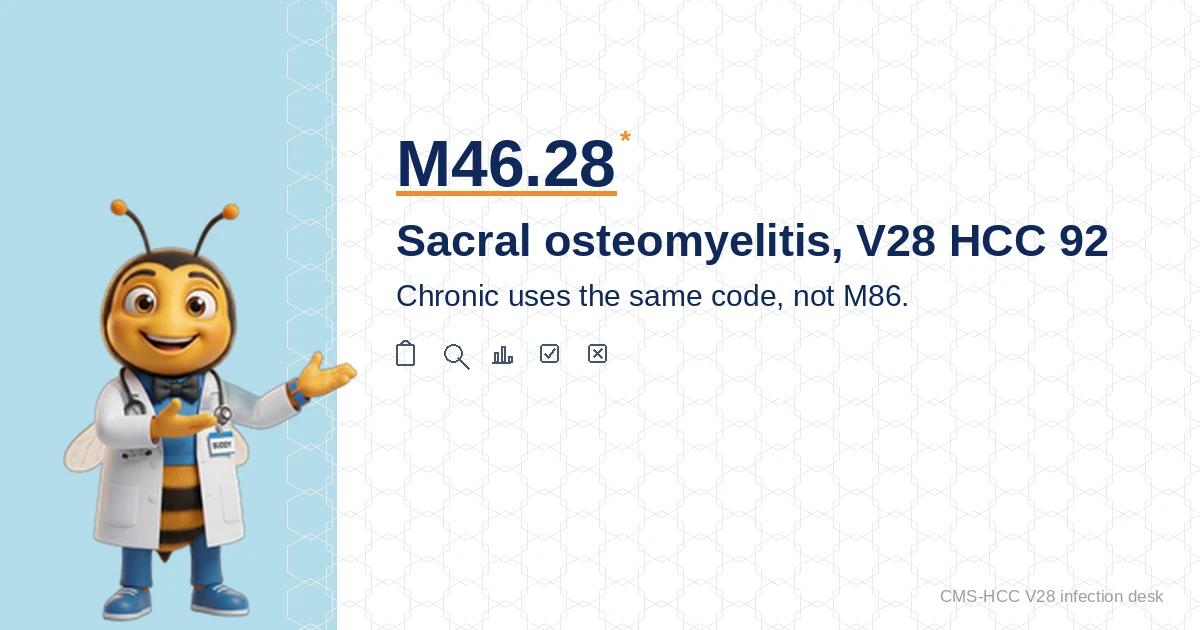
If you searched M46.28, sacral osteomyelitis ICD-10, or coccyx osteomyelitis ICD-10, here is the short answer. M46.28 (Osteomyelitis of vertebra, sacral and sacrococcygeal region) is the code for bone infection of the sacrum and the sacrococcygeal region. It maps to CMS-HCC V28 HCC 92 (Bone/Joint/Muscle/Severe Soft Tissue Infections/Necrosis) in the PY2026 V28 mappings, and the CMS 2027 Initial ICD-10-CM Mappings list it at V28 category 92 as well.
The code itself is simple. The questions around it are where charts go wrong. "Chronic" does not send you to a different code. A sacral pressure ulcer that reaches bone is not the same diagnosis as infection of the bone. Disc infection, unspecified discitis, and tuberculosis of the spine all sit in different places, and some of them carry no V28 category at all. This guide walks through each one at the desk.
The short version
| Code | What it is | V28 (PY2026) |
|---|---|---|
| M46.28 | Osteomyelitis of vertebra, sacral and sacrococcygeal region | HCC 92 |
| M46.27 | Osteomyelitis of vertebra, lumbosacral region | HCC 92 |
| M46.20 | Osteomyelitis of vertebra, site unspecified | HCC 92 |
| M46.38 | Infection of intervertebral disc (pyogenic), sacral and sacrococcygeal region | HCC 92 |
| M46.48 | Discitis, unspecified, sacral and sacrococcygeal region | No V28 map |
| M46.58 | Other infective spondylopathies, sacral and sacrococcygeal region | No V28 map |
| M46.1 | Sacroiliitis, not elsewhere classified | No V28 map |
| A18.01 | Tuberculosis of spine | No V28 map |
| L89.154 | Pressure ulcer of sacral region, stage 4 | HCC 379 |
| B95.61, B95.62, B95.7 | MSSA, MRSA, and other staphylococcus as the cause of diseases classified elsewhere | No V28 map |
Every HCC in this table comes from the PY2026 V28 mappings file, which has the same rows as the PY2027 initial V28 mapping, and each one matches the live code card. "No V28 map" means the code has no row in either file. M46.28 did not change in FY2027. It is billable in both the FY2026 and FY2027 order files.
How the Index gets you to M46.28
Start at the main term Osteomyelitis in the FY2027 Alphabetic Index. The subterm "vertebra" goes to M46.20, and under it "sacrococcygeal region" goes to M46.28. The Tabular title for M46.28 reads "sacral and sacrococcygeal region," so the sacrum and the sacrococcygeal region share this one code.
Two points save time here.
Acute and chronic land on the same code. Under Osteomyelitis, the subterms "acute," "chronic (or old)," and "subacute" each carry an entry for vertebra that says *see* Osteomyelitis, vertebra. So "chronic sacral osteomyelitis" and "acute osteomyelitis of the sacrum" both end at M46.28. Unlike category M86, subcategory M46.2 has no axis for acuity, a draining sinus, or a hematogenous route. Keep the provider's words in the record, but do not hunt for a "chronic" version of M46.28. There isn't one.
Vertebral osteomyelitis is not coded in M86. Category M86 (Osteomyelitis) has an Excludes2 note that lists osteomyelitis of the vertebra (M46.2-). That is why an M86 code for "other site" or "unspecified" is the wrong pick when the provider names the sacrum. M86.9 (Osteomyelitis, unspecified) is for osteomyelitis with no site or type documented. Once the sacrum is named, the Index path is M46.28.
Sacrum, lumbosacral, or a pelvic bone
The site has to match the bone the provider names.
- Sacrum or sacrococcygeal region. M46.28.
- Lumbosacral region. M46.27 (Osteomyelitis of vertebra, lumbosacral region). The Index lists "lumbosacral region" and "sacrococcygeal region" as separate subterms under Osteomyelitis, vertebra.
- More than one spinal region. Subcategory M46.2 has no "multiple sites" code. Guideline I.C.13.a.2 says codes describing specified sites are assigned individually by site when documented. If the provider documents infection in the lumbar spine and the sacrum, report each region that the provider names.
- Ischium or ilium. These are pelvic bones, not vertebrae, so the Index sends them to category M86. "Osteomyelitis, acute, ischium" goes to M86.18 (Other acute osteomyelitis, other site), and "Osteomyelitis, chronic, ischium" goes to M86.659. Both map to HCC 92. When a note says only "pelvic osteomyelitis" near a sacral wound, ask which bone is involved before you choose between M46.28 and an M86 code.
Bone, disc, or "discitis"
Category M46 holds several infection codes with the same sacral site character. They read alike and they do not map alike.
- Osteomyelitis of the vertebra: M46.2-. M46.28 maps to HCC 92.
- Infection of the intervertebral disc (pyogenic): M46.3-. The Index reaches it through "Infection, intervertebral disc, pyogenic," and "Discitis, pyogenic" says *see* that same entry. M46.38 (sacral and sacrococcygeal region) maps to HCC 92. Subcategory M46.3 carries a note to use an additional code (B95-B97) to identify the infectious agent.
- Discitis, unspecified: M46.4-. The Index sends plain "Discitis" to M46.40, and the sacral site is M46.48. There is no M46.4 row in the PY2026 V28 mappings.
- Other infective spondylopathies: M46.5-. "Spondylitis, infectious NEC" says *see* Spondylopathy, infective, which goes to M46.50. The sacral code M46.58 has no V28 row.
The difference between HCC 92 and no category can come down to one word. "Discitis" alone indexes to M46.4-. "Pyogenic discitis" indexes to M46.3-. "Osteomyelitis of the sacrum" indexes to M46.28. If the documentation describes both the disc and the bone, report what the provider documents for each, and query when the note uses one term in the assessment and another in the imaging summary.
M46.1 (Sacroiliitis, not elsewhere classified) is a joint inflammation code, not a bone infection code. It has no V28 row. Do not use it as a stand-in for sacral osteomyelitis.
The organism, and when it changes the code
Use additional code for the organism. Guideline I.C.1.b says that when an infection is classified outside Chapter 1 and the code does not name the organism, a code from B95, B96, or B97 is used as an additional code to identify it. In the FY2027 Tabular, the "use additional code (B95-B97)" note prints at category M86 and at subcategory M46.3, but not at subcategory M46.2. When the provider documents the organism for sacral osteomyelitis, the guideline still supports adding it after M46.28. For example, the Index lists methicillin resistant Staphylococcus aureus as a cause of disease classified elsewhere at B95.62. None of the B95 codes has a row in the V28 mappings, so the organism code adds detail, not a payment category.
Some organisms move the diagnosis to Chapter 1. Chapter 13 has an Excludes2 note for certain infectious and parasitic diseases (A00-B99), and the Index sends several organism-specific spine infections there:
- Tuberculosis. "Tuberculosis, sacrum" and "Tuberculosis, spine" go to A18.01 (Tuberculosis of spine), and the Tabular lists tuberculous osteomyelitis of spine as an inclusion term. A18.01 has no V28 row. Because A18.01 already includes tuberculous osteomyelitis of the spine, M46.28 is not added for the same infection.
- Gonococcal spondylitis. The Index sends it to A54.41, which maps to HCC 92.
- Typhoid and Salmonella osteomyelitis. The Index sends these to A01.05 and A02.24. Both map to HCC 92.
Sacral pressure ulcers and sacral osteomyelitis
Some of the searches that reach our M46.28 page mention a sacral wound. A deep sacral pressure ulcer and osteomyelitis of the sacrum are two separate diagnoses with two separate codes.
The pressure ulcer is coded from category L89 by site and stage. L89.154 (Pressure ulcer of sacral region, stage 4) includes the inclusion term "pressure ulcer with necrosis of soft tissues through to underlying muscle, tendon, or bone, sacral region." That term describes how deep the ulcer goes. It does not say the bone is infected. A stage 4 ulcer with exposed bone is not M46.28 unless the provider diagnoses osteomyelitis.
When the provider documents both, report both. Neither L89 nor M46.2 carries an Excludes1 note against the other, and the FY2027 Index has no combination entry for a pressure ulcer with osteomyelitis. Guideline I.C.12.a says to assign as many L89 codes as needed for all the pressure ulcers the patient has, and Section IV.J says to code all documented conditions that coexist and affect care.
In V28, the two codes sit in separate categories. L89.154 maps to HCC 379 (Pressure Ulcer of Skin with Necrosis Through to Muscle, Tendon, or Bone), and M46.28 maps to HCC 92. HCC 379 sits above HCC 380 to 383 in the hierarchy file, and no hierarchy row includes HCC 92, so both categories count when both codes are supported. For the stage rules for sacral ulcers, see our ulcer HCC desk guide for L89 and L97 codes.
Guideline I.B.14 adds one more check. A nurse or wound care clinician may document the pressure ulcer stage, but the pressure ulcer diagnosis must come from the patient's provider. The same holds for osteomyelitis: it is a provider diagnosis, not a reading of a wound note.
Epidural abscess and other nearby findings
An abscess in the spinal canal is coded on its own. The Tabular lists intraspinal epidural abscess as an inclusion term at G06.1 (Intraspinal abscess and granuloma), and category G06 has its own note to use an additional code (B95-B97) for the organism. G06.1 has no V28 row. When the provider documents both the abscess and the sacral osteomyelitis, each gets its own code.
FY2027: what changed and what did not
Nothing changed for subcategory M46.2 in FY2027. M46.20 through M46.28 appear as billable codes in both the FY2026 April and FY2027 order files, and the FY2027 order addenda have no M46 entries.
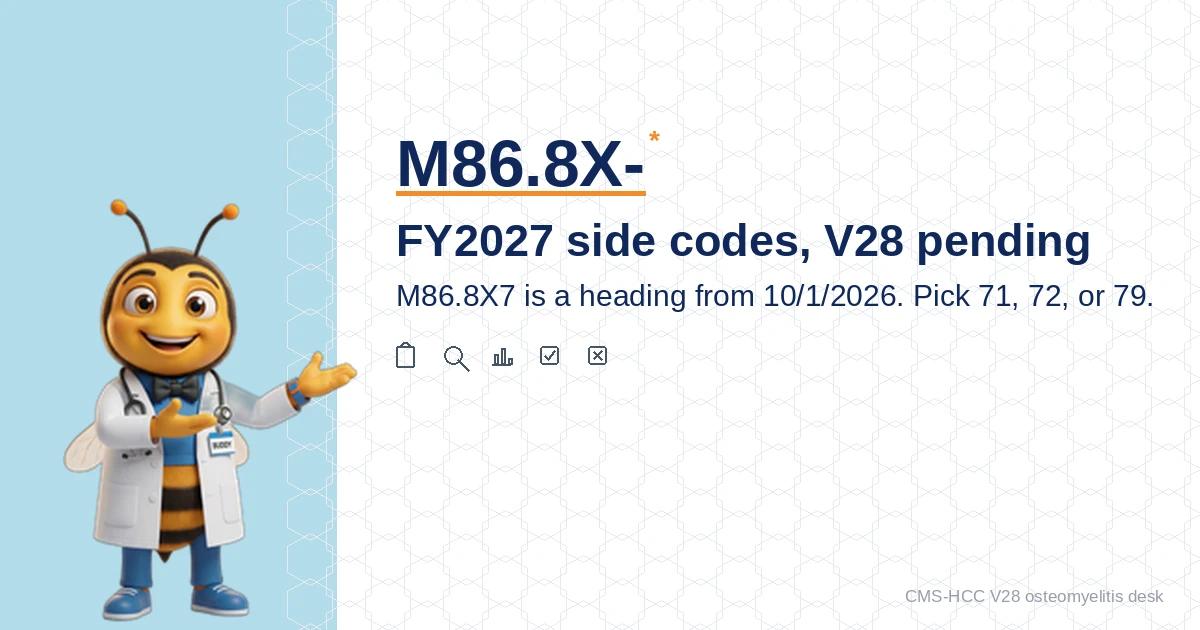
The FY2027 osteomyelitis changes were in M86.8X-, where FY2027 ICD-10-CM split the site codes by side and split "other site" into skull, face and sinuses, and other site. Those new codes, such as M86.8X89, are still pending a V28 map on their cards. Because vertebral osteomyelitis is excluded from category M86, that split does not touch sacral osteomyelitis.
What the record should show
MEAT (monitor, evaluate, assess, treat) is a review aid, not an official guideline, but it is a useful way to read a note for M46.28. MEAT is a review mnemonic, not a universal CMS coding rule. Follow the applicable coding, encounter, program, and payer requirements. Look for a provider statement that names the condition and the site, plus evidence that the condition was addressed at that visit. Examples include a current antibiotic plan, a referral or follow-up for the infection, a reviewed imaging result tied to the diagnosis, or an assessment of status.
Watch for these common gaps:
- Site not named. "Osteomyelitis" with no site indexes to M86.9. "Vertebral osteomyelitis" with no region indexes to M46.20. If other notes name the sacrum, query for the site.
- Resolved infection. Section IV.J says not to code conditions that were previously treated and no longer exist. A note that says "history of sacral osteomyelitis, treated last year, no current treatment" does not support M46.28 on that date of service.
- Uncertain wording in outpatient notes. Section IV.H says not to code diagnoses documented as "probable," "suspected," "questionable," or "rule out" in the outpatient setting. "Rule out sacral osteomyelitis" in an office note is coded to the documented signs, symptoms, or the ulcer, not M46.28. Section II.H handles uncertain diagnoses differently for inpatient admissions.
- A wound note standing in for a diagnosis. A wound care entry that says "bone palpable at base" documents depth. It does not establish osteomyelitis.
Sequencing
When M46.28 is reported with an organism code, the organism code follows it. Guideline I.B.7 says a "use additional code" instruction means the secondary code is added after the condition code. When the encounter covers both a sacral pressure ulcer and sacral osteomyelitis, no Tabular note fixes their order, so sequence by the reason for the encounter under the setting's own guidelines.
HCC 92 in the V28 hierarchy
In the PY2026 V28 hierarchy file, HCC 92 has its own row with no categories below it, and no other row lists HCC 92. Two practical results follow:
- Several HCC 92 codes on one record still count as one HCC 92. M46.28 with M86.18 for the ischium, or M46.28 with M72.6 (Necrotizing fasciitis), yields HCC 92 once.
- HCC 92 does not drop out when the patient also has a pressure ulcer HCC such as 379, or a cancer or diabetes HCC. Each category is assessed on its own row.
For how hierarchies work across the model, see HCC hierarchy and trumping rules explained.
Desk checklist
1. Confirm the provider documents osteomyelitis, not only a deep ulcer or exposed bone.
2. Confirm the bone: sacrum or sacrococcygeal region (M46.28), lumbosacral (M46.27), or a pelvic bone such as the ischium (category M86, by the Index).
3. Ignore "acute" and "chronic" for code choice in M46.2, but keep the wording in the record.
4. Separate bone from disc: pyogenic disc infection is M46.3-, unspecified discitis is M46.4-, and they do not map the same way.
5. Check for a Chapter 1 organism code that replaces M46.28, such as A18.01 for tuberculosis.
6. Add B95-B97 for a documented organism after M46.28.
7. Code the sacral pressure ulcer separately by stage when the provider documents it.
8. Do not code M46.28 for a resolved infection, or for a "rule out" in an outpatient note.
Sources
PY2026 CMS-HCC V28 ICD-10 mappings, hierarchy, and labels, and the PY2027 initial V28 mapping and hierarchy (the CMS files as stored by HCC Buddy); CMS 2027 Initial ICD-10-CM Mappings; FY2026 April and FY2027 ICD-10-CM order files and FY2027 order addenda; FY2027 ICD-10-CM Tabular List and Alphabetic Index; FY2027 ICD-10-CM Official Guidelines for Coding and Reporting, Sections I.B.7, I.B.14, I.C.1.b, I.C.12.a, I.C.13.a, II.H, IV.H, and IV.J. Code cards checked November 26, 2026.
Frequently asked questions
What is the ICD-10 code for sacral osteomyelitis?
M46.28 (Osteomyelitis of vertebra, sacral and sacrococcygeal region). It is billable in the FY2026 and FY2027 order files and maps to V28 HCC 92 (Bone/Joint/Muscle/Severe Soft Tissue Infections/Necrosis) in the PY2026 V28 mappings (M4628,92.0,,,).
Is there a separate code for chronic sacral osteomyelitis?
No. Under Osteomyelitis, the Index subterms acute, chronic (or old), and subacute each send vertebra to see Osteomyelitis, vertebra. Subcategory M46.2 has no acuity axis, so chronic sacral osteomyelitis is still M46.28.
What is the ICD-10 code for coccyx osteomyelitis?
The FY2027 Index lists the site under Osteomyelitis, vertebra, sacrococcygeal region, which goes to M46.28. The Tabular title is Osteomyelitis of vertebra, sacral and sacrococcygeal region, so the sacrum and the sacrococcygeal region share this one code.
Do I code a stage 4 sacral pressure ulcer and sacral osteomyelitis together?
Yes, when the provider documents both: L89.154 (Pressure ulcer of sacral region, stage 4), which maps to HCC 379 (L89154,379.0,,,), and M46.28, which maps to HCC 92. HCC 379 sits above HCC 380 to 383, and no hierarchy row includes HCC 92, so both categories count.
Is discitis the same as M46.28?
No. The Index sends plain Discitis to M46.40, and the sacral site is M46.48, which has no V28 row. Pyogenic disc infection is M46.3- (M46.38 maps to HCC 92). Bone infection of the sacrum is M46.28.
Is tuberculous osteomyelitis of the sacrum coded to M46.28?
No. The Index sends Tuberculosis, sacrum and Tuberculosis, spine to A18.01 (Tuberculosis of spine). The Tabular lists tuberculous osteomyelitis of spine as an inclusion term. A18.01 has no row in the PY2026 V28 mappings, and M46.28 is not added for the same infection.
What if the infection is of the ischium or ilium, not the sacrum?
Those are pelvic bones, not vertebrae, so the Index sends them to category M86. Osteomyelitis, acute, ischium goes to M86.18 (Other acute osteomyelitis, other site). Osteomyelitis, chronic, ischium goes to M86.659. Both map to HCC 92 (M8618,92.0,,, and M86659,92.0,,,).
Does HCC 92 drop when a sacral stage 4 pressure ulcer is also coded?
No. In the PY2026 V28 hierarchy file, HCC 92 has its own row with no categories below it (`HCC92,,,,,,`), and no other row lists HCC 92. HCC 379 supersedes HCC 380 to 383 (`HCC379,HCC380,HCC381,HCC382,HCC383,,`). Each category is assessed on its own row, so both can count when both codes are supported.
Related Tools
M46.28 card
Osteomyelitis of vertebra, sacral and sacrococcygeal region. Billable. V28 HCC 92.
M46.27 card
Osteomyelitis of vertebra, lumbosacral region. Billable. V28 HCC 92.
M46.38 card
Infection of intervertebral disc (pyogenic), sacral and sacrococcygeal region. Billable. V28 HCC 92.
L89.154 card
Pressure ulcer of sacral region, stage 4. Billable. V28 HCC 379.
A18.01 card
Tuberculosis of spine. Billable. No V28 HCC.
HCC 92 hub
Bone/Joint/Muscle/Severe Soft Tissue Infections/Necrosis. CNA ref 0.479. 609 mapped codes.
HCC 379 hub
Pressure Ulcer of Skin with Necrosis Through to Muscle, Tendon, or Bone. CNA ref 1.965. 25 mapped codes.
Encoder
Look up M46.28, the disc codes, and the sacral pressure ulcer codes with live V28 status.

HCC Buddy Coding Team
Editorial
Every HCC Buddy article is checked against the current CMS-HCC model and the active FY ICD-10-CM tabular release before it publishes.
Get HCC Coding Tips in Your Inbox
Join our newsletter for coding tips, guideline updates, and tool announcements.