
J91.0 Malignant Pleural Effusion: V28 HCC 17, Code First, and the C78.2 Question
Malignant pleural effusion is J91.0, V28 HCC 17 (PY2026). Code the cancer first, see when C78.2 also applies, and how mesothelioma and J90 effusions differ.
By the HCC Buddy Coding Team
Updated: November 27, 2026
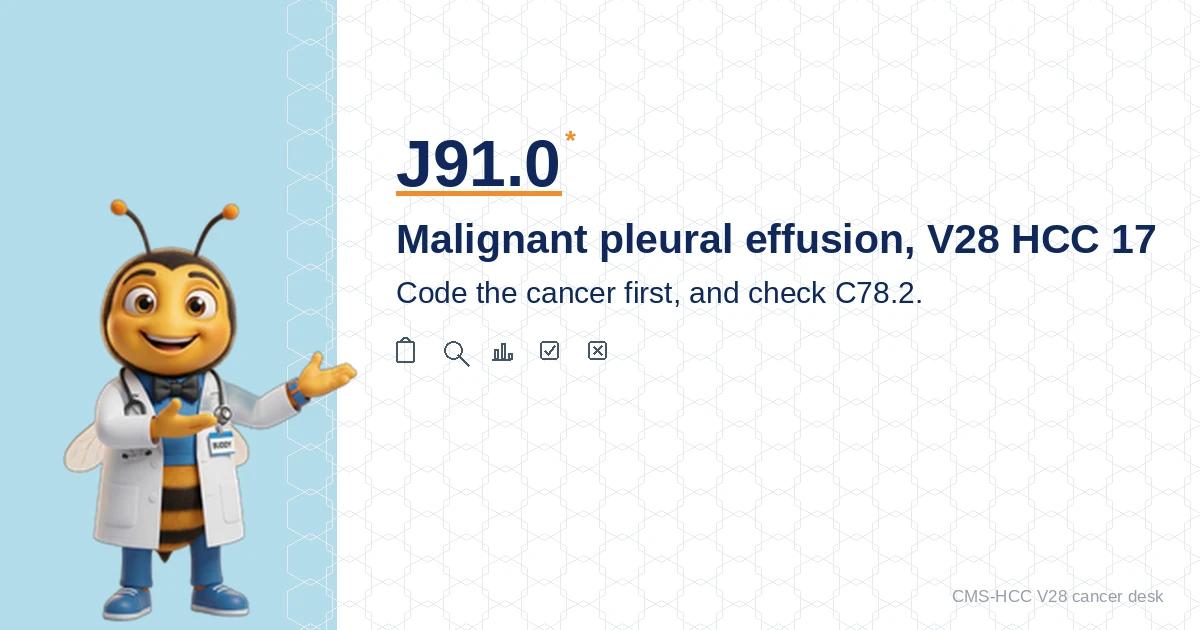
If you searched malignant pleural effusion ICD-10 or J91.0, here is the short answer. J91.0 (Malignant pleural effusion) maps to CMS-HCC V28 HCC 17 (Cancer Metastatic to Lung, Liver, Brain, and Other Organs; Acute Myeloid Leukemia Except Promyelocytic) in the PY2026 V28 mappings. The CMS 2027 Initial ICD-10-CM Mappings list it at V28 category 17 as well. J91.0 never stands alone. The FY2027 Tabular List puts one instruction under it: "Code first underlying neoplasm (C00-D49)."
That one note shapes the whole claim. You need the cancer code, you need it first, and you need to decide whether the provider has also documented spread to the pleura itself. This guide walks through those choices at the desk, along with the look-alike codes for effusions that are not malignant.
The short version
| Code | What it is | V28 (PY2026) |
|---|---|---|
| J91.0 | Malignant pleural effusion | HCC 17 |
| C78.2 | Secondary malignant neoplasm of pleura | HCC 17 |
| C38.4 | Malignant neoplasm of pleura (primary) | HCC 20 |
| C45.0 | Mesothelioma of pleura | HCC 19 |
| C34.90 | Malignant neoplasm of unspecified part of unspecified bronchus or lung | HCC 20 |
| C78.00 | Secondary malignant neoplasm of unspecified lung | HCC 17 |
| I31.31 | Malignant pericardial effusion in diseases classified elsewhere | HCC 17 |
| J90 | Pleural effusion, not elsewhere classified | No V28 map |
| J91.8 | Pleural effusion in other conditions classified elsewhere | No V28 map |
| J94.0 | Chylous effusion | No V28 map |
| J86.9 | Pyothorax without fistula (empyema) | HCC 283 |
| A15.6 | Tuberculous pleurisy | No V28 map |
Every HCC in this table comes from the PY2026 V28 mappings file, which has the same rows as the PY2027 initial V28 mapping, and each one matches the live code card. "No V28 map" means the code has no row in either file. J91.0 is billable in the FY2027 order file. It has no laterality, so a left, right, or bilateral malignant effusion is still J91.0.
What "code first" means for J91.0
Category J91 is titled "Pleural effusion in conditions classified elsewhere." J91.0 carries the note "Code first underlying neoplasm (C00-D49)."
The FY2027 guidelines explain how to read that note. Section I.B.7 says: "'Code first' notes are also under certain codes that are not specifically manifestation codes but may be due to an underlying cause. When there is a 'code first' note and an underlying condition is present, the underlying condition should be sequenced first, if known." Section I.A.13 adds that "code first" and "use additional code" notes indicate "the proper sequencing order of the codes, etiology followed by manifestation."
In practice, a malignant pleural effusion is a manifestation of a cancer that is coded somewhere in Chapter 2. A claim line with J91.0 and no neoplasm code is incomplete. If the record says "malignant pleural effusion" and you cannot find which cancer, that is a query, not a reason to drop the code-first step.
Which cancer code goes first
The underlying neoplasm is whatever the provider documents as the cause. Most often that is a primary cancer with its metastatic sites.
- A known primary. Code the primary from the malignant column of the Neoplasm Table, or from the histology term in the Alphabetic Index. For example, lung cancer with no further detail is C34.90, which maps to HCC 20 in the PY2026 V28 mappings.
- Other documented metastatic sites. The Chapter 2 general guidelines say that when a neoplasm is malignant, "any secondary (metastatic) sites should also be determined." Code each documented secondary site, such as C78.00 for metastasis to the lung or C78.7 for the liver.
- Primary not found. Guideline I.C.2.k says C80.1 (Malignant (primary) neoplasm, unspecified) "should only be used when no determination can be made as to the primary site of a malignancy." C80.1 maps to HCC 23.
- Primary removed and no longer treated. Guideline I.C.2.m says that when a primary has been excised or eradicated, no further treatment is directed to that site, and there is no evidence of disease there, a Z85 code is used for the former site. Guideline I.C.2.d adds that "any mention of extension, invasion, or metastasis to another site is coded as a secondary malignant neoplasm to that site." So a breast cancer that was removed years ago and is no longer treated, with documented pleural metastases today, is coded with the secondary site (C78.2) and a Z85 history code, such as Z85.3 (Personal history of malignant neoplasm of breast). No Z85 code has a row in the PY2026 V28 mappings.
J91.0 or C78.2: effusion versus pleural metastasis
This is the question most coders ask about this code. J91.0 and C78.2 are different codes that describe different things.
- J91.0 describes the fluid. The Alphabetic Index sends "Effusion, malignant pleural" and "Effusion, pleura, malignant" to J91.0.
- C78.2 describes tumor in the pleura itself. The Table of Neoplasms row "pleura, pleural (cavity)," including the parietal and visceral subterms, gives C78.2 in the secondary column.
The classification does not tell you to add C78.2 because an effusion is called malignant, and it does not tell you to replace J91.0 with C78.2. Code C78.2 when the provider documents pleural metastases, pleural tumor implants, or cancer "metastatic to the pleura." Code J91.0 when the provider documents a malignant effusion. When both are documented, both codes belong on the claim, with the cancer codes first. If the note says only "malignant effusion" and you cannot tell from the record whether the provider means pleural involvement, query rather than assume.
Both codes map to HCC 17, so the choice does not change the V28 category. It does change whether the claim says what the provider said.
When the pleura is the primary site
Not every pleural cancer is a metastasis. The Neoplasm Table row for the pleura gives C38.4 (Malignant neoplasm of pleura) in the primary column. But the guidelines tell you to check the histology first: "if the histological term is documented, that term should be referenced first, rather than going immediately to the Neoplasm Table."
For pleural mesothelioma, that order matters. The Index entry "Mesothelioma (malignant), site classification, pleura" goes to C45.0 (Mesothelioma of pleura), and C45.0 carries an Excludes1 note for "other malignant neoplasm of pleura (C38.4)." The two do not go together for the same tumor. In the PY2026 V28 mappings, C45.0 maps to HCC 19 (Myelodysplastic Syndromes, Multiple Myeloma, and Other Cancers) and C38.4 maps to HCC 20 (Lung and Other Severe Cancers). A malignant effusion from mesothelioma is C45.0 first, then J91.0.
Pleural effusion that is not malignant
A pleural effusion in a patient with cancer is not automatically malignant. The provider has to say so. Several Tabular notes keep these apart.
- J90, Pleural effusion, not elsewhere classified. This includes "Pleural effusion NOS." J90 has an Excludes1 note for malignant pleural effusion (J91.0), so the two are not coded together. If the provider documents an unspecified effusion without calling it malignant, J90 is the Index default ("Effusion, pleura"). When the provider documents a specific type, code that type instead, such as J94.0 for chylous effusion. J90 has no row in the PY2026 V28 mappings.
- J91.8, Pleural effusion in other conditions classified elsewhere. The Index sends "Effusion, pleura, in conditions classified elsewhere" here, with a code-first note for the underlying disease, such as filariasis or influenza. J91.8 has no V28 row.
- Heart failure and lupus. Category J91 has Excludes2 notes for "pleural effusion in heart failure (I50.-)" and "pleural effusion in systemic lupus erythematosus (M32.13)." Under Guideline I.A.12.b, an Excludes2 note means the excluded condition is not part of the code, and both may be reported when the patient has both. M32.13 (Lung involvement in systemic lupus erythematosus) lists "Pleural effusion due to systemic lupus erythematosus" as an inclusion term. It maps to HCC 94 and HCC 280 in the PY2026 V28 mappings. I50.9 (Heart failure, unspecified) maps to HCC 226.
- Chylous effusion, empyema, tuberculosis. J90 has Excludes1 notes for chylous effusion (J94.0, no V28 row) and tuberculous pleural effusion (A15.6, no V28 row). An infected pleural space documented as empyema is J86.9 (Pyothorax without fistula), which maps to HCC 283 (Empyema, Lung Abscess).
A sibling code: malignant pericardial effusion
The heart has a matching code. I31.31 (Malignant pericardial effusion in diseases classified elsewhere) carries the same "Code first underlying neoplasm (C00-D49)" note and also maps to HCC 17. The Index sends "Effusion, pericardium, malignant, in disease classified elsewhere" to I31.31. A pericardial effusion that is not described as malignant goes elsewhere in I31.3, such as I31.39, which has no V28 row. A malignant pleural effusion and a malignant pericardial effusion are two codes when the provider documents both.
Sequencing
The order of codes on a claim does not change the V28 category, but the claim still has to follow the guidelines.
- Any encounter with J91.0. The neoplasm code goes before J91.0, per the code-first note.
- Thoracentesis. Guideline I.C.2.f says: "When the reason for admission/encounter is to determine the extent of the malignancy, or for a procedure such as paracentesis or thoracentesis, the primary malignancy or appropriate metastatic site is designated as the principal or first-listed diagnosis, even though chemotherapy or radiotherapy is administered." J91.0 follows the cancer codes.
- Treatment directed at the primary, or at a metastatic site only. Guideline I.C.2.l.1 puts the primary first, followed by the metastatic sites. Guideline I.C.2.l.2 puts the metastatic site first when treatment is directed only toward it, with the primary as an additional code.
- Chemotherapy, immunotherapy, or external beam radiation as the reason for the encounter. Guideline I.C.2.e.2 says to list the Z51 encounter code (Z51.0, Z51.11, or Z51.12) first and the malignancy as a secondary diagnosis, for example Z51.11 (Encounter for antineoplastic chemotherapy).
- Insertion or implantation of radioactive elements (for example, brachytherapy) as the reason for the encounter. Guideline I.C.2.e.2 says to sequence the malignancy first. Do not assign Z51.0.
How the V28 hierarchy plays out
In the V28 hierarchy file, HCC 17 sits at the top of the cancer group and supersedes HCC 18, 19, 20, 21, 22, and 23. With J91.0 supported:
- J91.0 with C34.90 for the lung primary: both are coded. HCC 17 counts, and HCC 20 drops.
- J91.0 with C45.0 for pleural mesothelioma: HCC 17 counts, and HCC 19 drops.
- J91.0 with C80.1 for an unknown primary: HCC 17 counts, and HCC 23 drops.
- J91.0 with C78.2, C78.00, or I31.31: all map to HCC 17, which counts once.
This is also why J91.0 deserves a careful look before you submit. On its own row, it carries HCC 17, the highest cancer category in the model. A J91.0 that is not supported by documentation can lift a record to HCC 17 when the documented cancer maps lower. Code every supported site, and let the hierarchy sort the categories. For more on how categories drop, see Hierarchy and trumping rules.
What the record should show
J91.0 counts only when the malignant effusion is current. For treating encounters, the provider also needs to document the condition and show that it was monitored, evaluated, assessed, or treated at that visit. For outpatient diagnostic-services-only encounters under Section IV.K, a confirmed or definitive diagnosis in a physician's final interpretation, available at the time of coding, can support J91.0. A problem list that still says "malignant pleural effusion" months after the effusion resolved does not meet that bar. Section IV.J says: "Do not code conditions that were previously treated and no longer exist." For the full checklist, see MEAT criteria for HCC coding. MEAT is a review mnemonic, not a universal CMS coding rule. Follow the applicable coding, encounter, program, and payer requirements.
Pending results need care in the outpatient setting. Section IV.H says not to code a diagnosis documented as "probable," "suspected," "questionable," "rule out," "compatible with," "consistent with," or "working diagnosis." A clinic note that says "effusion, suspect malignant, cytology pending" is not J91.0. Code to the highest degree of certainty instead, which is usually J90 for the effusion, along with the cancer codes that are already confirmed. The inpatient rule for uncertain diagnoses is different, and Section IV.H notes that difference.
Guideline I.B.14 says code assignment is based on the documentation by the patient's provider, the practitioner "legally accountable for establishing the patient's diagnosis." Outside the Section IV.K exception below, a pathology or imaging report in the chart is not a substitute for the treating provider documenting the malignant effusion. Section IV.K covers outpatient encounters where the patient receives diagnostic services only. For diagnostic tests that have been interpreted by a physician, with the final report available at the time of coding, code any confirmed or definitive diagnosis documented in the interpretation.
Audit pitfalls to check before you submit
- J91.0 reported without a neoplasm code, or with the neoplasm listed after it.
- J91.0 coded for "pleural effusion" in a patient with cancer when the provider never called the effusion malignant.
- J90 and J91.0 reported together for the same effusion, against the Excludes1 note.
- C78.2 added for every malignant effusion without documented pleural metastasis, or J91.0 dropped when C78.2 is coded.
- Pleural mesothelioma coded to C38.4 instead of C45.0.
- A left or right malignant effusion searched for a laterality code that does not exist.
- J91.0 carried forward from an old problem list after the effusion resolved.
- J91.0 captured from "suspicious for malignant effusion" wording in an outpatient note.
Quick desk checklist
1. Confirm the provider calls the effusion malignant. If not, J90 or another effusion code applies.
2. Find the underlying cancer and code it first. Check the histology before the Neoplasm Table.
3. Code each documented metastatic site. Add C78.2 only when the provider documents pleural involvement.
4. For pleural mesothelioma, use C45.0, not C38.4.
5. Use C80.1 only when no primary can be determined. If the primary was removed and is not being treated, use its Z85 code and keep the active secondary sites.
6. Sequence by the encounter: the cancer before J91.0, and the cancer first for a thoracentesis.
7. Confirm current disease. For treating encounters, confirm MEAT on the date of service. For Section IV.K diagnostic-only encounters, a confirmed diagnosis in the physician's final interpretation can support the code. Do not code uncertain outpatient wording.
8. Confirm the V28 category on the live code card for the payment year you are scoring.
Related HCC Buddy pages
- J91.0 code card
- J90 code card
- C78.2 code card
- C45.0 code card
- C38.4 code card
- I31.31 code card
- C80.1 code card
- V28 HCC 17
- V28 HCC 19
- V28 HCC 20
- C78.7 liver metastasis desk guide
- Hierarchy and trumping rules
- MEAT criteria for HCC coding
Sources
- HCC Buddy live code cards for every code in this guide, and the V28 HCC 17, 19, 20, 23, 226, and 283 pages, checked November 27, 2026.
- PY2026 CMS-HCC V28 ICD-10 mappings file, V28 hierarchy file, and V28 relative factors file on HCC Buddy main, plus the PY2027 initial V28 mapping on HCC Buddy main.
- CMS 2027 Initial ICD-10-CM Mappings file ("Includes ICD-10 codes valid in FY2025 and FY2026").
- FY2027 ICD-10-CM order file.
- FY2027 ICD-10-CM Tabular List (J90, J91, J94, J86, I31.3, C34, C38.4, C45, C78, C80, M32.13, A15.6), FY2027 Table of Neoplasms (pleura, parietal, visceral), FY2027 Alphabetic Index ("Effusion," "Mesothelioma"), and FY2027 ICD-10-CM Official Guidelines for Coding and Reporting, Sections I.A.12, I.A.13, I.B.7, I.B.14, I.C.2 (general, d, e, f, k, l, m), IV.H, IV.J, and IV.K.
V28 mappings come from the cited live code pages and the PY2026 V28 mappings file. Not medical advice. Not a Coding Clinic reprint.
Current as of November 27, 2026. Always confirm the V28 mapping for the payment year you are scoring and the live code card before you lock a map claim. The map claims here come from the PY2026 V28 mappings file and the PY2027 initial V28 file, which have the same rows.
Frequently asked questions
What is the ICD-10 code for malignant pleural effusion?
J91.0 (Malignant pleural effusion). It is billable in the FY2026 and FY2027 order files and maps to V28 HCC 17 (Cancer Metastatic to Lung, Liver, Brain, and Other Organs; Acute Myeloid Leukemia Except Promyelocytic) in the PY2026 V28 mappings (J910,17.0,,,). Code the underlying cancer first.
Is there a left or right code for malignant pleural effusion?
No. J91.0 has no laterality, so a left, right, or bilateral malignant effusion is still J91.0.
Do I code C78.2 with J91.0?
Only when the provider documents pleural metastases, pleural tumor implants, or cancer metastatic to the pleura. C78.2 describes tumor in the pleura (C782,17.0,,,); J91.0 describes the effusion. Both map to HCC 17, and both belong on the claim when both are documented, with the cancer codes first.
Can J91.0 be the first-listed code?
The J91.0 note says to code first the underlying neoplasm (C00-D49). Guideline I.C.2.f also puts the primary malignancy or appropriate metastatic site first when the encounter is for a procedure such as thoracentesis. J91.0 follows the cancer codes.
What if the provider does not call the effusion malignant?
Use J90 (Pleural effusion, not elsewhere classified) when the effusion is unspecified and not called malignant. The Index sends Effusion, pleura to J90, and J90 has an Excludes1 note for malignant pleural effusion (J91.0). If the provider documents a specific type, code that type instead, such as J94.0 for chylous effusion. J90 has no row in the PY2026 V28 mappings.
How is a malignant effusion from pleural mesothelioma coded?
C45.0 (Mesothelioma of pleura) first, then J91.0. C45.0 maps to HCC 19 (C450,19.0,,,) and carries an Excludes1 note for other malignant neoplasm of pleura (C38.4), so do not add C38.4 for the same tumor. In the V28 hierarchy, HCC 17 supersedes HCC 19, so HCC 17 counts.
What if the primary site cannot be determined?
Guideline I.C.2.k says C80.1 (Malignant (primary) neoplasm, unspecified) should only be used when no determination can be made as to the primary site. C80.1 maps to HCC 23 (C801,23.0,,,). With supported J91.0, HCC 17 counts and HCC 23 drops.
Does HCC 17 drop when a lung primary is also coded?
No. In the PY2026 V28 hierarchy file, HCC 17 supersedes HCC 18, 19, 20, 21, 22, and 23 (`HCC17,HCC18,HCC19,HCC20,HCC21,HCC22,HCC23`), and no category supersedes HCC 17. J91.0 with C34.90 (C3490,20.0,,,) keeps HCC 17, and HCC 20 drops.
Related Tools
J91.0 card
Malignant pleural effusion. Billable. V28 HCC 17.
C78.2 card
Secondary malignant neoplasm of pleura. Billable. V28 HCC 17.
C45.0 card
Mesothelioma of pleura. Billable. V28 HCC 19.
C38.4 card
Malignant neoplasm of pleura. Billable. V28 HCC 20.
J90 card
Pleural effusion, not elsewhere classified. Billable. No V28 HCC.
I31.31 card
Malignant pericardial effusion in diseases classified elsewhere. Billable. V28 HCC 17.
HCC 17 hub
Cancer Metastatic to Lung, Liver, Brain, and Other Organs; Acute Myeloid Leukemia Except Promyelocytic. CNA ref 4.209. 78 mapped codes.
Encoder
Look up J91.0, C78.2, and the pleural effusion look-alikes with live V28 status.

HCC Buddy Coding Team
Editorial
Every HCC Buddy article is checked against the current CMS-HCC model and the active FY ICD-10-CM tabular release before it publishes.
Get HCC Coding Tips in Your Inbox
Join our newsletter for coding tips, guideline updates, and tool announcements.