
C78.7 Liver Metastasis: V28 HCC 17, Primary vs Secondary, and the History Trap
Secondary liver cancer is C78.7, V28 HCC 17 (PY2026). See when liver cancer is C22 instead, plus carcinoid, hepatic nodes, unknown primary, and Z85 history.
By the HCC Buddy Coding Team
Updated: November 25, 2026
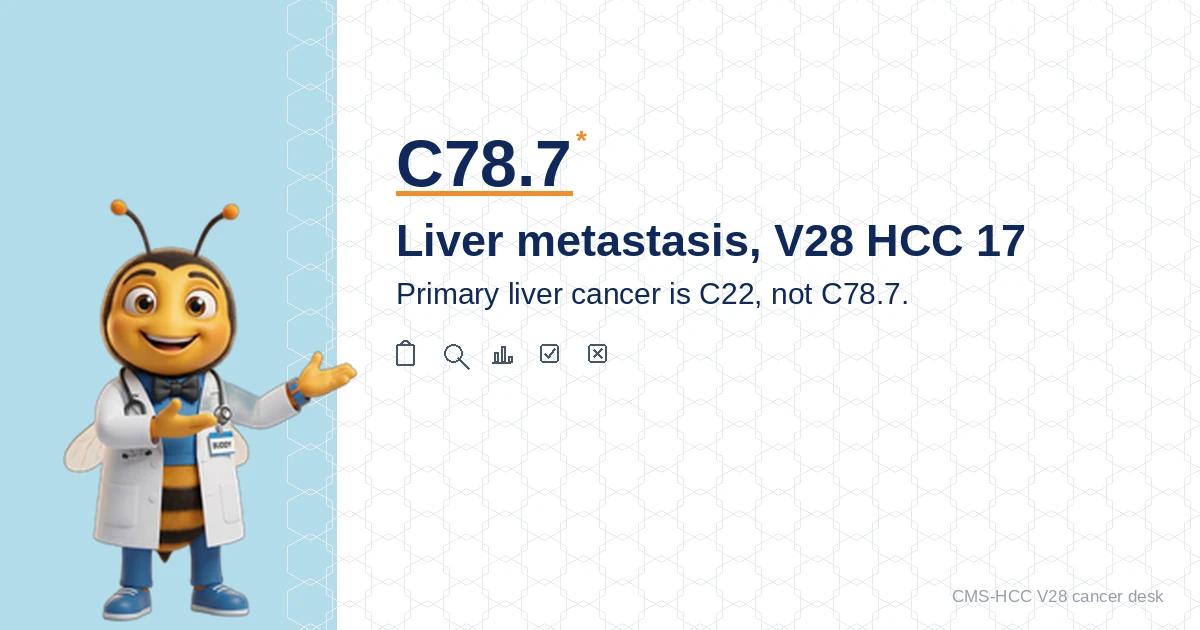
If you searched C78.7, secondary liver cancer ICD-10, or liver metastasis ICD-10, here is the short answer. C78.7 (Secondary malignant neoplasm of liver and intrahepatic bile duct) is the code for cancer that started somewhere else and spread to the liver. It maps to CMS-HCC V28 HCC 17 (Cancer Metastatic to Lung, Liver, Brain, and Other Organs; Acute Myeloid Leukemia Except Promyelocytic) in the PY2026 V28 mappings, and the CMS 2027 Initial ICD-10-CM Mappings list it at V28 category 17 as well.
The harder part is everything around it. A note that says "liver cancer" is not automatically C78.7. Cancer that started in the liver goes to category C22, which maps to a different HCC. Secondary carcinoid in the liver has its own code. Hepatic lymph nodes are not the liver. And once the liver disease is gone, the history codes follow their own rule. This guide walks through each of those at the desk.
The short version
| Code | What it is | V28 (PY2026) |
|---|---|---|
| C78.7 | Secondary malignant neoplasm of liver and intrahepatic bile duct | HCC 17 |
| C7B.02 | Secondary carcinoid tumors of liver | HCC 17 |
| C78.89 | Secondary malignant neoplasm of other digestive organs (used for extrahepatic bile ducts) | HCC 17 |
| C22.0 | Liver cell carcinoma (hepatocellular carcinoma, hepatoma) | HCC 20 |
| C22.1 | Intrahepatic bile duct carcinoma (cholangiocarcinoma) | HCC 20 |
| C22.8 | Malignant neoplasm of liver, primary, unspecified as to type | HCC 20 |
| C22.9 | Malignant neoplasm of liver, not specified as primary or secondary | HCC 20 |
| C77.2 | Secondary and unspecified malignant neoplasm of intra-abdominal lymph nodes (the Neoplasm Table sends hepatic and porta hepatis nodes here) | HCC 18 |
| R16.0, R93.2 | Hepatomegaly NEC; abnormal findings on diagnostic imaging of liver and biliary tract | No V28 map |
| Z85.05, Z85.89 | Personal history of malignant neoplasm of liver; of other organs and systems | No V28 map |
Every HCC in this table comes from the PY2026 V28 mappings file, which has the same rows as the PY2027 initial V28 mapping, and each one matches the live code card. "No V28 map" means the code has no row in either file. C78.7 did not change in FY2027. It is billable in both the FY2026 and FY2027 order files.
Primary or secondary: read the words, then the table
The single most common C78.7 error is a direction error. Some of the searches that reach our C78.7 page are for "liver cell carcinoma" and "hepatocellular carcinoma." Those are primary liver cancers, and they do not belong in C78.7.
The FY2027 guidelines tell you where to start. Section I.C.2 says to reference the Neoplasm Table first, but if a histological term is documented, look up that term in the Alphabetic Index before going to the table. For the liver, that order matters:
- Hepatocellular carcinoma or hepatoma. The Index sends "Cancer, hepatocellular" to C22.0, and the Tabular lists hepatocellular carcinoma and hepatoma as inclusion terms there.
- Cholangiocarcinoma. "Cholangiocarcinoma, liver" goes to C22.1 (Intrahepatic bile duct carcinoma).
- "Primary liver cancer" with no type. The Neoplasm Table row "liver, primary" gives C22.8 in the primary column.
- "Liver cancer" with no word about primary or secondary. The Neoplasm Table row "liver" gives C22.9 (Malignant neoplasm of liver, not specified as primary or secondary) in the primary column and C78.7 in the secondary column.
- Metastatic to the liver, or spread to the liver. The Index entry "Metastasis, metastatic, cancer, to specified site" says see Neoplasm, secondary, by site. That is the C78.7 path.
Category C22 carries an Excludes1 note for C78.7. A liver tumor is either a primary liver cancer or a metastasis to the liver, and the code follows what the provider documents. Do not pick C78.7 because the patient has cancer somewhere else, and do not pick C22.9 because the note says "liver lesion" without saying whether the tumor started there. When the record is unclear, query.
V28 makes the stakes plain. C22.0 through C22.9 map to HCC 20 (Lung and Other Severe Cancers), and C78.7 maps to HCC 17. The code drives the category, never the other way around.
"Metastatic from" versus "metastatic to"
The Index splits the phrase in two. "Metastasis, metastatic, cancer, from specified site" says see Neoplasm, malignant, by site. "To specified site" says see Neoplasm, secondary, by site. So "colon cancer metastatic to the liver" needs two codes: the colon primary from the malignant column (for example, C18.9, Malignant neoplasm of colon, unspecified, HCC 22) and C78.7 for the liver.
The Chapter 2 general guidelines say that when a neoplasm is malignant, any secondary (metastatic) sites should also be determined. Code the primary and each documented secondary site. Guideline I.C.2.j says C80.0 (Disseminated malignant neoplasm, unspecified) is only for advanced metastatic disease with no known primary or secondary sites, and it should not replace codes for the primary site and all known secondary sites. Once liver metastases are documented, a secondary site is known.
When the primary is unknown
Sometimes the provider documents liver metastases and states that the primary site has not been found. Guideline I.C.2.k says C80.1 (Malignant (primary) neoplasm, unspecified) should only be used when no determination can be made as to the primary site. That is the situation it fits: C78.7 for the liver, plus C80.1 for the unknown primary.
Do not use C80.1 just because the primary is missing from today's note. If the primary is documented elsewhere in the record for the same encounter, or the provider can name it, code it or query. C80.1 maps to HCC 23 in the PY2026 V28 mappings, and HCC 17 sits above it in the hierarchy, so the choice does not change the V28 category. It does change whether the claim is accurate.
Bile ducts, hepatic nodes, and carcinoid
Intrahepatic versus extrahepatic bile ducts. C78.7 covers the liver and the intrahepatic bile ducts. In the Neoplasm Table, "intrahepatic (bile) duct" gives C78.7 in the secondary column, while "extrahepatic (bile) duct" and "gall duct (extrahepatic)" give C78.89. Both map to HCC 17, but they are different codes, so the documented site still matters.
Hepatic and porta hepatis lymph nodes. These are lymph nodes, not liver. The Neoplasm Table lists "lymph gland (secondary), hepatic" and "porta hepatis" at C77.2 (Secondary and unspecified malignant neoplasm of intra-abdominal lymph nodes), which maps to HCC 18. If the report describes involved nodes at the porta hepatis and no lesion in the liver itself, C78.7 is not the code.
Secondary carcinoid tumors. Category C78 has an Excludes1 note for secondary carcinoid tumors of liver (C7B.02). The Index entry "Tumor, carcinoid, secondary, liver" goes to C7B.02 (Secondary carcinoid tumors of liver), which maps to HCC 17. Category C7B has a "Use additional code to identify any functional activity" note. A primary malignant carcinoid goes to category C7A by site. For example, C7A.00 (Malignant carcinoid tumor of unspecified site) maps to HCC 21.
Sequencing
The order of codes on a claim does not change the V28 category, but the claim still has to follow the guidelines.
- Treatment directed at the primary. Guideline I.C.2.a and I.C.2.l.1 put the primary malignancy first, followed by any metastatic sites.
- Treatment directed only at the liver metastases. Guideline I.C.2.b and I.C.2.l.2 put the secondary site first, even though the primary is still present. The primary is coded as an additional code.
- Chemotherapy, immunotherapy, or external beam radiation as the reason for the encounter. Guideline I.C.2.e.2 says to list the Z51 encounter code (Z51.0, Z51.11, or Z51.12) first and the malignancy as a secondary diagnosis.
- Insertion or implantation of radioactive elements (for example, brachytherapy) as the reason for the encounter. Guideline I.C.2.e.2 says to sequence the malignancy first. Do not assign Z51.0.
- Signs and symptoms. Guideline I.C.2.g says that Chapter 18 symptoms tied to an existing primary or secondary malignancy cannot replace the malignancy as the first-listed diagnosis. If malignant ascites is documented, R18.0 has its own "code first" note for the malignancy.
How the V28 hierarchy plays out
In the V28 hierarchy file, HCC 17 supersedes HCC 18, 19, 20, 21, 22, and 23. When C78.7 is supported, it is the cancer category that counts:
- C78.7 with C18.9: both are coded. HCC 17 counts, and HCC 22 drops.
- C78.7 with bone metastasis (C79.51, HCC 18) or hepatic node involvement (C77.2, HCC 18): HCC 17 counts, and HCC 18 drops.
- C78.7 with C80.1 for an unknown primary: HCC 17 counts, and HCC 23 drops.
- C78.7 with other HCC 17 codes, such as C78.00 for lung metastasis or R18.0: HCC 17 counts once.
The hierarchy works on what was coded correctly. Code every documented site, and let the model sort the categories. For more on how categories drop, see Hierarchy and trumping rules.
The history trap
Liver metastases are often treated, and sometimes they are gone. The guidelines draw the line carefully.
Guideline I.C.2.m says that when a primary malignancy has been excised or eradicated, no further treatment is directed to that site, and there is no evidence of any existing primary malignancy at that site, you use a Z85 code for the former site. If treatment is still directed to the site, the malignancy code stays until treatment is completed. Guideline I.C.2.d adds that any mention of extension, invasion, or metastasis to another site is coded as a secondary malignant neoplasm of that site. So a colon primary that was removed years ago, with no treatment now directed to the colon and no evidence of disease there, but with active liver metastases today, is C78.7 plus Z85.038 (Personal history of other malignant neoplasm of large intestine), not C18.9.
The same guideline limits the history codes. Codes in Z85.0 through Z85.85 are only for the former site of a primary malignancy. Z85.05 (Personal history of malignant neoplasm of liver) is for a former primary liver cancer, not for liver metastases that have resolved. Guideline I.C.2.m says Z85.89 may be assigned for the former site of either a primary or a secondary malignancy. None of the Z85 codes in this guide has a row in the PY2026 V28 mappings.
Treatment timing is a clinical fact the provider has to document. If the note does not make clear whether the liver disease is current, query rather than assume either way.
MEAT and uncertain wording
For HCC reporting, C78.7 needs current liver metastases documented in the eligible encounter record. Section IV.J says to code all documented conditions that coexist at the time of the encounter/visit and that "require or affect patient care, treatment or management," and not to code conditions that were previously treated and no longer exist. Review the full eligible record for documentation support, and apply the payer and program requirements that govern HCC reporting. MEAT is a review mnemonic, not a universal CMS coding rule. For the full checklist, see MEAT criteria for HCC coding.
Imaging language needs extra care in the outpatient setting. Section IV.H says not to code a diagnosis documented as "probable," "suspected," "questionable," "rule out," "compatible with," "consistent with," or "working diagnosis." A clinic note that says "liver lesions concerning for metastases, biopsy pending" is not C78.7. Code to the highest degree of certainty instead. The Index sends "Abnormal, diagnostic imaging, liver" to R93.2, and "Mass, liver" to R16.0. Neither has a row in the PY2026 V28 mappings. The inpatient rule for uncertain diagnoses is different, and Section IV.H notes that difference.
Guideline I.B.14 says code assignment is based on the documentation by the patient's provider, the practitioner legally accountable for establishing the diagnosis. Outside the Section IV.K exception below, a radiology impression in the chart is not a substitute for the treating provider documenting and assessing the liver metastases. Section IV.K covers outpatient encounters where the patient receives diagnostic services only. For diagnostic tests that have been interpreted by a physician, with the final report available at the time of coding, code any confirmed or definitive diagnosis documented in the interpretation.
Audit pitfalls to check before you submit
- C78.7 coded for hepatocellular carcinoma or cholangiocarcinoma, which belong in C22.
- C22.9 coded for "liver metastases" because the note said "liver cancer" in one place.
- C78.7 coded for porta hepatis or hepatic node involvement, which goes to C77.2.
- C78.7 coded for a secondary carcinoid of the liver, which goes to C7B.02.
- C80.0 or C80.1 used when the primary and secondary sites are documented.
- A resolved liver metastasis reported as Z85.05, which is only for a former primary liver cancer.
- C78.7 captured from "suspicious for metastasis" wording in an outpatient note.
- C78.7 carried forward from an old problem list with no assessment on the date of service.
Quick desk checklist
1. Find the histology first. Hepatocellular carcinoma and cholangiocarcinoma go to C22.
2. Decide direction. "Metastatic to the liver" is C78.7. "Liver cancer" with no direction is C22.9. Query when the notes conflict.
3. Separate the liver from nearby sites: extrahepatic bile ducts (C78.89), hepatic and porta hepatis nodes (C77.2), and secondary carcinoid (C7B.02).
4. Code the primary site too. Use C80.1 only when no primary can be determined.
5. Use the Z85 code for the primary only when it was excised or eradicated, no further treatment is directed to that site, and there is no evidence of any existing primary malignancy at that site (Guideline I.C.2.m). If treatment is still directed to that site, or there is evidence of existing primary malignancy there, code the primary as current disease. Keep C78.7 for active liver disease.
6. Sequence by what the encounter treats: the primary, the liver metastases, or a Z51 encounter.
7. Confirm current disease and documentation support in the full eligible record, under the payer and program requirements for HCC reporting. Do not code uncertain outpatient wording.
8. Confirm the V28 category on the live code card for the payment year you are scoring.
Related HCC Buddy pages
- C78.7 code card
- C7B.02 code card
- C22.0 code card
- C22.1 code card
- C22.9 code card
- C77.2 code card
- C80.1 code card
- R18.0 code card
- Z85.89 code card
- V28 HCC 17
- V28 HCC 18
- V28 HCC 20
- Hierarchy and trumping rules
- MEAT criteria for HCC coding
Sources
- HCC Buddy live code cards for every code in this guide, and the V28 HCC 17, 18, 20, 22, and 23 pages, checked November 25, 2026.
- PY2026 CMS-HCC V28 ICD-10 mappings file, V28 hierarchy file, and V28 relative factors file on HCC Buddy main, plus the PY2027 initial V28 mapping on HCC Buddy main.
- CMS 2027 Initial ICD-10-CM Mappings file ("Includes ICD-10 codes valid in FY2025 and FY2026").
- FY2026 (April 1, 2026) and FY2027 ICD-10-CM order files.
- FY2027 ICD-10-CM Tabular List (C22, C78, C7B, C80, R18), FY2027 Table of Neoplasms (liver, liver primary, intrahepatic and extrahepatic bile ducts, hepatic and porta hepatis lymph nodes), FY2027 Alphabetic Index ("Metastasis, metastatic," "Cancer, hepatocellular," "Cholangiocarcinoma," "Tumor, carcinoid, secondary," "Mass, liver," "Abnormal, diagnostic imaging, liver"), and FY2027 ICD-10-CM Official Guidelines for Coding and Reporting, Sections I.C.2 (general, a, b, d, g, j, k, l, m) and IV.H.
V28 mappings come from the cited live code pages and the PY2026 V28 mappings file. Not medical advice. Not a Coding Clinic reprint.
Current as of November 25, 2026. Always confirm the V28 mapping for the payment year you are scoring and the live code card before you lock a map claim. The map claims here come from the PY2026 V28 mappings file and the PY2027 initial V28 file, which have the same rows.
Frequently asked questions
What is the ICD-10 code for secondary liver cancer?
C78.7 (Secondary malignant neoplasm of liver and intrahepatic bile duct). It is billable in the FY2026 and FY2027 order files and maps to V28 HCC 17 (Cancer Metastatic to Lung, Liver, Brain, and Other Organs; Acute Myeloid Leukemia Except Promyelocytic) in the PY2026 V28 mappings (C787,17.0,,,).
Is hepatocellular carcinoma coded to C78.7?
No. Hepatocellular carcinoma is a primary liver cancer. The Index sends Cancer, hepatocellular to C22.0 (Liver cell carcinoma), which lists hepatocellular carcinoma and hepatoma as inclusion terms. C22.0 maps to HCC 20 (Lung and Other Severe Cancers), not HCC 17.
What if the note says only "liver cancer"?
The Neoplasm Table row for liver gives C22.9 (Malignant neoplasm of liver, not specified as primary or secondary) in the primary column and C78.7 in the secondary column. Code what the provider documents, and query when other notes describe metastatic disease.
How do I code liver metastases with an unknown primary?
C78.7 for the liver plus C80.1 (Malignant (primary) neoplasm, unspecified), when no determination can be made as to the primary site (Guideline I.C.2.k). HCC 17 sits above HCC 23 (C80.1) in the V28 hierarchy, so HCC 17 counts.
Is secondary carcinoid of the liver coded to C78.7?
No. Category C78 has an Excludes1 note for secondary carcinoid tumors of liver (C7B.02). The Index sends Tumor, carcinoid, secondary, liver to C7B.02, which also maps to HCC 17.
Are hepatic or porta hepatis lymph nodes coded to C78.7?
No. The Neoplasm Table lists hepatic and porta hepatis lymph glands at C77.2 (Secondary and unspecified malignant neoplasm of intra-abdominal lymph nodes), which maps to HCC 18. C78.7 is for the liver and the intrahepatic bile ducts.
Can I use Z85.05 for resolved liver metastases?
No. Guideline I.C.2.m says codes from Z85.0 to Z85.85 are only for the former site of a primary malignancy. Z85.05 is for a former primary liver cancer. Z85.89 may be assigned for the former site of either a primary or a secondary malignancy. None of the Z85 codes has a row in the PY2026 V28 mappings.
Which HCCs does HCC 17 supersede?
In the PY2026 V28 hierarchy file, HCC 17 supersedes HCC 18, 19, 20, 21, 22, and 23, and no category supersedes HCC 17. So C78.7 with a C22 or C18.9 primary keeps HCC 17, and the lower cancer category drops.
Related Tools
C78.7 card
Secondary malignant neoplasm of liver and intrahepatic bile duct. Billable. V28 HCC 17.
C22.0 card
Liver cell carcinoma. Billable. V28 HCC 20.
C7B.02 card
Secondary carcinoid tumors of liver. Billable. V28 HCC 17.
Z85.89 card
Personal history of malignant neoplasm of other organs and systems. Billable. No V28 HCC.
HCC 17 hub
Cancer Metastatic to Lung, Liver, Brain, and Other Organs; Acute Myeloid Leukemia Except Promyelocytic. CNA ref 4.209. 78 mapped codes.
HCC 20 hub
Lung and Other Severe Cancers. CNA ref 1.136. 233 mapped codes.
Encoder
Look up C78.7, the C22 primary liver codes, and the history codes with live V28 status.

HCC Buddy Coding Team
Editorial
Every HCC Buddy article is checked against the current CMS-HCC model and the active FY ICD-10-CM tabular release before it publishes.
Get HCC Coding Tips in Your Inbox
Join our newsletter for coding tips, guideline updates, and tool announcements.