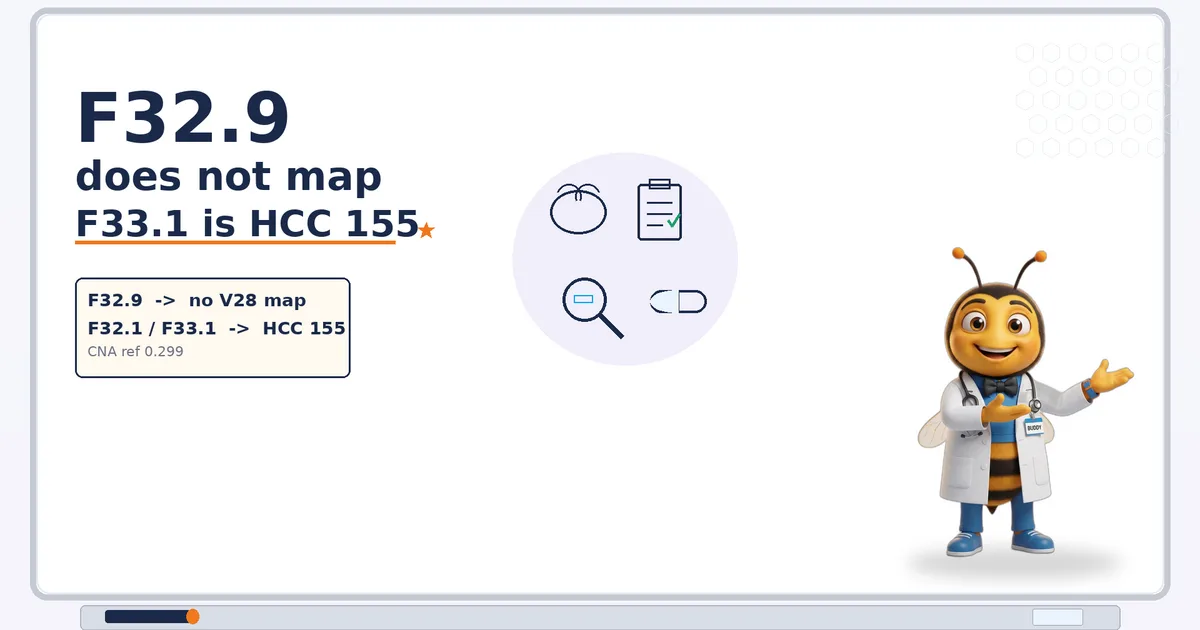

F41.9 Does Not Map in V28. Moderate Recurrent Depression F33.1 Is HCC 155.
F41.9 / F41.1 / F41.0 have verified no payable CMS-HCC V28 mapping. F33.1 and F33.2 map to HCC 155 (CNA 0.299). F31.9 maps to HCC 154 (CNA 0.351). Leftover-style anxiety desk: codes, MEAT, query traps.
By the HCC Buddy Coding Team
Updated: September 23, 2026
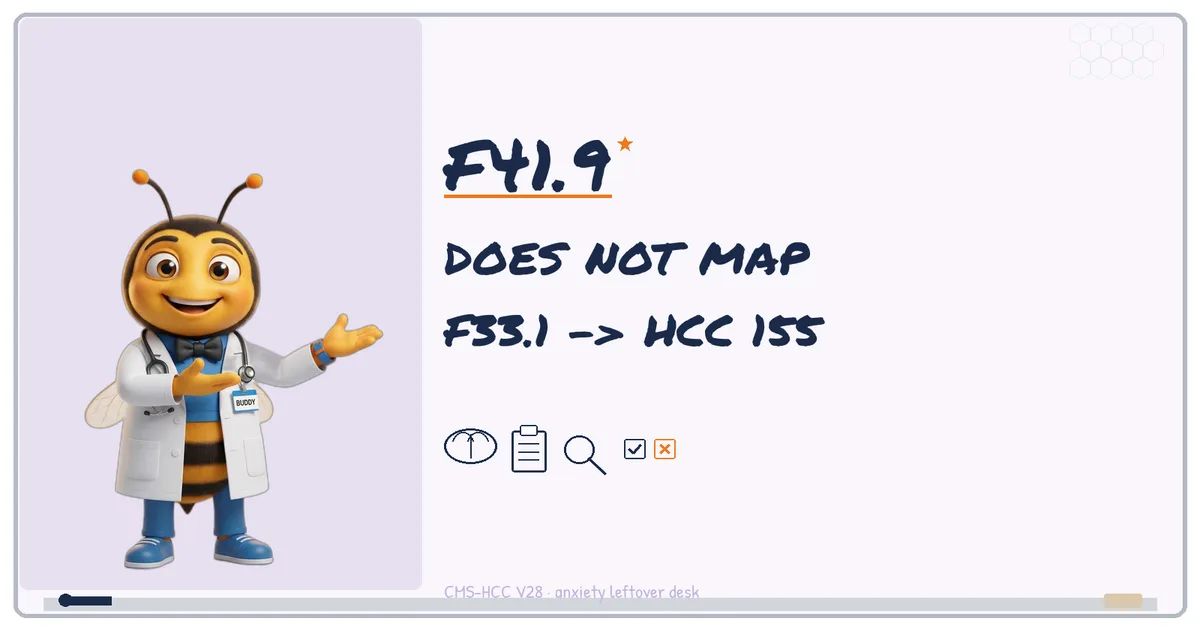
If you searched F41.9, anxiety disorder unspecified, or GAD next to HCC or V28, you are looking at one of the most common behavioral-health leftovers under CMS-HCC V28 for payment year 2026. F41.9 (Anxiety disorder, unspecified) is billable. On the live FY2026 card it has no payable CMS-HCC V28 mapping. Look up the F41.9 card.
F41.1 (Generalized anxiety disorder) and F41.0 (Panic disorder) are likewise billable with no community V28 payment map. Some anxiety cards may still show a Part D RxHCC category (for example RxHCC 133) with member context. That is not a CMS-HCC V28 community payment map. Keep the models separate.
The mood codes that do map under community V28 in this desk are moderate or severe major depression without psychosis, and bipolar without psychosis. F33.1 (Major depressive disorder, recurrent, moderate) maps to V28 HCC 155 (Major Depression, Moderate or Severe, without Psychosis) with a source-labeled community non-dual aged (CNA) reference of 0.299. F33.2 (recurrent, severe without psychotic features) also maps to HCC 155. F31.9 (Bipolar disorder, unspecified) maps to V28 HCC 154 (Bipolar Disorders without Psychosis) with CNA 0.351.
This page is the leftover-style F41.9 anxiety map desk for that leak. It is not a rewrite of the F32.9 depression leftover desk, the behavioral health HCC guide, or the depression HCC coding guide.
Desk table: verified maps and no-maps (2026-09-23)
| Code | Official short | V28 result | CNA ref | CSV (no decimal) |
|---|---|---|---|---|
| F41.9 | Anxiety disorder, unspecified | none | n/a | no `F419` row |
| F41.1 | Generalized anxiety disorder | none | n/a | no `F411` row |
| F41.0 | Panic disorder | none | n/a | no `F410` row |
| F33.1 | MDD, recurrent, moderate | HCC 155 | 0.299 | `F331,155.0,,,` |
| F33.2 | MDD, recurrent, severe w/o psychosis | HCC 155 | 0.299 | `F332,155.0,,age >= 2,` (+ `age < 2`) |
| F31.9 | Bipolar disorder, unspecified | HCC 154 | 0.351 | `F319,154.0,,age >= 2,` (+ `age < 2`) |
Coefficients are source-labeled CNA references from the live cards and the HCC 155 / HCC 154 hubs. Not member totals. Hierarchy still applies: HCC 155 is superseded by HCC 151, 152, 153, and 154 when a more severe category in the same disease group is also present.
What F41.9 is (and is not)
F41.9 is Anxiety disorder, unspecified. It is the catch-all when the provider documents an anxiety disorder without a more specific type. It is billable. Billable does not mean risk-adjusted under PY2026 community V28.
Do not treat F41.9 as if it mapped like moderate recurrent depression. Do not invent F33.1 or F31.9 from an anxiety-only assessment. Query when the chart supports a mapped mood diagnosis.
F41.1 (GAD) and F41.0 (panic) are more specific anxiety codes. They still show no payable V28 mapping on the live cards and have no PY2026 V28 CSV rows. Specificity inside anxiety does not create HCC 155.
When mood documentation changes the map
If the provider documents major depressive disorder, recurrent, moderate, use F33.1. That maps to HCC 155 (CNA 0.299).
If the chart supports major depressive disorder, recurrent, severe without psychotic features, use F33.2. That also maps to HCC 155.
If the provider documents bipolar disorder (even unspecified), look up the exact F31 code that matches documentation. F31.9 maps to V28 HCC 154 (CNA 0.351). Episode-specific F31 codes without psychosis also map to HCC 154. Codes with psychotic features such as F31.2, F31.5, and F31.64 map to HCC 152, not 154. Several F31.7x remission codes (F31.70, F31.72, F31.74, F31.76, F31.78) have no PY2026 V28 row. Prefer specificity from the chart; do not treat "more specific F31" as a 154 guarantee.
Pick the path from the documentation:
1. Chart says anxiety / GAD / panic / anxiety unspecified only -> expect F41.9 / F41.1 / F41.0, no V28 payment map.
2. Chart supports MDD recurrent moderate -> F33.1 -> HCC 155.
3. Chart supports MDD recurrent severe without psychosis -> F33.2 -> HCC 155.
4. Chart supports bipolar -> look up the exact F31 code (example F31.9 -> HCC 154; psychotic-feature F31 codes -> HCC 152; some F31.7x remission codes -> no V28 row).
5. Chart is only "depression" without episode / severity -> do not invent F33.1. See the F32.9 depression leftover desk.
6. Do not invent MDD or bipolar for RAF from anxiety-only notes. Query when findings support it.
Anxiety and depression often co-occur clinically. Code both when both are documented and supported. Coding anxiety alone does not substitute for a mapped depression or bipolar code.
MEAT for HCC 155 / 154 capture
A mapped code still needs monitoring, evaluation, assessment, or treatment in the eligible encounter year. A problem-list row that says "depression" or "bipolar" from last year does not carry HCC 155 or 154 forward by itself.
For F33.1 / F33.2 (HCC 155) and F31.9 (HCC 154), the note should support:
MEAT is a review mnemonic, not a universal CMS coding rule. Follow the applicable coding, encounter, program, and payer requirements. See MEAT and problem lists.
Audit and query traps
1. Leaving supported moderate recurrent MDD on F41.9 because "anxiety and depression travel together." Anxiety alone does not create HCC 155.
2. Treating GAD (F41.1) or panic (F41.0) as if they mapped like F33.1. Neither maps under V28.
3. Inventing F33.1 from an anxiety-only note to create RAF. Query when findings support MDD.
4. Confusing Part D RxHCC mapping on anxiety cards with CMS-HCC V28 community payment.
5. Skipping MEAT for a historical depression or bipolar label with no current assessment or treatment.
6. Ignoring hierarchy: when HCC 151, 152, 153, or 154 also applies in the same disease group, HCC 155 can be superseded.
7. Mixing this anxiety leftover into the F32.9 depression leftover desk. Cross-link; keep the F41.9 walk here.
8. Rewriting this trap into the behavioral-health or depression overview posts. Cross-link those.
9. Inventing V24 payment maps for current-year non-PACE scoring.
10. Reporting anxiety as bipolar without provider documentation of bipolar disorder.
11. Treating every F31 code as HCC 154. Psychotic-feature codes (for example F31.2 / F31.5 / F31.64) map to HCC 152. Some F31.7x remission codes have no PY2026 V28 row.
Two-minute check
1. Open the live F41.9, F41.1, and F41.0 cards. Confirm Not mapped under V28.
2. If the chart supports MDD recurrent moderate or severe without psychosis, confirm F33.1 / F33.2 -> HCC 155.
3. If the chart supports bipolar, look up the exact F31 code. F31.9 -> HCC 154. Do not assume every more specific F31 maps to 154 (psychotic-feature codes map to HCC 152; some remission codes have no V28 row).
4. Confirm MEAT in the eligible encounter year for any mapped code you report.
5. Do not invent mapped mood codes from anxiety-only documentation.
Sources and related desks
Related Tools
F41.9 card
Anxiety disorder, unspecified. Billable. No V28 map.
F41.1 card
Generalized anxiety disorder. No V28 map.
F41.0 card
Panic disorder. No V28 map.
F33.1 card
MDD, recurrent, moderate. V28 HCC 155, CNA 0.299.
F33.2 card
MDD, recurrent, severe without psychosis. V28 HCC 155.
F31.9 card
Bipolar disorder, unspecified. V28 HCC 154, CNA 0.351.
HCC 155 hub
Major Depression, Moderate or Severe, without Psychosis. CNA 0.299.
HCC 154 hub
Bipolar Disorders without Psychosis. CNA 0.351.
ICD-10 to HCC
Look up one diagnosis against the current V28 map.
Encoder
Search the exact ICD-10-CM code with live V28 status.

HCC Buddy Coding Team
Editorial
Every HCC Buddy article is checked against the current CMS-HCC model and the active FY ICD-10-CM tabular release before it publishes.
Get HCC Coding Tips in Your Inbox
Join our newsletter for coding tips, guideline updates, and tool announcements.