
7 Behavioral Health Diagnoses That Carry an HCC Under V28 (and the Specificity That Keeps Them)
V28 retired the old combined psych HCC and replaced it with severity-graded HCCs. Major depression, bipolar, schizophrenia, and substance use disorders still risk-adjust, but mild, unspecified, and in-remission depression no longer do. Here is what maps and what the documentation has to say.
By the HCC Buddy Coding Team
Updated: September 5, 2026
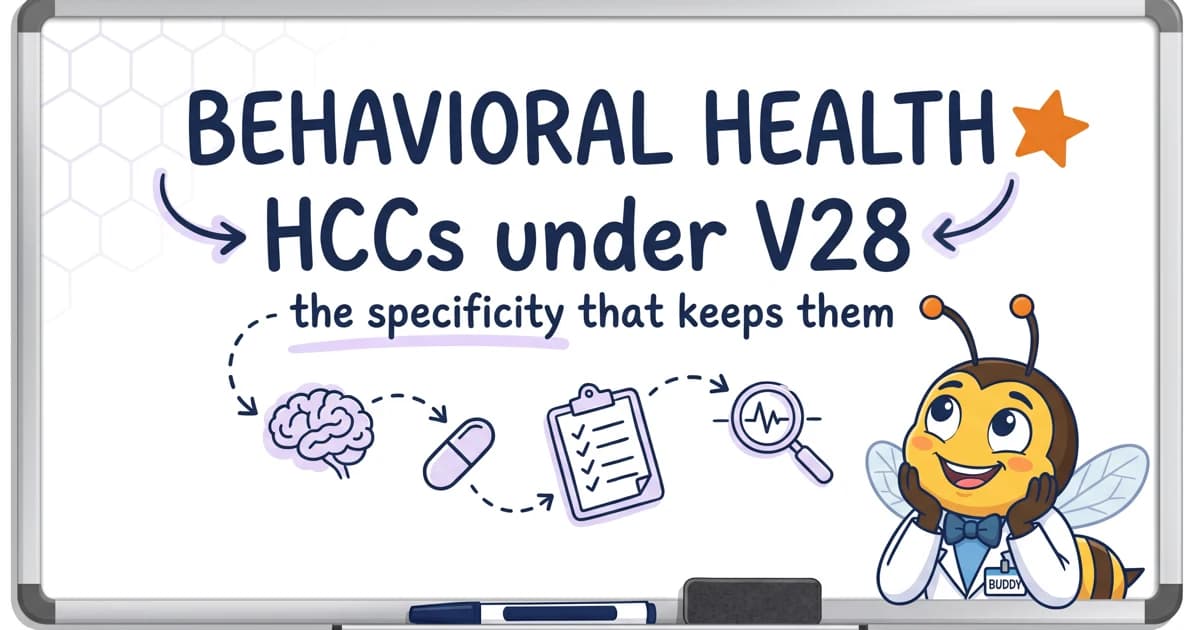
Under the CMS-HCC V28 model, behavioral health diagnoses still carry real risk-adjustment weight, but the model is far pickier about specificity than V24 was. Major depression (moderate or severe), bipolar disorder, schizophrenia and schizoaffective disorder, and moderate-to-severe substance use disorders all map to an HCC. Mild, unspecified, and in-remission depression no longer do. Anxiety, PTSD, ADHD, and autism never did.
The reason this changed is structural. V24 grouped major depression, bipolar, and paranoid (delusional and psychotic) disorders into a single HCC, HCC 59. V28 broke that into separate, severity-graded HCCs and pulled the low-acuity and unspecified codes out of the money entirely. Schizophrenia had its own HCC even under V24 (HCC 57) and is HCC 151 now. So in V28, the severity and specificity in the note are not documentation niceties. They decide whether the HCC exists at all. Below is what maps, what each one is worth, and which words in the chart hold it.
Current as of June 2026. HCC and coefficient references use the CMS-HCC V28 model (PY2026, which runs the V28 model at 100% per the CMS CY2024 Rate Announcement phase-in schedule). Code descriptions are FY2026 ICD-10-CM.
Key Takeaways
- Severity is now load-bearing for depression. Moderate or severe major depression maps to HCC 155. Mild, unspecified, and in-remission major depression carry no HCC under V28.
- Psychotic features bump the tier. Depression or mania with psychotic features maps to HCC 152, Psychosis, which is weighted higher than the non-psychotic depression HCC.
- Substance use is split by drug and severity. Alcohol use disorder (moderate/severe) maps to HCC 139; drug use disorder (moderate/severe) to HCC 137; mild drug use disorder to HCC 138. Mild alcohol use disorder maps to nothing.
- Some big diagnoses still map to nothing. Anxiety, PTSD, ADHD, autism, and intellectual disability carry no HCC under V28.
1. Major Depression, Moderate or Severe
This is one of the most common behavioral health HCCs, and one of the easiest to code out of the money.
Moderate or severe major depressive disorder maps to HCC 155, Major Depression, Moderate or Severe, without Psychosis, under V28. That covers both single-episode and recurrent forms: F32.1 (single, moderate), F32.2 (single, severe), F33.1 (recurrent, moderate), F33.2 (recurrent, severe).
Here is the trap. Mild major depression (F32.0, F33.0), unspecified recurrent depression (F33.9, and likewise F32.9 for single episode), and depression in remission (F33.4-) all carry no HCC under V28. Under V24, every one of those mapped to HCC 59. They do not anymore.
The single most common way to lose this HCC is "major depressive disorder, unspecified." If the provider documented and is treating moderate or severe depression but the note codes to F33.9, the HCC is gone. The severity has to be in the documentation, and the code has to reflect it. When the chart describes active, treated depression without a severity, that is a query, not a default to unspecified. For the single-condition deep dive, see our depression HCC coding guide.
2. Depression or Mania With Psychotic Features
When major depression or a bipolar episode is documented with psychotic features, you leave the depression HCC and move up to HCC 152, Psychosis, Except Schizophrenia. It carries a higher coefficient than HCC 155. Recurrent severe depression with psychotic symptoms (F33.3) and bipolar episodes with psychotic features (F31.2, F31.5) all map here.
"With psychotic features" is a specific clinical determination the provider makes, and it changes the HCC. You never add it to reach a higher tier. But when it is clearly documented, coding the non-psychotic depression code instead undercodes the patient's acuity. Read the note for the psychotic-features qualifier and code to what is documented.
3. Bipolar Disorder
Bipolar disorder without psychotic features maps to HCC 154, Bipolar Disorders without Psychosis, under V28. The whole F31 family lands here, including bipolar II (F31.81) and the manic and depressed episode codes without psychosis (for example F31.10, F31.30).
Bipolar maps cleanly across most of its subcodes, which makes it forgiving. Watch the two edges. An episode documented with psychotic features goes to HCC 152 (see item 2), not HCC 154. And a vague "mood disorder" without the bipolar diagnosis documented does not get you here at all.
4. Schizophrenia and Schizoaffective Disorder
Schizophrenia (F20.-) and schizoaffective disorder (F25.-) map to HCC 151, Schizophrenia, the highest coefficient of the behavioral health HCCs under V28.
Schizophrenia is a chronic condition, but a prior diagnosis does not automatically establish the current date-of-service code or payment-year input. Verify the provider's current documentation, the applicable data-collection period, eligible encounter source, and official coding guidance. MEAT may organize that review; it does not decide it.
5. Alcohol Use Disorder, Moderate or Severe
Alcohol dependence, the moderate-to-severe end of alcohol use disorder, maps to HCC 139, Alcohol Use Disorder, Moderate/Severe, or Alcohol Use with Specified Non-Psychotic Complications, under V28. F10.20 (dependence, uncomplicated) is the workhorse code. F10.21 (alcohol dependence, in remission) still maps too.
The trap is the low end. Alcohol abuse, the mild tier (F10.10), and alcohol use, unspecified (F10.99), carry no HCC under V28. There is no mild-alcohol HCC.
Two things coders get backwards here. First, remission does not cost you the HCC for a substance use disorder, which is the opposite of depression in item 1. A documented alcohol dependence in remission still maps. Second, "alcohol abuse" is not a smaller version of "alcohol dependence" for risk adjustment. It maps to nothing. The dependence-versus-abuse distinction is doing real work.
6. Drug Use Disorder
Drug use disorder splits by severity under V28, and it behaves differently from alcohol. Moderate-to-severe drug dependence maps to HCC 137, Drug Use Disorder, Moderate/Severe, or Drug Use with Non-Psychotic Complications: opioid dependence (F11.20), cocaine dependence (F14.20), other psychoactive substance dependence (F19.20).
Unlike alcohol, mild drug use disorder still maps. Opioid abuse (F11.10) maps to HCC 138, Drug Use Disorder, Mild, Uncomplicated, Except Cannabis. Two carve-outs to remember: cannabis is excluded from the mild HCC, and "use, unspecified" (for example F11.90) maps to nothing.
The drug side has a mild HCC (138) that the alcohol side does not, so the same severity word lands differently depending on the substance. Code the substance and the severity the provider documented. Do not assume the alcohol pattern carries over to drugs, or the other way around.
7. What Does Not Carry an HCC Under V28
These are the ones coders expect to risk-adjust. None of them do under V28:
- Anxiety disorders, including generalized anxiety disorder (F41.1): no HCC.
- Post-traumatic stress disorder (F43.1-): no HCC.
- Attention-deficit/hyperactivity disorder (F90.-): no HCC.
- Autism spectrum disorder (F84.0): no HCC.
- Intellectual disabilities (F70 through F79): no HCC.
Code them. They are real, documented conditions and they belong in the chart. They just do not move the RAF, and nothing you do to the code changes that. Do not spend a query trying to upgrade an anxiety code into something that maps. There is nothing on the other side of that door.
At a Glance
| Diagnosis | Specific code example | V28 HCC | What loses the HCC |
|---|---|---|---|
| Major depression, moderate/severe | F33.1, F33.2 | HCC 155 | Mild, unspecified (F33.9), or in remission (F33.4-) → none |
| Depression/mania with psychotic features | F33.3, F31.2 | HCC 152 | Coding the non-psychotic version when psychosis is documented |
| Bipolar disorder | F31.81, F31.30 | HCC 154 | Episode with psychotic features moves to HCC 152 |
| Schizophrenia / schizoaffective | F20.9, F25.0 | HCC 151 | Not recapturing the chronic dx in the data year |
| Alcohol use disorder | F10.20, F10.21 (remission) | HCC 139 | Abuse/mild (F10.10) or use-unspecified (F10.99) → none |
| Drug use disorder | F11.20 (mod/severe), F11.10 (mild) | HCC 137 / 138 | Cannabis excluded from mild; "use, unspecified" → none |
| Anxiety, PTSD, ADHD, autism, intellectual disability | F41.1, F43.1-, F90.-, F84.0, F70-F79 | none | Maps to no HCC under V28 |
Frequently Asked Questions
Does unspecified depression (F33.9) carry an HCC under V28?
No. Unspecified major depression, mild major depression, and major depression in remission all map to no HCC under V28. Only moderate or severe major depression maps, to HCC 155. Document and code the severity.
Does depression in remission still count for risk adjustment?
Not under V28. Major depression in remission (F33.4-) carries no HCC, even though it did under V24's combined HCC 59. This is the opposite of substance use disorders, where remission still maps.
Do substance use disorders in remission still map?
Yes. Alcohol dependence in remission (F10.21) still maps to HCC 139 under V28. A documented substance use disorder in remission is reported and keeps its HCC.
Does anxiety or PTSD map to an HCC?
No. Generalized anxiety disorder (F41.1) and PTSD (F43.1-) carry no HCC under V28. They are correct to code clinically, but they do not risk-adjust.
What happened to HCC 59?
V24's HCC 59 grouped major depression, bipolar, and paranoid disorders. V28 split it into HCC 152 (psychosis), 154 (bipolar without psychosis), and 155 (major depression, moderate or severe). Schizophrenia was already separate under V24 (HCC 57) and is HCC 151 now. If a code used to map under HCC 59, check the table above for its V28 landing spot.
Disclaimer
This article is professional and educational information for risk-adjustment coders, not coding, billing, legal, or medical advice. Behavioral health code assignment depends on the full medical record, the provider's documented diagnosis and severity, and applicable coding guidance. Verify every code and HCC mapping against the current CMS-HCC V28 model files, the ICD-10-CM Official Guidelines, and AHA Coding Clinic before you apply it. No provider-patient or advisory relationship is created by reading this.
Sources
- CMS Risk Adjustment, CMS-HCC model software and PY2026 (V28) HCC assignments and coefficients: https://www.cms.gov/medicare/payment/medicare-advantage-rates-statistics/risk-adjustment
- CMS CY2024 Medicare Advantage and Part D Rate Announcement (V28 phase-in schedule): https://www.cms.gov/medicare/payment/medicare-advantage-rates-statistics/ratebooks-supporting-data
- FY2026 ICD-10-CM code descriptions and F-chapter conventions: https://www.cms.gov/medicare/coding-billing/icd-10-codes
Related Tools

HCC Buddy Coding Team
Editorial
Every HCC Buddy article is checked against the current CMS-HCC model and the active FY ICD-10-CM tabular release before it publishes.
Get HCC Coding Tips in Your Inbox
Join our newsletter for coding tips, guideline updates, and tool announcements.