
D68.311 Acquired Hemophilia Maps HCC 112. Nearby D68.312 / D68.318 / D68.32 Do Not Map.
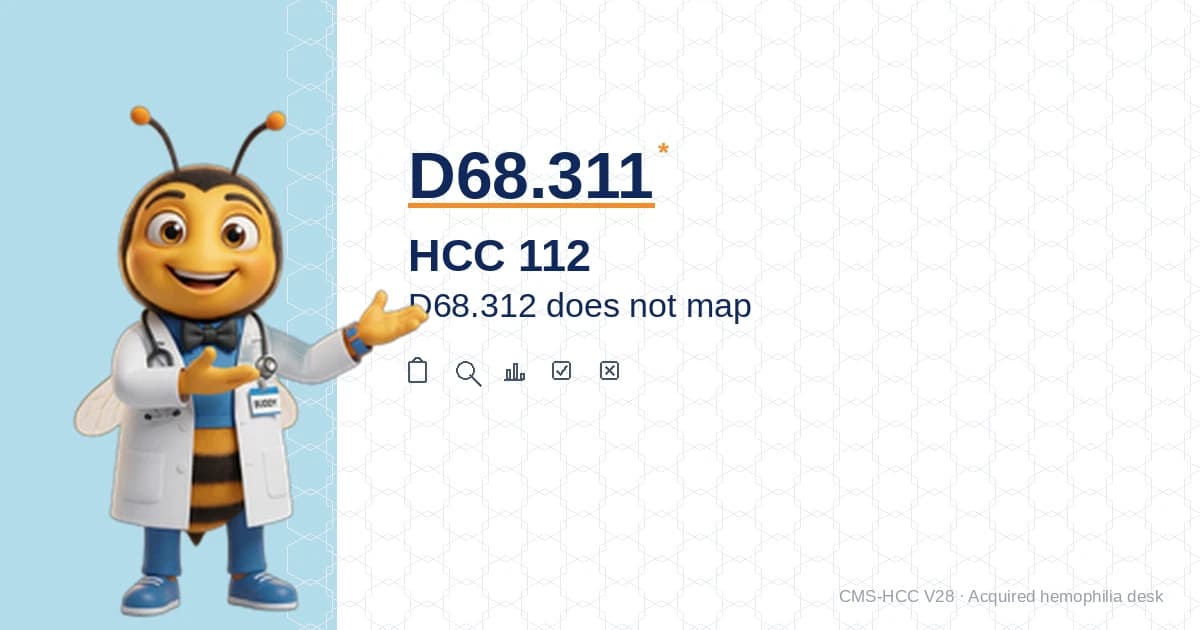
D68.311 acquired hemophilia maps CMS-HCC V28 HCC 112 (CNA ref 0.45). Nearby D68.312, D68.318, D68.32, and D68.4 do not map. D68.2 / D68.1 / D68.01 also map 112. D66/D67 hereditary paths use sex edits (male 111 / female 112).
By the HCC Buddy Coding Team
Updated: September 30, 2026
If you searched autoimmune inhibitors to clotting factors, D68.311, or nearby clotting-factor inhibitor queries next to V28, you are looking at a narrow D68.3x cluster where one billable leaf maps and several nearby leaves do not under CMS-HCC V28 for payment year 2026.
D68.311 (Acquired hemophilia) is billable. On the live HCC Buddy FY2026 card it maps to CMS-HCC V28 HCC 112, and the PY2026 V28 CSV row is `D68311,112.0,,,`. Official inclusion terms on the card include autoimmune hemophilia, autoimmune inhibitors to clotting factors, and secondary hemophilia. The live HCC 112 hub title is Immune Thrombocytopenia and Specified Coagulation Defects and Hemorrhagic Conditions, with a source-labeled community non-dual aged reference coefficient of 0.45 (about 21 ICD rows). The D68.311 card displays that same CNA reference as 0.450. That is a category reference, not a member RAF total.
Nearby D68 leaves are also billable ICD-10-CM codes, but they do not map in V28. Live cards show verified no payable V28 mapping, and the PY2026 CSV has no row for them:
Billable is not the same as risk-adjusted. Do not invent a V28 map for those leaves.
Other D68 leaves that do map to HCC 112 in the same CSV file (useful contrast in the same HCC 112 bucket) include D68.2 (Hereditary deficiency of other clotting factors), D68.1 (Hereditary factor XI deficiency), and D68.01 (Von Willebrand disease, type 1). CSV rows: `D682,112.0,,,`, `D681,112.0,,,`, `D6801,112.0,,,`.
Hereditary factor VIII / IX contrast is different. D66 (Hereditary factor VIII deficiency) and D67 (Hereditary factor IX deficiency) use sex and age edits in the PY2026 CSV. Male path (`SEX_EDIT_CONDITION` 1.0) maps to HCC 111 Hemophilia, Male (with age splits). Female path (`SEX_EDIT_CONDITION` 2.0) maps to HCC 112. Do not say D66 / D67 always map only to HCC 111. Confirm sex and age on the live card and CSV before you lock a claim. The HCC 111 hub shows a source-labeled CNA reference of 4.639 (2 ICD rows). That is a different category from acquired hemophilia D68.311.
This page is the coder-desk walk for the D68.311 / autoimmune-inhibitors cluster under CMS-HCC V28 for payment year 2026.
Desk table: verified maps (2026-09-30)
| Code | Official short | V28 result | Coeff ref | CSV (no decimal) |
|---|---|---|---|---|
| D68.311 | Acquired hemophilia | HCC 112 | 0.45 | `D68311,112.0,,,` |
| D68.2 | Hereditary deficiency of other clotting factors | HCC 112 | 0.45 | `D682,112.0,,,` |
| D68.1 | Hereditary factor XI deficiency | HCC 112 | 0.45 | `D681,112.0,,,` |
| D68.01 | Von Willebrand disease, type 1 | HCC 112 | 0.45 | `D6801,112.0,,,` |
| D68.312 | Antiphospholipid antibody with hemorrhagic disorder | Does not map | - | no CSV row |
| D68.318 | Other hemorrhagic disorder due to intrinsic circulating anticoagulants, antibodies, or inhibitors | Does not map | - | no CSV row |
| D68.32 | Hemorrhagic disorder due to extrinsic circulating anticoagulants | Does not map | - | no CSV row |
| D68.4 | Acquired coagulation factor deficiency | Does not map | - | no CSV row |
| D66 | Hereditary factor VIII deficiency | HCC 111 (male) / HCC 112 (female) | 4.639 / 0.45 | see sex/age rows below |
| D67 | Hereditary factor IX deficiency | HCC 111 (male) / HCC 112 (female) | 4.639 / 0.45 | see sex/age rows below |
HCC 112 coeff ref 0.45 is the live hub community non-dual aged reference (ICD cards show 0.450). HCC 111 coeff ref 4.639 is the live hub CNA reference for Hemophilia, Male. Not member totals. Segment coefficients vary.
Exact D66 / D67 CSV rows cited in this desk:
```
D66,111.0,,age < 65,1.0
D66,111.0,,age >= 65,1.0
D66,112.0,,,2.0
D67,111.0,,age < 65,1.0
D67,111.0,,age >= 65,1.0
D67,112.0,,,2.0
```
What D68.311 means on the claim
D68.311 is the acquired (autoimmune inhibitor) hemophilia leaf. Use it when the chart supports acquired hemophilia / autoimmune inhibitors to clotting factors, not when the chart only supports a nearby D68.3x leaf that does not map.
Do not substitute D68.312, D68.318, D68.32, or D68.4 to force an HCC 112. Those leaves are billable and clinically real when documented, but they have no V28 payment map in the PY2026 CSV.
Do not confuse acquired hemophilia (D68.311 -> HCC 112) with hereditary factor VIII / IX deficiency (D66 / D67), which route through HCC 111 or HCC 112 by sex edit.
Coding paths (documentation-driven)
Pick the path from what the chart actually supports. Do not invent acquired hemophilia, antiphospholipid hemorrhagic disorder, or hereditary hemophilia for RAF.
1. Chart supports acquired hemophilia / autoimmune inhibitors to clotting factors -> D68.311 -> V28 HCC 112.
2. Chart supports antiphospholipid antibody with hemorrhagic disorder -> D68.312 -> billable, no V28 map.
3. Chart supports other hemorrhagic disorder due to intrinsic circulating anticoagulants, antibodies, or inhibitors -> D68.318 -> billable, no V28 map.
4. Chart supports hemorrhagic disorder due to extrinsic circulating anticoagulants (including drug-induced patterns on the card) -> D68.32 -> billable, no V28 map.
5. Chart supports acquired coagulation factor deficiency (for example liver disease or vitamin K deficiency patterns on the card) -> D68.4 -> billable, no V28 map.
6. Chart supports hereditary deficiency of other clotting factors -> D68.2 -> HCC 112.
7. Chart supports hereditary factor XI deficiency -> D68.1 -> HCC 112.
8. Chart supports Von Willebrand disease, type 1 -> D68.01 -> HCC 112.
9. Chart supports hereditary factor VIII deficiency -> D66 -> HCC 111 (male path) or HCC 112 (female path). Check sex/age edits.
10. Chart supports hereditary factor IX deficiency -> D67 -> HCC 111 (male path) or HCC 112 (female path). Check sex/age edits.
11. Do not treat billable as risk-adjusted without checking the live card and CSV.
12. Do not invent member RAF totals from the 0.45 / 0.450 / 4.639 references.
MEAT for mapped HCC 112 (and HCC 111 when used)
A mapped D68.311 (or other mapped leaf in this desk) still needs monitoring, evaluation, assessment, or treatment in the eligible encounter year. A problem-list row that says "hemophilia" or "inhibitor" from a prior year does not carry the HCC forward by itself.
For mapped coagulation HCCs in this desk, the note should support:
MEAT is a review mnemonic, not a universal CMS coding rule. Follow the applicable coding, encounter, program, and payer requirements. See MEAT and problem lists.
Audit and query traps
1. Coding D68.312 / D68.318 / D68.32 / D68.4 as if they map to HCC 112 in V28. They do not. No CSV row. Live cards: no payable V28 map.
2. Treating billable D68.3x siblings as risk-adjusted because D68.311 maps. Map is leaf-specific.
3. Saying D66 / D67 always map only to HCC 111. Female path is HCC 112 (`SEX_EDIT_CONDITION` 2.0).
4. Dropping age edits on the male D66 / D67 rows (`age < 65` / `age >= 65` with sex 1.0).
5. Using the 0.45 / 0.450 CNA reference, or the 4.639 HCC 111 reference, as a member RAF total.
6. Inventing Coding Clinic quotes, competitor CTAs, or PHI examples.
7. Confusing acquired hemophilia (D68.311) with hereditary hemophilia (D66 / D67) or with acquired factor deficiency (D68.4).
8. Coding a historical "hemophilia" or "inhibitor" label with no current MEAT in the eligible year.
9. Treating a nearby no-map D68 leaf as interchangeable with D68.311 for RAF.
Related desks and tools
Current as of September 30, 2026. Always confirm the live card and the PY2026 V28 CSV before you lock a map claim.
Related Tools
D68.311 card
Acquired hemophilia. Billable. V28 HCC 112.
D68.312 card
Antiphospholipid antibody with hemorrhagic disorder. Billable. No V28 map.
D68.318 card
Other intrinsic circulating anticoagulant hemorrhagic disorder. No V28 map.
D68.32 card
Extrinsic circulating anticoagulant hemorrhagic disorder. No V28 map.
D68.4 card
Acquired coagulation factor deficiency. Billable. No V28 map.
D66 card
Hereditary factor VIII deficiency. Male HCC 111 / female HCC 112.
HCC 112 hub
Immune Thrombocytopenia and Specified Coagulation Defects and Hemorrhagic Conditions. CNA ref 0.45.
HCC 111 hub
Hemophilia, Male. Source-labeled CNA reference 4.639.
ICD-10 to HCC
Look up one diagnosis against the current V28 map.
Encoder
Search the exact ICD-10-CM code with live V28 status.

HCC Buddy Coding Team
Editorial
Every HCC Buddy article is checked against the current CMS-HCC model and the active FY ICD-10-CM tabular release before it publishes.
Get HCC Coding Tips in Your Inbox
Join our newsletter for coding tips, guideline updates, and tool announcements.