
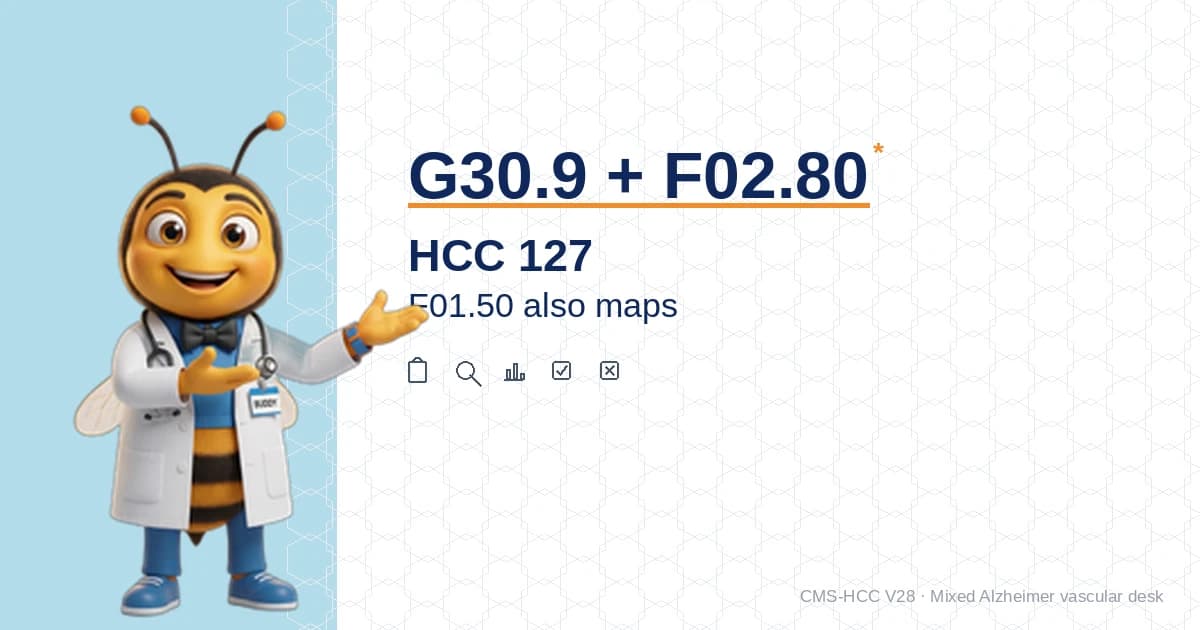
Mixed Alzheimer's and Vascular Dementia: G30 + F02.8 Maps HCC 127. F01 Vascular Also Maps. Severity Picks 125/126/127.
Mixed Alzheimer's + vascular dementia under CMS-HCC V28: G30 + F02.8 maps HCC 127 (Code First etiology; Excludes2 allows F01 when both documented). F01.50 also maps HCC 127. Severity picks HCC 126 (moderate) or 125 (severe). Hubs share CNA ref 0.341; hierarchy collapses additive RAF.
By the HCC Buddy Coding Team
Updated: September 29, 2026
If you searched mixed Alzheimer's and vascular dementia HCC ICD 10, HCC dementia, or HCC 127 next to V28, you are looking at a mapping cluster that mixes etiology sequencing (G30 + F02) with vascular dementia (F01) and severity tiers that pick HCC 125, 126, or 127 under CMS-HCC V28 for payment year 2026.
G30.9 (Alzheimer's disease, unspecified) is billable. On the live HCC Buddy FY2026 card it maps to CMS-HCC V28 HCC 127, and the PY2026 V28 CSV row is `G309,127.0,,,`. Related Alzheimer's leaves G30.0, G30.1 (CSV carries `age >= 15`), and G30.8 also map to HCC 127.
F02.80 (Dementia in other diseases classified elsewhere, unspecified severity, without behavioral disturbance, psychotic disturbance, mood disturbance, and anxiety) is billable and maps to HCC 127 (CSV `F0280,127.0,,,`). F02 is etiology/manifestation: live Code First says the underlying physiological condition, such as Alzheimer's (G30.-). F02 is never the principal diagnosis alone. Live Excludes2 lists vascular dementia (F01.5-, F01.A-, F01.B-, F01.C-). Excludes2 means you can code both when both are documented.
F01.50 (Vascular dementia, unspecified severity, without behavioral disturbance, psychotic disturbance, mood disturbance, and anxiety) is billable and maps to HCC 127 (CSV `F0150,127.0,age >= 15,,`). Related unspecified-severity leaves such as F01.511 also map to HCC 127 with the same age edit.
When the chart supports mixed Alzheimer's and vascular dementia, expect G30.- plus the matching F02.8x dementia manifestation, and F01.x when vascular dementia is also documented. There is no single combination ICD-10-CM code for mixed Alzheimer's plus vascular. Do not invent one.
Severity characters move the payment category: moderate F01.B* / F02.B* map to HCC 126, and severe F01.C* / F02.C* map to HCC 125. Unspecified / mild paths in this desk stay on HCC 127. The live HCC 125, HCC 126, and HCC 127 hubs each show a source-labeled community non-dual aged reference coefficient of 0.341 (about 18 / 18 / 65 ICD rows). That is a category reference, not a member total. V28 hierarchy collapses dementia HCCs: 125 supersedes 126 and 127; 126 supersedes 127. Do not invent additive member RAF from coding both etiologies in the same year.
For the broader three-tier dementia overview, see Dementia HCC coding guide.
Desk table: verified maps (2026-09-29)
| Code | Official short | V28 result | Coeff ref | CSV (no decimal) |
|---|---|---|---|---|
| G30.9 | Alzheimer's disease, unspecified | HCC 127 | 0.341 | `G309,127.0,,,` |
| G30.0 | Alzheimer's disease with early onset | HCC 127 | 0.341 | `G300,127.0,,,` |
| G30.1 | Alzheimer's disease with late onset | HCC 127 | 0.341 | `G301,127.0,age >= 15,,` |
| G30.8 | Other Alzheimer's disease | HCC 127 | 0.341 | `G308,127.0,,,` |
| F02.80 | Dementia in other diseases, unsp severity, without BD/psych/mood/anxiety | HCC 127 | 0.341 | `F0280,127.0,,,` |
| F02.811 | Dementia in other diseases, unsp severity, with agitation | HCC 127 | 0.341 | `F02811,127.0,,,` |
| F02.818 | Dementia in other diseases, unsp severity, with other behavioral disturbance | HCC 127 | 0.341 | `F02818,127.0,,,` |
| F01.50 | Vascular dementia, unsp severity, without BD/psych/mood/anxiety | HCC 127 | 0.341 | `F0150,127.0,age >= 15,,` |
| F01.511 | Vascular dementia, unsp severity, with agitation | HCC 127 | 0.341 | `F01511,127.0,age >= 15,,` |
| F01.518 | Vascular dementia, unsp severity, with other behavioral disturbance | HCC 127 | 0.341 | `F01518,127.0,age >= 15,,` |
| F01.B0 | Vascular dementia, moderate, without BD/psych/mood/anxiety | HCC 126 | 0.341 | `F01B0,126.0,age >= 15,,` |
| F01.C0 | Vascular dementia, severe, without BD/psych/mood/anxiety | HCC 125 | 0.341 | `F01C0,125.0,age >= 15,,` |
| F02.B0 | Dementia in other diseases, moderate, without BD/psych/mood/anxiety | HCC 126 | 0.341 | `F02B0,126.0,,,` |
| F02.C0 | Dementia in other diseases, severe, without BD/psych/mood/anxiety | HCC 125 | 0.341 | `F02C0,125.0,,,` |
Coefficients are source-labeled community non-dual aged references from the live hubs (0.341 on HCC 125, 126, and 127). Not member totals. Segment coefficients vary. Note `age >= 15` on cited F01* and G30.1 CSV rows.
What mixed Alzheimer's + vascular means on the claim
There is no single ICD-10-CM combination code for mixed Alzheimer's and vascular dementia. When both etiologies are documented:
1. Code the Alzheimer's etiology under G30.- (for example G30.9).
2. Code First / manifestation: assign the matching F02.8x (or F02.A* / F02.B* / F02.C* when severity is documented) for dementia in other diseases. F02 never stands alone as principal.
3. Because F02 Excludes2 vascular dementia F01.5- / F01.A- / F01.B- / F01.C-, you may also assign F01.x when vascular dementia is documented.
Do not invent a mixed-dementia leaf that does not exist. Do not drop the etiology when F02 is used. Do not treat Excludes2 as Excludes1 (Excludes1 would forbid both; Excludes2 allows both when both are true).
Severity picks HCC 125 / 126 / 127
Under V28, severity characters change the payment category even when the etiology path is the same family:
All three hubs show the same source-labeled community non-dual aged reference coefficient 0.341. Say that carefully: same CNA reference does not mean additive payment when multiple dementia HCCs appear. Hierarchy collapses them.
V28 hierarchy (do not invent additive RAF)
Live hubs state:
Coding both Alzheimer's (G30 + F02) and vascular (F01) in the same eligible year does not invent two separate dementia member coefficients. Hierarchy keeps one dementia HCC from this group for payment. Confirm the live hub and calculator for the enrollment segment you need.
Coding paths (documentation-driven)
Pick the path from what the chart actually supports. Do not invent Alzheimer's, vascular dementia, or severity for RAF.
1. Chart supports Alzheimer's disease, unspecified -> G30.9 -> V28 HCC 127.
2. Chart supports Alzheimer's with dementia manifestation under F02 (unspecified severity without BD/psych/mood/anxiety) -> G30.- Code First, then F02.80 -> HCC 127. Never F02 alone as principal.
3. Chart supports vascular dementia, unspecified severity without BD/psych/mood/anxiety -> F01.50 -> HCC 127 (`age >= 15` CSV edit).
4. Chart supports mixed Alzheimer's and vascular when both are documented -> G30.- + F02.8x and F01.x as supported (Excludes2 allows both). Still one dementia hierarchy outcome for payment.
5. Chart supports moderate vascular dementia -> matching F01.B* -> HCC 126.
6. Chart supports severe vascular dementia -> matching F01.C* -> HCC 125.
7. Chart supports moderate / severe dementia in other diseases (with etiology Code First) -> matching F02.B* / F02.C* -> HCC 126 / 125.
8. Chart supports behavioral disturbance characters (for example F02.811, F01.511) -> use the leaf that matches documentation. Unspecified-severity leaves in this desk still map HCC 127.
9. Do not invent a single mixed-dementia ICD code.
10. Do not treat billable as risk-adjusted without checking the live card and CSV.
MEAT for mapped dementia HCCs
A mapped G30 / F02 / F01 code still needs monitoring, evaluation, assessment, or treatment in the eligible encounter year. A problem-list row that says "dementia" or "Alzheimer's" from a prior year does not carry the HCC forward by itself.
For mapped dementia HCCs in this desk, the note should support:
MEAT is a review mnemonic, not a universal CMS coding rule. Follow the applicable coding, encounter, program, and payer requirements. See MEAT and problem lists.
Audit and query traps
1. Coding F02.80 without Code First G30.- (or other underlying etiology) when F02 is used. Incomplete sequencing.
2. Treating F02 Excludes2 vascular dementia as if it forbids coding F01 when both are documented. Excludes2 allows both.
3. Inventing a single combination code for mixed Alzheimer's + vascular. Use G30 + F02 and F01 as supported.
4. Expecting additive member RAF from coding both etiologies. V28 hierarchy collapses dementia HCCs.
5. Ignoring severity characters that move payment to HCC 126 (moderate) or HCC 125 (severe).
6. Using the 0.341 CNA reference as a member RAF total, or inventing different CNA weights across 125/126/127 when the hubs show the same reference.
7. Dropping the `age >= 15` edit note on cited F01* and G30.1 CSV rows.
8. Rewriting the Dementia HCC coding guide tier overview into this post. Cross-link; keep this mixed Alzheimer's / vascular / HCC 127 walk here.
9. Inventing Coding Clinic quotes, competitor CTAs, or PHI examples.
10. Coding a historical "dementia" label with no current MEAT in the eligible year.
11. Treating this page as the full dementia overview (use the Dementia HCC coding guide for the three-tier overview; this desk is the mixed etiology walk only).
12. Confusing Excludes1 with Excludes2 on the F02 card.
Related desks and tools
Current as of September 29, 2026. Always confirm the live card and the PY2026 V28 CSV before you lock a map claim.
Related Tools
G30.9 card
Alzheimer's unspecified. Billable. V28 HCC 127.
F02.80 card
Dementia in other diseases, unsp severity. V28 HCC 127. Code First etiology.
F01.50 card
Vascular dementia, unsp severity. Billable. V28 HCC 127.
F01.511 card
Vascular dementia, unsp severity, with agitation. V28 HCC 127.
F01.B0 card
Vascular dementia, moderate. V28 HCC 126.
F01.C0 card
Vascular dementia, severe. V28 HCC 125.
HCC 127 hub
Dementia, Mild or Unspecified. Source-labeled CNA reference 0.341.
HCC 126 hub
Dementia, Moderate. Source-labeled CNA reference 0.341.
HCC 125 hub
Dementia, Severe. Source-labeled CNA reference 0.341.
ICD-10 to HCC
Look up one diagnosis against the current V28 map.
Encoder
Search the exact ICD-10-CM code with live V28 status.

HCC Buddy Coding Team
Editorial
Every HCC Buddy article is checked against the current CMS-HCC model and the active FY ICD-10-CM tabular release before it publishes.
Get HCC Coding Tips in Your Inbox
Join our newsletter for coding tips, guideline updates, and tool announcements.