
Dementia HCC V28: Three Tiers, Not One
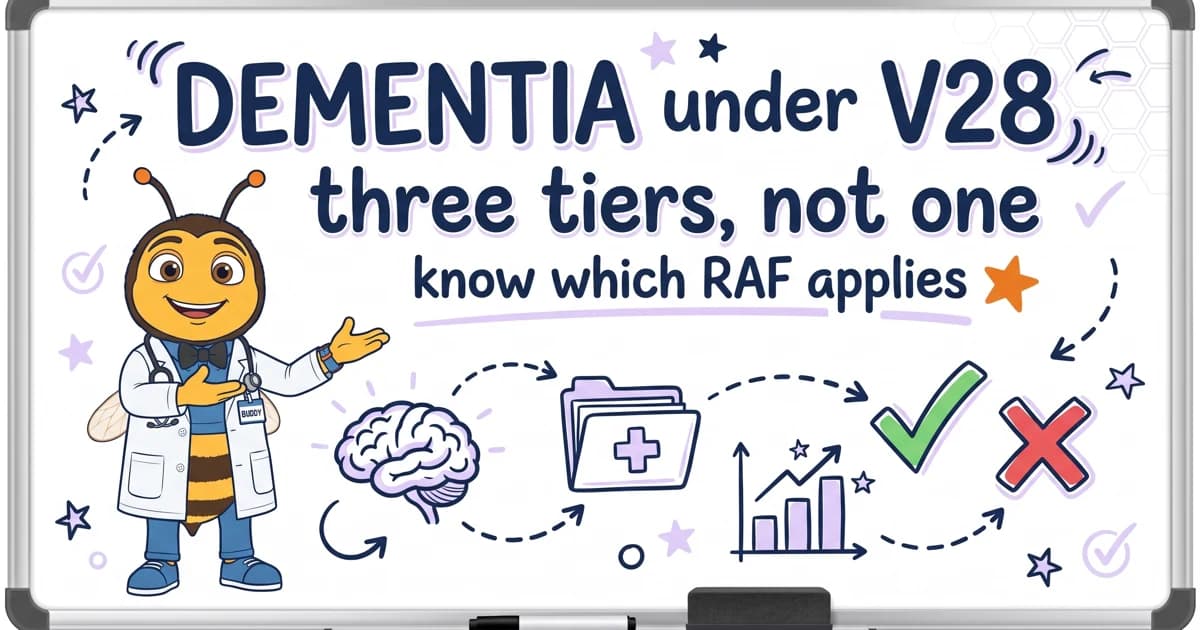
V28 split dementia into three HCC tiers: 125 (severe), 126 (moderate), 127 (mild). Severity subcode drives the tier. G30.x codes all map to HCC 127.
By the HCC Buddy Coding Team
Updated: August 25, 2026
Quick Answer
Dementia maps to HCC categories 125, 126, and 127 under V28, stratified by severity, with all three tiers (HCC 125, 126, and 127) constrained to the same 0.341 CNA RAF weight in V28. The key codes are F01.x (vascular dementia), F02.x (dementia in diseases classified elsewhere, including Alzheimer's-related), F03.x (unspecified dementia), and G30.x (Alzheimer's disease). Under V28, CMS restructured the dementia HCCs to emphasize severity, coders now need documentation of behavioral disturbance and severity level, not just the dementia type. The most impactful coding change: dementia "without behavioral disturbance" and "with behavioral disturbance" now map to different HCC tiers, making behavioral documentation essential for accurate risk adjustment.
Dementia in the Medicare Population
Dementia affects approximately 6.7 million Americans aged 65 and older, with prevalence increasing sharply with age. In the Medicare Advantage population, dementia is one of the most expensive conditions to manage, driving costs through skilled nursing facility stays, home health services, medication management, caregiver support, and frequent hospitalizations for comorbid conditions.
For risk adjustment purposes, dementia is a high-value HCC category. Accurate coding requires understanding the ICD-10 code families, the V28 HCC structure, and the documentation requirements for severity and behavioral disturbance.
Dementia ICD-10 Code Families
Vascular Dementia (F01.x)
Vascular dementia results from cerebrovascular disease, strokes, TIAs, or chronic small vessel ischemic disease that damages brain tissue and causes cognitive decline.
| ICD-10 Code | Description | HCC (V28) |
|---|---|---|
| F01.50 | Vascular dementia, unspecified severity, without behavioral disturbance | HCC 127 |
| F01.51 | Vascular dementia, unspecified severity, with behavioral disturbance | HCC 127 |
| F01.511 | Vascular dementia, unspecified severity, with agitation | HCC 127 |
| F01.518 | Vascular dementia, unspecified severity, with other behavioral disturbance | HCC 127 |
| F01.52 | Vascular dementia, unspecified severity, with psychotic disturbance | HCC 127 |
| F01.53 | Vascular dementia, unspecified severity, with mood disturbance | HCC 127 |
| F01.54 | Vascular dementia, unspecified severity, with anxiety | HCC 127 |
| F01.A0 | Vascular dementia, mild, without behavioral disturbance | HCC 127 |
| F01.A11 | Vascular dementia, mild, with agitation | HCC 127 |
| F01.A18 | Vascular dementia, mild, with other behavioral disturbance | HCC 127 |
| F01.A4 | Vascular dementia, mild, with anxiety | HCC 127 |
| F01.B0 | Vascular dementia, moderate, without behavioral disturbance | HCC 126 |
| F01.B11 | Vascular dementia, moderate, with agitation | HCC 126 |
| F01.B18 | Vascular dementia, moderate, with other behavioral disturbance | HCC 126 |
| F01.B4 | Vascular dementia, moderate, with anxiety | HCC 126 |
| F01.C0 | Vascular dementia, severe, without behavioral disturbance | HCC 125 |
| F01.C11 | Vascular dementia, severe, with agitation | HCC 125 |
| F01.C18 | Vascular dementia, severe, with other behavioral disturbance | HCC 125 |
| F01.C4 | Vascular dementia, severe, with anxiety | HCC 125 |
Dementia in Other Diseases (F02.x), Including Alzheimer's
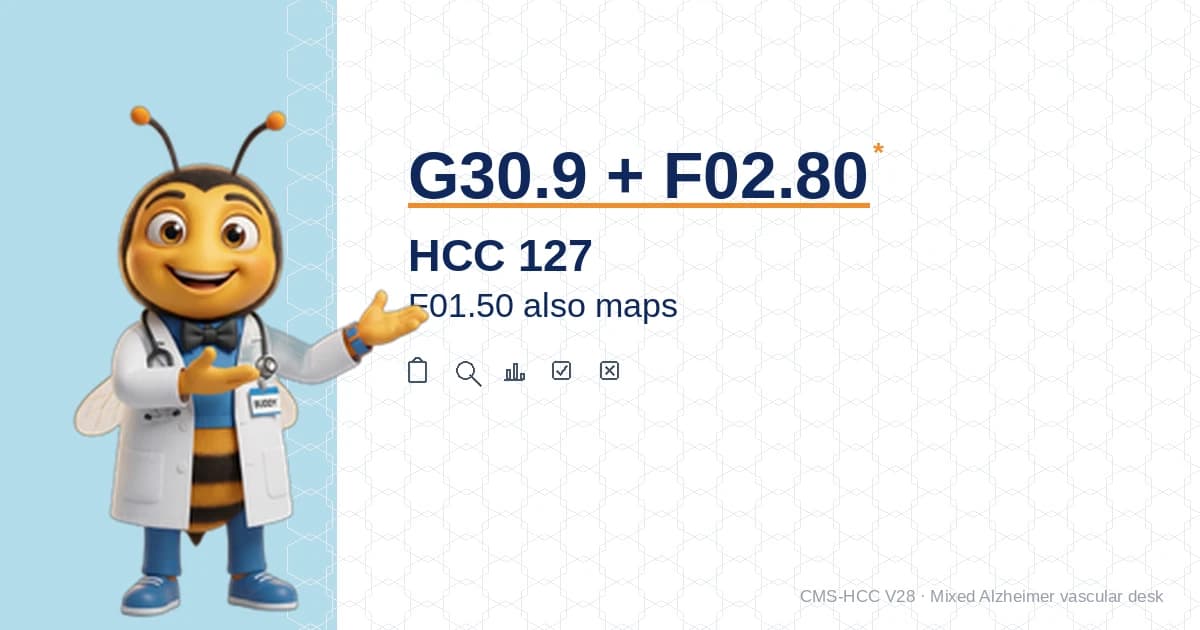
F02.x codes are used for dementia that occurs as a manifestation of another documented disease. The most common use is for Alzheimer's disease dementia, where F02.x is coded alongside G30.x (Alzheimer's disease).
| ICD-10 Code | Description | HCC (V28) |
|---|---|---|
| F02.80 | Dementia in other diseases, unspecified severity, without behavioral disturbance | HCC 127 |
| F02.81 | Dementia in other diseases, unspecified severity, with behavioral disturbance | HCC 127 |
| F02.811 | Dementia in other diseases, unspecified severity, with agitation | HCC 127 |
| F02.818 | Dementia in other diseases, unspecified severity, with other behavioral disturbance | HCC 127 |
| F02.82 | Dementia in other diseases, unspecified severity, with psychotic disturbance | HCC 127 |
| F02.83 | Dementia in other diseases, unspecified severity, with mood disturbance | HCC 127 |
| F02.84 | Dementia in other diseases, unspecified severity, with anxiety | HCC 127 |
| F02.A0 | Dementia in other diseases, mild, without behavioral disturbance | HCC 127 |
| F02.A11 | Dementia in other diseases, mild, with agitation | HCC 127 |
| F02.A18 | Dementia in other diseases, mild, with other behavioral disturbance | HCC 127 |
| F02.B0 | Dementia in other diseases, moderate, without behavioral disturbance | HCC 126 |
| F02.B11 | Dementia in other diseases, moderate, with agitation | HCC 126 |
| F02.B18 | Dementia in other diseases, moderate, with other behavioral disturbance | HCC 126 |
| F02.C0 | Dementia in other diseases, severe, without behavioral disturbance | HCC 125 |
| F02.C11 | Dementia in other diseases, severe, with agitation | HCC 125 |
| F02.C18 | Dementia in other diseases, severe, with other behavioral disturbance | HCC 125 |
Unspecified Dementia (F03.x)
F03.x codes are used when the type of dementia (vascular, Alzheimer's, etc.) is not documented. The same severity and behavioral disturbance structure applies.
| ICD-10 Code | Description | HCC (V28) |
|---|---|---|
| F03.90 | Unspecified dementia, unspecified severity, without behavioral disturbance | HCC 127 |
| F03.91 | Unspecified dementia, unspecified severity, with behavioral disturbance | HCC 127 |
| F03.911 | Unspecified dementia, unspecified severity, with agitation | HCC 127 |
| F03.918 | Unspecified dementia, unspecified severity, with other behavioral disturbance | HCC 127 |
| F03.92 | Unspecified dementia, unspecified severity, with psychotic disturbance | HCC 127 |
| F03.93 | Unspecified dementia, unspecified severity, with mood disturbance | HCC 127 |
| F03.94 | Unspecified dementia, unspecified severity, with anxiety | HCC 127 |
| F03.A0 | Unspecified dementia, mild, without behavioral disturbance | HCC 127 |
| F03.A11 | Unspecified dementia, mild, with agitation | HCC 127 |
| F03.B0 | Unspecified dementia, moderate, without behavioral disturbance | HCC 126 |
| F03.B11 | Unspecified dementia, moderate, with agitation | HCC 126 |
| F03.C0 | Unspecified dementia, severe, without behavioral disturbance | HCC 125 |
| F03.C11 | Unspecified dementia, severe, with agitation | HCC 125 |
Alzheimer's Disease (G30.x)
G30.x codes classify the Alzheimer's disease itself and are coded in addition to the F02.x dementia code. The combination of G30.x + F02.x captures both the underlying disease and the dementia manifestation.
| ICD-10 Code | Description | Notes |
|---|---|---|
| G30.0 | Alzheimer's disease with early onset | Onset before age 65 |
| G30.1 | Alzheimer's disease with late onset | Onset at age 65 or later (most common) |
| G30.8 | Other Alzheimer's disease | Atypical presentations |
| G30.9 | Alzheimer's disease, unspecified | Onset timing not specified |
Coding rule: When a patient has Alzheimer's disease with dementia, code both the G30.x (Alzheimer's disease) and the F02.x (dementia manifestation). The G30.x code is sequenced first as the underlying disease, followed by the F02.x code with the appropriate severity and behavioral disturbance designation.
V28 Changes to Dementia HCC Categories
V28 fundamentally restructured how dementia is categorized for risk adjustment. Under V24, dementia mapped primarily based on type. Under V28, the stratification emphasizes severity and behavioral disturbance, the full mapping tables are published in the CMS 2026 risk-adjustment model software and ICD-10 mappings:
The V28 Dementia HCC Hierarchy
- HCC 125: Dementia, Severe / With Behavioral Disturbance (Higher Severity), Captures severe dementia regardless of behavioral status, plus moderate or unspecified-severity dementia with behavioral disturbance. V28 CNA coefficient: 0.341.
- HCC 126: Dementia, Moderate / Without Behavioral Disturbance (Medium Severity), Captures moderate dementia without behavioral disturbance, mild dementia with behavioral disturbance, and unspecified-severity dementia without behavioral disturbance. V28 CNA coefficient: 0.341.
- HCC 127: Dementia, Mild / Without Behavioral Disturbance (Lower Severity), Captures mild dementia without behavioral disturbance. V28 CNA coefficient: 0.341.
All three tiers carry the same 0.341 CNA coefficient in V28. CMS constrained them equal. The documentation imperative is clinical accuracy and hierarchy positioning, not a higher RAF. Coders should still capture the highest-supported severity tier because RADV reviewers expect the coded severity to match documented functional and cognitive status.
The Hierarchy Rule
HCC 125 trumps HCC 126, which trumps HCC 127. If a patient qualifies for both HCC 125 and HCC 127, only HCC 125 is counted. Coders should capture the highest-supported severity and behavioral status.
Documentation Requirements for Dementia Coding
Severity Documentation
Under V28, severity determines the HCC tier. Providers should document severity using standard clinical terms:
- Mild: "Mild cognitive impairment due to Alzheimer's disease" or "Mild dementia, MMSE 20-24" or "Early-stage dementia with preserved ADL function"
- Moderate: "Moderate dementia, MMSE 10-19" or "Dementia with impaired IADLs, requires supervision for complex tasks"
- Severe: "Severe dementia, MMSE below 10" or "Late-stage dementia, dependent for all ADLs, nonverbal" or "Advanced dementia, bed-bound"
Cognitive assessment tools that support severity:
- MMSE (Mini-Mental State Examination): Mild = 20-24, Moderate = 10-19, Severe = < 10
- MoCA (Montreal Cognitive Assessment): Mild = 18-25, Moderate = 10-17, Severe = < 10
- Clinical Dementia Rating (CDR): CDR 0.5-1 = Mild, CDR 2 = Moderate, CDR 3 = Severe
Behavioral Disturbance Documentation
Behavioral disturbance is the second axis of V28 dementia coding and has a direct impact on HCC tier assignment. Providers should document:
- Agitation: Restlessness, pacing, verbal or physical aggression, resistance to care
- Psychotic features: Hallucinations (visual or auditory), delusions, paranoia
- Wandering: Leaving the home or facility unsupervised, getting lost
- Mood disturbance: Depression, anxiety, apathy, emotional lability associated with the dementia
- Sleep disturbance: Sundowning, night-time wandering, reversed sleep-wake cycle
- Disinhibition: Socially inappropriate behavior, impulsivity
When behavioral disturbance is present, the code shifts from "without behavioral disturbance" to "with behavioral disturbance", which often moves the patient to a higher HCC tier.
Common Dementia Coding Errors
Error 1: Missing the Behavioral Disturbance Code
A patient with documented moderate Alzheimer's dementia and "occasional agitation requiring redirection" is coded as F02.B0 (moderate, without behavioral disturbance) instead of F02.B11 (moderate, with agitation). This drops the patient from HCC 125 to HCC 126.
Error 2: Not Coding Both G30.x and F02.x for Alzheimer's
A patient with documented Alzheimer's disease is coded with only G30.9, missing the F02.x code entirely. Or conversely, coded with only F02.80, missing the G30.x code. Both codes are required for Alzheimer's dementia.
Error 3: Using "History of Dementia" Language
Dementia does not resolve. A patient diagnosed with dementia has dementia, it is a current, chronic, progressive condition. "History of dementia" or "h/o Alzheimer's" is inappropriate language that could cause coders to skip the diagnosis. Providers should document dementia as a current active condition at every encounter.
Error 4: Failing to Specify Severity
"Dementia" without severity forces the coder to F03.90 (unspecified severity, without behavioral disturbance), HCC 127. If the patient has moderate or severe dementia based on cognitive assessment, the documentation should state it explicitly to support the higher HCC tier.
Dementia Medications as Diagnostic Signals
Use the Drug Reference tool to identify patients who may have undocumented or undercoded dementia. Key medications:
- Donepezil (Aricept): Cholinesterase inhibitor used for mild-to-moderate Alzheimer's dementia
- Rivastigmine (Exelon): Cholinesterase inhibitor for mild-to-moderate Alzheimer's and Parkinson's dementia
- Galantamine (Razadyne): Cholinesterase inhibitor for mild-to-moderate Alzheimer's
- Memantine (Namenda): NMDA receptor antagonist for moderate-to-severe Alzheimer's dementia
- Donepezil/memantine combination (Namzaric): Combination therapy for moderate-to-severe Alzheimer's
A patient on donepezil without a coded dementia diagnosis is a missed HCC. A patient on memantine coded with "mild" dementia should be reviewed, memantine is indicated for moderate-to-severe dementia, which suggests the severity documentation may need updating.
Using HCC Buddy for Dementia Code Lookups
Type any F01, F02, F03, or G30 code into the ICD-10 Encoder to see the exact V28 HCC mapping. This is particularly important for dementia because the behavioral disturbance and severity axes create dozens of code variations, each mapping to a different HCC tier.
> RAF Calculator: The RAF Calculator supports CMS-HCC V28 for Payment Year 2026 and requires complete member context. HCC Buddy shows a score only after the server confirms the required source and calculation checks. If a check is unavailable or does not pass, no score is shown.
Because HCC 125, 126, and 127 carry the same 0.341 CNA coefficient in V28, the calculator will show the same contribution regardless of tier. What it will show is how the dementia HCC combines with any other coded conditions and whether any interaction terms apply. Use it to verify the total score, not to compare dementia tier weights that no longer differ.
Key Takeaways
1. V28 stratifies dementia by severity and behavioral disturbance, both dimensions affect the HCC tier (125, 126, or 127).
2. Behavioral disturbance documentation moves patients to higher HCC tiers, agitation, psychotic features, wandering, and mood disturbance all count.
3. Alzheimer's requires dual coding, G30.x (the disease) plus F02.x (the dementia manifestation).
4. Severity needs explicit documentation, cognitive assessment scores (MMSE, MoCA) and functional status descriptions support the severity level.
5. Dementia medications are strong diagnostic signals, donepezil, rivastigmine, galantamine, and memantine should always have a corresponding dementia diagnosis in the chart.
Look up a dementia code and check the CY2026 V28 result, historical PY2025 V24 reference, and source status.
Related Tools

HCC Buddy Coding Team
Editorial
Every HCC Buddy article is checked against the current CMS-HCC model and the active FY ICD-10-CM tabular release before it publishes.
Get HCC Coding Tips in Your Inbox
Join our newsletter for coding tips, guideline updates, and tool announcements.