
J69.0 Aspiration Pneumonia Maps to HCC 282 in V28. J18.9 and J15.9 Do Not.
J69.0 aspiration pneumonia maps to CMS-HCC V28 HCC 282 (CNA ref 0.44). J18.9, J15.9, J13, J14, and J15.3/J15.4/J15.7 are billable but do not map. CSV rows, Tabular notes, MEAT, and audit traps.
By the HCC Buddy Coding Team
Updated: October 5, 2026
If you searched aspiration pneumonia, J69.0, or J18.9 next to V28, you are looking at a pneumonia cluster where the organism or mechanism on the chart decides whether a code maps under CMS-HCC V28 for payment year 2026.
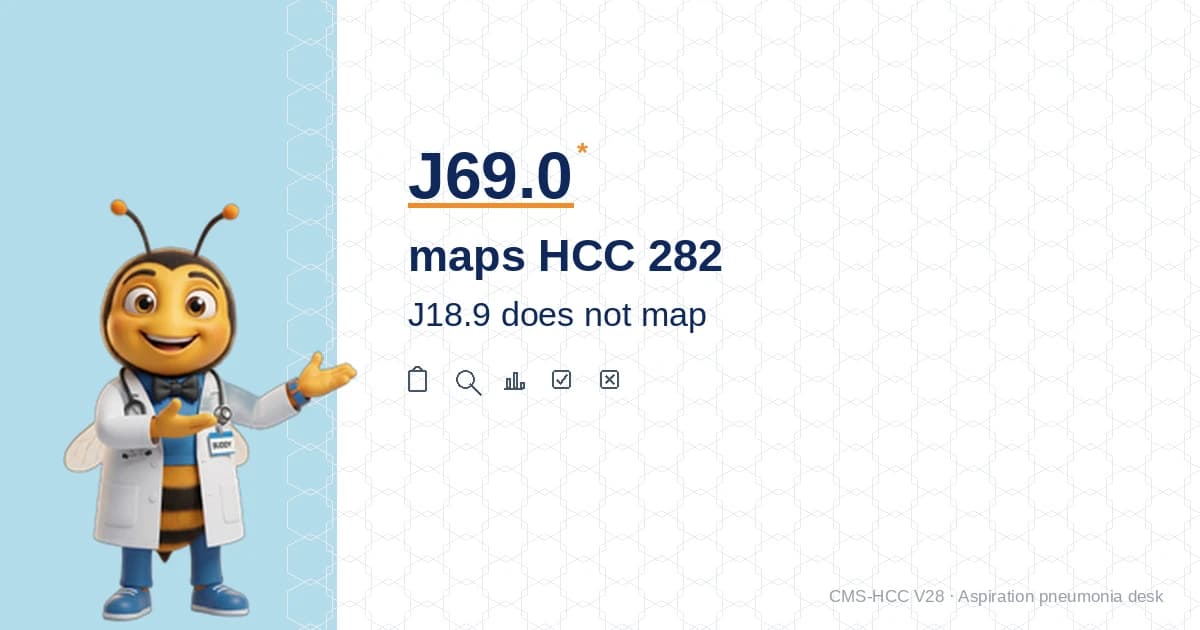
J69.0 (Pneumonitis due to inhalation of food and vomit) is billable and maps to HCC 282 in CMS-HCC V28. The PY2026 V28 CSV row is `J690,282.0,,,`. The FY2027 Tabular lists Aspiration pneumonia NOS and aspiration pneumonia due to food (regurgitated), gastric secretions, milk, or vomit under J69.0.
J18.9 (Pneumonia, unspecified organism) is billable but does not map in V28. The PY2026 CSV has no row for `J189`, and no row for any J18 leaf. J15.9 (Unspecified bacterial pneumonia) also does not map. There is no `J159` row.
The live HCC 282 hub title is Aspiration and Specified Bacterial Pneumonias, with a source-labeled community non-dual aged reference coefficient of 0.44 and 14 ICD rows. That is a category reference, not a member RAF total. The 14 rows are J69.0, J69.1, J69.8, A48.1 (Legionnaires' disease), and ten J15 leaves:
- J69.0 Pneumonitis due to inhalation of food and vomit -> HCC 282
- J69.1 Pneumonitis due to inhalation of oils and essences -> HCC 282
- J69.8 Pneumonitis due to inhalation of other solids and liquids -> HCC 282
- J15.0 Klebsiella pneumoniae, J15.1 Pseudomonas, J15.20 staphylococcus unspecified, J15.211 MSSA, J15.212 MRSA, J15.29 other staphylococcus, J15.5 Escherichia coli, J15.61 Acinetobacter baumannii, J15.69 other Gram-negative bacteria, J15.8 other specified bacteria -> HCC 282
- A48.1 Legionnaires' disease -> HCC 282
Several pneumonia leaves that coders reach for every day are billable but do not map in V28 (no CSV row):
- J18.9 Pneumonia, unspecified organism, plus J18.0, J18.1, and J18.8
- J15.9 Unspecified bacterial pneumonia
- J15.3 Pneumonia due to streptococcus, group B, and J15.4 Pneumonia due to other streptococci
- J15.7 Pneumonia due to Mycoplasma pneumoniae
- J13 Pneumonia due to Streptococcus pneumoniae
- J14 Pneumonia due to Hemophilus influenzae
- J12.9 Viral pneumonia, unspecified
- J95.4 Chemical pneumonitis due to anesthesia
Billable is not the same as risk-adjusted. A J15 code is not automatically HCC 282. The map is leaf-specific.
As of October 5, 2026, the public ICD leaf cards default to the FY2027 ICD-10-CM edition and read the V28 result from the CMS 2027 Initial ICD-10-CM Mappings (payment year 2027, 2026 dates of service). For every leaf in this desk, that card result agrees with the PY2026 V28 CSV and the live HCC 282 hub. Payment maps in this desk are verified from the PY2026 CSV and the hub listing.
This page is the coder-desk walk for the J69.0 aspiration pneumonia map under CMS-HCC V28.
Desk table: verified maps (2026-10-05)
| Code | Official short | V28 result | Coeff ref | CSV (no decimal) |
|---|---|---|---|---|
| J69.0 | Pneumonitis due to inhalation of food and vomit | HCC 282 | 0.44 | `J690,282.0,,,` |
| J69.1 | Pneumonitis due to inhalation of oils and essences | HCC 282 | 0.44 | `J691,282.0,,,` |
| J69.8 | Pneumonitis due to inhalation of other solids and liquids | HCC 282 | 0.44 | `J698,282.0,,,` |
| J15.1 | Pneumonia due to Pseudomonas | HCC 282 | 0.44 | `J151,282.0,,,` |
| J15.212 | Pneumonia due to Methicillin resistant Staphylococcus aureus | HCC 282 | 0.44 | `J15212,282.0,,,` |
| J15.8 | Pneumonia due to other specified bacteria | HCC 282 | 0.44 | `J158,282.0,,,` |
| J18.9 | Pneumonia, unspecified organism | Does not map | - | no CSV row |
| J15.9 | Unspecified bacterial pneumonia | Does not map | - | no CSV row |
| J15.3 | Pneumonia due to streptococcus, group B | Does not map | - | no CSV row |
| J15.4 | Pneumonia due to other streptococci | Does not map | - | no CSV row |
| J15.7 | Pneumonia due to Mycoplasma pneumoniae | Does not map | - | no CSV row |
| J13 | Pneumonia due to Streptococcus pneumoniae | Does not map | - | no CSV row |
| J14 | Pneumonia due to Hemophilus influenzae | Does not map | - | no CSV row |
| J95.4 | Chemical pneumonitis due to anesthesia | Does not map | - | no CSV row |
HCC 282 coeff ref 0.44 is the live hub community non-dual aged reference. Not a member total. Segment coefficients vary.
What J69.0 means on the claim
J69.0 is the aspiration pneumonia leaf. Use it when the provider documents aspiration pneumonia or pneumonitis due to inhaled food, vomit, gastric secretions, or milk. It maps to HCC 282 when supported in the eligible year.
Do not assign J69.0 because a patient has dysphagia, a feeding tube, or an aspiration risk note. Risk is not diagnosis. The provider has to document the pneumonia or pneumonitis.
Do not code "pneumonia" as J69.0 because the patient is elderly, in a facility, or had a swallow study. If the note only says pneumonia with no organism and no aspiration, that is J18.9, and J18.9 does not map.
FY2027 Tabular notes coders ask about
These notes are shown on the live FY2027 cards with their source level:
- J69 category: Code also, if applicable, other types of pneumonias, such as bacterial pneumonia (J13-J15.-) and viral pneumonia (J12.-).
- J69.0: Code also any associated foreign body in respiratory tract (T17.-).
- J69.0 Excludes1: chemical pneumonitis due to anesthesia (J95.4) and obstetric aspiration pneumonitis (O74.0).
- J69 category Excludes1: neonatal aspiration syndromes (P24.-) and postprocedural pneumonitis (J95.4).
- J18 and J15 categories: Code also, if applicable, aspiration pneumonia (J69.-). J15 and J13 also carry Code also abscess (J85.1).
So aspiration pneumonia and a documented bacterial pneumonia can both be reported when the chart supports both. A "code also" note does not make the second code map. The T17 foreign body code adds detail but has no V28 row. A Pseudomonas pneumonia on J15.1 and an aspiration pneumonia on J69.0 both land in HCC 282, so the category counts once.
Coding paths (documentation-driven)
Pick the path from what the chart actually supports. Do not add aspiration, an organism, or a mechanism for RAF.
1. Provider documents aspiration pneumonia (food, vomit, gastric secretions, milk, or NOS) -> J69.0 -> V28 HCC 282.
2. Provider documents lipoid pneumonia from inhaled oils -> J69.1 -> V28 HCC 282.
3. Provider documents pneumonitis from other inhaled solids or liquids -> J69.8 -> V28 HCC 282.
4. Provider documents pneumonia with a mapped J15 organism (Klebsiella, Pseudomonas, staphylococcus, E. coli, Acinetobacter baumannii, other Gram-negative, other specified bacteria) -> that J15 leaf -> V28 HCC 282.
5. Provider documents Legionnaires' disease -> A48.1 -> V28 HCC 282.
6. Provider documents pneumonia with no organism and no aspiration -> J18.9 -> billable, no V28 map.
7. Provider documents bacterial pneumonia with no organism -> J15.9 -> billable, no V28 map.
8. Provider documents pneumococcal, H. influenzae, streptococcal (J15.3, J15.4), Mycoplasma, or viral pneumonia -> that leaf -> billable, no V28 map.
9. Chemical pneumonitis due to anesthesia -> J95.4 -> billable, no V28 map. Per the Excludes1 note, it is not J69.0.
10. Ventilator associated pneumonia -> J95.851. That is a separate leaf with CSV row `J95851,211.0,,,` (V28 HCC 211, Respirator Dependence/Tracheostomy Status/Complications). It is not an HCC 282 path.
11. Lung abscess with pneumonia -> J85.1 maps to HCC 283 (Empyema, Lung Abscess, CNA ref 0.204). The HCC 282 hub supersedes HCC 283, so when HCC 282 is also supported, HCC 282 counts instead.
12. Do not invent member RAF totals from the 0.44 reference.
MEAT for mapped HCC 282
Pneumonia is usually an acute condition. A mapped J69.0 or J15 leaf needs support in the encounter where it is treated or actively assessed. A problem list or history line that says "aspiration pneumonia" from a prior admission does not carry HCC 282 forward.
For mapped leaves in this desk, the note should support:
- M Monitor: respiratory status, oxygen needs, fever curve, swallow precautions when documented
- E Evaluate: chest imaging, cultures or organism results when used, swallow evaluation findings when documented
- A Assess: an explicit diagnosis of aspiration pneumonia, or pneumonia due to the named organism (not "rule out" or "possible" in an outpatient note)
- T Treat: antibiotics, diet or feeding plan changes, speech therapy referral, follow-up imaging when relevant
MEAT is a review mnemonic, not a universal CMS coding rule. Follow the applicable coding, encounter, program, and payer requirements. See MEAT, acute vs history of, and problem lists.
Audit and query traps
1. Coding J18.9 and expecting an HCC. J18.9 does not map. No CSV row.
2. Treating every J15 code as HCC 282. J15.3, J15.4, J15.7, and J15.9 have no CSV row.
3. Treating J13 pneumococcal or J14 H. influenzae pneumonia as mapped because J15 organisms map. They do not.
4. Assigning J69.0 from dysphagia, a feeding tube, or an aspiration precaution order without a documented aspiration pneumonia.
5. Carrying a resolved aspiration pneumonia forward from a discharge summary into a later office visit with no current assessment.
6. Using J69.0 for chemical pneumonitis due to anesthesia. The Excludes1 note sends that to J95.4, which does not map.
7. Expecting the T17 foreign body code to add an HCC. It has no V28 row.
8. Counting HCC 282 twice when J69.0 and a mapped J15 leaf are both coded. Same category, counted once.
9. Using the 0.44 CNA reference as a member RAF total.
10. Inventing Coding Clinic quotes, competitor CTAs, or PHI examples.
Related desks and tools
- Live cards: J69.0, J69.1, J69.8, J18.9, J15.9, J15.1, J15.8, J13, J95.4, J95.851
- Hubs: HCC 282, HCC 283, HCC 211
- Lookup: ICD-10 to HCC, Encoder
- Evidence habits: MEAT, acute vs history of, problem lists
- Nearby map/trap desks: HCC 213 cardio-respiratory failure, T80.211 CVC bloodstream sequencing, D56.0 alpha thalassemia
Current as of October 5, 2026. Always confirm the PY2026 V28 CSV and the live HCC hub before you lock a map claim.
Related Tools
J69.0 card
Pneumonitis due to inhalation of food and vomit. Billable. V28 HCC 282.
J18.9 card
Pneumonia, unspecified organism. Billable. No V28 map in PY2026 CSV.
J15.9 card
Unspecified bacterial pneumonia. Billable. No V28 map.
J15.1 card
Pneumonia due to Pseudomonas. Billable. V28 HCC 282.
J95.4 card
Chemical pneumonitis due to anesthesia. Billable. No V28 map.
HCC 282 hub
Aspiration and Specified Bacterial Pneumonias. CNA ref 0.44.
HCC 283 hub
Empyema, Lung Abscess. CNA ref 0.204. Superseded by HCC 282.
ICD-10 to HCC
Look up one diagnosis against the current V28 map.
Encoder
Search the exact ICD-10-CM code with live V28 status.

HCC Buddy Coding Team
Editorial
Every HCC Buddy article is checked against the current CMS-HCC model and the active FY ICD-10-CM tabular release before it publishes.
Get HCC Coding Tips in Your Inbox
Join our newsletter for coding tips, guideline updates, and tool announcements.