
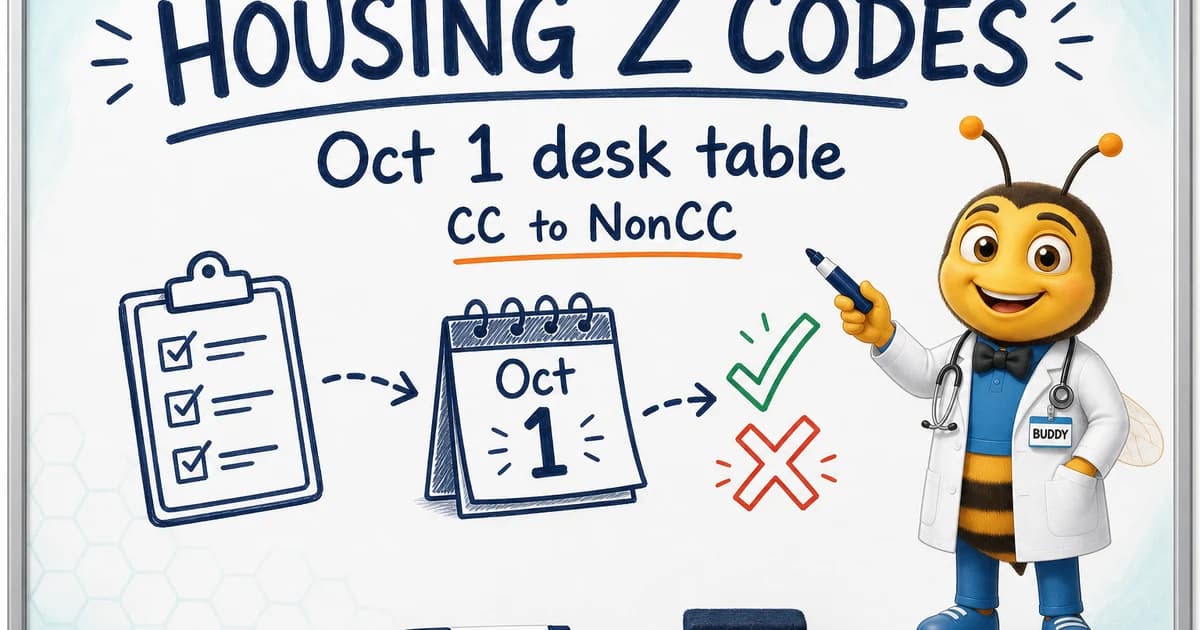
Housing Z Codes on October 1: The CC to NonCC Desk Table
Working table for the 10 homelessness, inadequate-housing, and housing-instability ICD-10-CM Z codes CMS moved from CC to NonCC on October 1, 2026. What changes for MS-DRG severity, and what does not.
By the HCC Buddy Coding Team
Updated: August 18, 2026
If your grouper still treats Z59.00 as a CC after October 1, 2026, the MS-DRG severity is wrong. The code itself is not going anywhere.
CMS finalized a CC-to-NonCC change for 10 ICD-10-CM Z codes that describe homelessness, inadequate housing, and housing instability. The change is in CMS-1849-F, the FY 2027 IPPS/LTCH PPS final rule (91 FR 49570), and it is effective October 1, 2026. This page is the working table: each code, the official title, what flips on October 1, and what does not.
The announcement is already on CMS Watch as FY2027 IPPS moves 10 housing Z codes from CC to NonCC on October 1. Do not use that piece as your cheat sheet. Use this one.
*Current as of August 18, 2026. Codes and titles come from CMS-1849-F Table 6J.2, Deletions to the CC List, FY 2027, in the Tables 6A-6K zip on the FY 2027 IPPS final-rule home page. Effective date is October 1, 2026 (CMS-1849-F / 91 FR 49570). CMS-HCC statements use the official 2026 Final ICD-10-CM Mappings. SDOH assignment rules cite the FY 2026 ICD-10-CM Official Guidelines; the FY 2027 guidelines were not posted on the CMS ICD-10 page as of this writing. Verify against current CMS files and your grouper before you rely on it.*
The working table
Titles below are the Table 6J.2 wording. They match the FY 2026 tabular and the FY 2027 ICD-10-CM order file. The Federal Register preamble adds a comma in a couple of titles (Homelessness, unspecified). Use the table file when you are matching a grouper edit.
| Code | Title (Table 6J.2) | What changes October 1, 2026 | What does not change |
|---|---|---|---|
| Z59.00 | Homelessness unspecified | Secondary-dx IPPS severity moves from CC to NonCC | Still a valid ICD-10-CM code. Still reportable SDOH documentation. Not a CMS-HCC. |
| Z59.01 | Sheltered homelessness | CC to NonCC | Same. Valid, reportable, not an HCC. |
| Z59.02 | Unsheltered homelessness | CC to NonCC | Same. Valid, reportable, not an HCC. |
| Z59.10 | Inadequate housing, unspecified | CC to NonCC | Same. Valid, reportable, not an HCC. |
| Z59.11 | Inadequate housing environmental temperature | CC to NonCC | Same. Valid, reportable, not an HCC. |
| Z59.12 | Inadequate housing utilities | CC to NonCC | Same. Valid, reportable, not an HCC. |
| Z59.19 | Other inadequate housing | CC to NonCC | Same. Valid, reportable, not an HCC. |
| Z59.811 | Housing instability, housed, with risk of homelessness | CC to NonCC | Same. Valid, reportable, not an HCC. |
| Z59.812 | Housing instability, housed, homelessness in past 12 months | CC to NonCC | Same. Valid, reportable, not an HCC. |
| Z59.819 | Housing instability, housed unspecified | CC to NonCC | Same. Valid, reportable, not an HCC. |
CMS finalized those ten, without modification, and said they are reflected in Table 6J.2. None of them remain on Table 6J, the complete FY 2027 CC list.
If a code is not in that table, omit it from this change. Do not add Z59.2, Z59.41, Z59.86, or any other Z59 code because it "sounds like housing." Those codes are not in Table 6J.2.
How to read CC versus HCC
CC and NonCC are IPPS MS-DRG severity flags. They apply when the diagnosis is reported as a secondary diagnosis on an acute inpatient claim. A CC can move a stay into a "with CC" MS-DRG. A NonCC does not.
CMS-HCC is a different system. It is the Medicare Advantage risk-adjustment model. A code can be a CC and not an HCC, or an HCC and not a CC. These ten were CCs. They were not CMS-HCC mapped.
The official 2026 Final ICD-10-CM Mappings file has no rows for Z59.00, Z59.01, Z59.02, Z59.10, Z59.11, Z59.12, Z59.19, Z59.811, Z59.812, or Z59.819. They are not an HCC. Stop there. Do not invent a V28 category.
If the question in front of you is RAF, use the ICD-10 to HCC tool for the payment year you are coding. Do not read an IPPS CC flag as a risk-adjustment signal.
What does not change
The codes stay in ICD-10-CM. None of the ten appear in Table 6C (invalid diagnosis codes). None of them are new in Table 6A. The official FY 2027 ICD-10-CM order file still lists all ten with a valid-code flag, and they are not in the FY 2027 order addenda. This is not a deletion. It is a severity-flag change.
They stay reportable when the record supports them. FY 2026 Official Guidelines Section I.C.21.c.17 says SDOH codes describing social problems, conditions, or risk factors should be assigned when that information is documented. Documentation that the patient is experiencing homelessness supports a code from subcategory Z59.0-. Assign as many SDOH codes as are needed for the current episode. Section I.B.14 still lists SDOH codes among the exceptions that may be based on documentation from clinicians other than the patient's provider, and it says those codes should be reported as secondary diagnoses.
They stay social-risk documentation, not a medical diagnosis. CMS's stated reason in CMS-1849-F is that these SDOH Z codes describe social circumstances and not medical conditions or illnesses. That is why the agency moved the severity flag. It is not a statement that the codes are invalid.
They were not an HCC before October 1, and they are not an HCC after. Losing the CC flag does not create, remove, or remap a CMS-HCC. See status Z codes that carry an HCC under V28 and ICD-10 codes that do not map to HCC if you need the risk-adjustment side of Z codes.
What does change on October 1
For FY 2027 IPPS discharges on or after October 1, 2026, these ten codes are NonCC when reported as a secondary diagnosis. A stay will not pick up a "with CC" MS-DRG from one of these Z codes alone.
Mark the grouper, encoder, abstracting tip sheet, and any homemade CC list that still shows them as CCs. The effective date is the discharge date, not the admit date, unless your vendor says otherwise. Confirm that with your grouper documentation.
CMS told commenters that recognition of extra inpatient complexity should come from coding the medical conditions that were more clinically severe, that needed more treatment time, or that were managed while the facility worked through a harder discharge, as documented in the record. That is not a new Z-code instruction. It is the existing rule: code the conditions the record supports.
Do not mix this file with the FY 2027 new-code list. The housing codes already exist. The 238 additions and 21 deletions live on the FY 2027 ICD-10-CM changes page. Table 6J.2 also deletes a few restructured diagnosis codes that are not housing codes (for example I42.0 after it becomes a category header). Those are code-set changes. They are not this CC-to-NonCC policy.
Before you finalize a chart
- Confirm the discharge is on or after October 1, 2026 before you treat the code as NonCC.
- Assign the Z59 code the record actually supports. Unsheltered is Z59.02, not Z59.00, when the note says the patient is living in a place not meant for habitation.
- Keep the medical conditions that drive resource use. The CC flag is leaving the housing code, not the pneumonia, the decompensated heart failure, or the wound that will not close.
- Leave other Z59 codes alone unless they are in Table 6J.2. Food insecurity, financial insecurity, and transportation insecurity are a different list.
- If someone asks whether RAF changed, show them the 2026 mapping file, not the IPPS CC table.
The CMS newsroom fact sheet for CMS-1849-F covers payment rates and quality programs. It does not list these ten codes. Do not build a tip sheet from that page. Build it from Table 6J.2.
Frequently asked questions
Which housing Z codes change from CC to NonCC on October 1, 2026?
Ten codes in Table 6J.2: Z59.00, Z59.01, Z59.02, Z59.10, Z59.11, Z59.12, Z59.19, Z59.811, Z59.812, and Z59.819. CMS finalized that list without modification. AHIMA's August 3, 2026 fact sheet names the same ten as a secondary cross-check. If a code is not in the CMS table, leave it off yours.
Do I still report homelessness if it will not be a CC?
Yes, when the documentation supports it. The Official Guidelines still govern assignment. CMS-1849-F changes the MS-DRG severity flag. It does not retire the code or the SDOH reporting rules.
Is this a CMS-HCC change?
No. CMS-1849-F is the hospital inpatient PPS rule. The change it finalizes is the CC/NonCC designation used in MS-DRG grouping. These ten codes are not in the official 2026 CMS-HCC mappings. They are not an HCC.
What if FY 2027 Official Guidelines change the SDOH section?
Then follow the FY 2027 guidelines once CDC/NCHS and CMS post them. As of August 18, 2026, the FY 2027 ICD-10-CM Coding Guidelines PDF was marked not yet available on the CMS ICD-10 page. The assignment language above is FY 2026, which is the current posted guideline file.
Disclaimer
This article is for professional and educational use only. It is not coding, billing, legal, or medical advice. Verify every code, CC/NonCC flag, and HCC mapping against current official CMS, ICD-10-CM, and AHA Coding Clinic guidance, your grouper, and your payer's policy before you assign it. Reading it creates no provider, patient, or advisory relationship.
Sources
CMS-1849-F Table 6J.2, Deletions to the CC List, FY 2027 (file inside the zip: CMS-1849-F Table 6J.2 - Deletions to the CC List - FY 2027.txt), posted from the FY 2027 IPPS final-rule home page
Medicare Program; Hospital Inpatient Prospective Payment Systems for Acute Care Hospitals (IPPS) and the Long-Term Care Hospital Prospective Payment System and Policy Changes and Fiscal Year (FY) 2027 Rates (CMS-1849-F), 91 FR 49570, published August 4, 2026, effective October 1, 2026
FY 2027 Hospital IPPS and LTCH PPS Final Rule fact sheet (CMS-1849-F) (rule issuance and payment-rate overview; does not list the 10 codes)
FY 2027 ICD-10-CM Code Descriptions in Tabular Order (icd10cm_order_2027.txt), via the CMS ICD-10 page
ICD-10-CM Official Guidelines for Coding and Reporting, FY 2026, Sections I.B.14 and I.C.21.c.17
Related Tools

HCC Buddy Coding Team
Editorial
Every HCC Buddy article is checked against the current CMS-HCC model and the active FY ICD-10-CM tabular release before it publishes.
Get HCC Coding Tips in Your Inbox
Join our newsletter for coding tips, guideline updates, and tool announcements.