
Bullous Pemphigoid Is L12.0, Not L10.0. Both Still Map to HCC 387
L12.0 is bullous pemphigoid. L10.0 is pemphigus vulgaris. Both map to V28 HCC 387 (CNA 0.406). Reporting both does not open a second 387. Desk table for the leftover pairing of bullous pemphigoid with L10.0.
By the HCC Buddy Coding Team
Updated: September 5, 2026
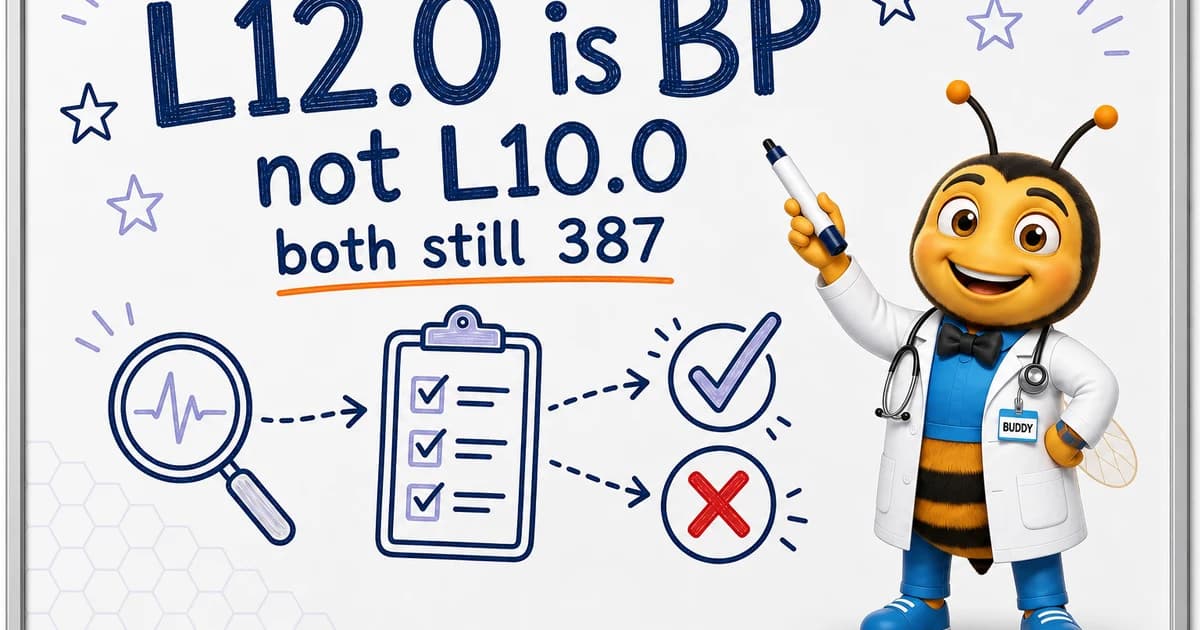
L12.0 is bullous pemphigoid. L10.0 is pemphigus vulgaris. Both map to HCC 387. The leftover search pairs bullous pemphigoid with L10.0. That pairing is the miss.
Open the live L12.0 and L10.0 cards before you invent a second 387 or a V24 row. This page is the desk table for that leftover. It is not a rewrite of the E11.65 desk. It is not a SNF CB, CLFS, or G0685 story.
*Current as of August 27, 2026. V28 mapping and CNA factors come from the live code pages named below and the 2026 Final ICD-10-CM Mappings. Payment year 2026 is 100% V28. Look the exact codes up. Do not code from this recap. Do not invent a V24 map.*
Quick answer
No. Bullous pemphigoid is L12.0, not L10.0. L10.0 is pemphigus vulgaris. On the live cards both map to CMS-HCC V28 HCC 387, Pemphigus, Pemphigoid, and Other Specified Autoimmune Skin Disorders. The source-labeled community non-dual aged reference coefficient is 0.406. V24 is not mapped.
| Code | What the row is naming | V28 payment HCC | CNA |
|---|---|---|---|
| L12.0 | Bullous pemphigoid | HCC 387 | 0.406 |
| L10.0 | Pemphigus vulgaris | HCC 387 | 0.406 |
| L12.1 | Cicatricial pemphigoid | HCC 387 | 0.406 |
| L12.8 | Other pemphigoid | HCC 387 | 0.406 |
| L12.9 | Pemphigoid, unspecified | HCC 387 | 0.406 |
Reporting both L12.0 and L10.0 does not open a second 387.
One bucket. 14 codes.
The live HCC 387 card lists 14 ICD-10-CM codes in one bucket. L12.0 and L10.0 sit in that same bucket. Two codes on the encounter still pay 387 once. Do not stack 387.
Do not invent a V24 map
The live L12.0 and L10.0 cards show no V24 mapping. Do not back-fill a V24 HCC.
L12.2, L12.3, and L10.5 are not 387
L12.2 is billable. It is not in the PY2026 V28 map file. Do not invent a 387 row.
L12.3 is a header. It is not billable. The children are L12.30, L12.31, and L12.35. Look the exact child card up. Do not assume 387 from the header.
L10.5 is also unmapped in V28.
How the cards distinguish the two
The leftover is the code, not the dollar. When the record uses these findings, the live cards keep them apart:
- L12.0: tense blisters. Subepidermal blistering when histopathology is used. Linear basement-membrane immunofluorescence when that test is used. BP180 / BP230 when those antibodies are tested.
- L10.0: intraepidermal blistering when histopathology is used. Intercellular IgG deposits when immunofluorescence is used.
Do not pick L12.0 or L10.0 from a problem-list row. Assign the code the provider assessed.
Review documentation support
An HCC mapping does not establish reportability. Review the full eligible record and apply the official coding, encounter, program and payer requirements. A problem-list row from last year is not enough. See MEAT criteria and problem lists do not validate HCCs. MEAT is the training mnemonic. The authorities are the Official Guidelines and the record from the date of service.
Common misses
1. Coding bullous pemphigoid as L10.0. L12.0 is bullous pemphigoid. L10.0 is pemphigus vulgaris.
2. Stacking two 387s. Both codes sit in one bucket. 387 pays once.
3. Inventing a V24 map. The live L12.0 and L10.0 cards show V24 not mapped.
4. Treating L12.3 as 387. L12.3 is a header. Look the child card up.
5. Assigning 387 to L12.2 or L10.5. Neither is in the PY2026 V28 map file.
Two-minute check
1. Name the condition the provider assessed today: bullous pemphigoid or pemphigus vulgaris.
2. Assign L12.0 or L10.0 from that assessment. Do not swap them.
3. Look that exact code up on HCC Buddy or in the encoder. Expect HCC 387, CNA 0.406.
4. If both codes are supported, they still pay 387 once. Do not stack 387.
5. Review documentation support under the applicable official rules. Do not invent a V24 map. Do not assume 387 on L12.3.
Related
- L12.0: V28 HCC 387
- L10.0: V28 HCC 387
- HCC 387: 14 codes, one bucket
- L12.3: header. Look the child card up.
- ICD-10 Encoder · MEAT criteria · Problem lists
Disclaimer
This article is for professional and educational use only. It is not coding, billing, legal, or medical advice. Verify every code, HCC map, and guideline section against current official CMS and ICD-10-CM guidance and your payer's policy before you assign it. Reading it creates no provider, patient, or advisory relationship.
By the HCC Buddy Coding Team. V28 mappings and CNA factors from the cited live code pages (CMS-HCC V28 PY2026 model software and ICD-10-CM mapping file). Not medical advice. Not a SNF CB, CLFS, G0685, or V44 story. Not a rewrite of the E11.65 leftover.
Sources
L12.0 (V28 HCC 387 CNA 0.406; live card shows no V24 mapping)
L10.0 (V28 HCC 387 CNA 0.406; live card shows no V24 mapping)
L12.1 · L12.8 · L12.9 (V28 HCC 387)
L12.2 (not in the PY2026 V28 map file)
L12.3 (header / not billable; children L12.30, L12.31, L12.35)
L10.5 (unmapped in V28)
HCC 387 (14 codes; CNA 0.406)
Frequently asked questions
Is bullous pemphigoid coded as L10.0?
No. Bullous pemphigoid is L12.0. L10.0 is pemphigus vulgaris. Open the live cards before you swap them.
What do L12.0 and L10.0 map to in CMS-HCC V28?
On the live cards and in the PY2026 V28 map file, both map to HCC 387 (CNA 0.406). The live cards show V24 not mapped. Do not invent a V24 HCC.
If I report both L12.0 and L10.0, do I get two HCC 387s?
No. The live HCC 387 card lists 14 codes in one bucket. Reporting both still pays 387 once. Do not stack 387.
Does L12.3 map to HCC 387?
L12.3 is a header. It is not billable. The children are L12.30, L12.31, and L12.35. Look the exact child card up. Do not assume 387 from the header.
Do L12.2 or L10.5 map in V28?
No. L12.2 is billable but is not in the PY2026 V28 map file. L10.5 is also unmapped in V28. Do not invent those rows.
Related Tools
L12.0 card
Bullous pemphigoid. V28 HCC 387, CNA 0.406. Confirm the live card. V24 is not mapped on that card.
L10.0 card
Pemphigus vulgaris. Same V28 HCC 387, CNA 0.406. V24 is not mapped.
HCC 387
Pemphigus, Pemphigoid, and Other Specified Autoimmune Skin Disorders. 14 codes, one bucket.
MEAT criteria
Review documentation under the applicable official rules. MEAT can organize that review; it does not decide whether a diagnosis is reportable.
Problem lists
A leftover list row does not validate an HCC. This post is the L12.0 leftover.
Encoder
Look up the exact L12.0 or L10.0 the record supports.

HCC Buddy Coding Team
Editorial
Every HCC Buddy article is checked against the current CMS-HCC model and the active FY ICD-10-CM tabular release before it publishes.
Get HCC Coding Tips in Your Inbox
Join our newsletter for coding tips, guideline updates, and tool announcements.