
ICD-10-CM to HCC Mapping: How It Works
Understand the crosswalk between ICD-10-CM diagnosis codes and HCC categories, including how RAF scores are calculated and why accurate mapping matters.
By the HCC Buddy Coding Team
Updated: March 7, 2026
Understanding the ICD-10 to HCC Crosswalk
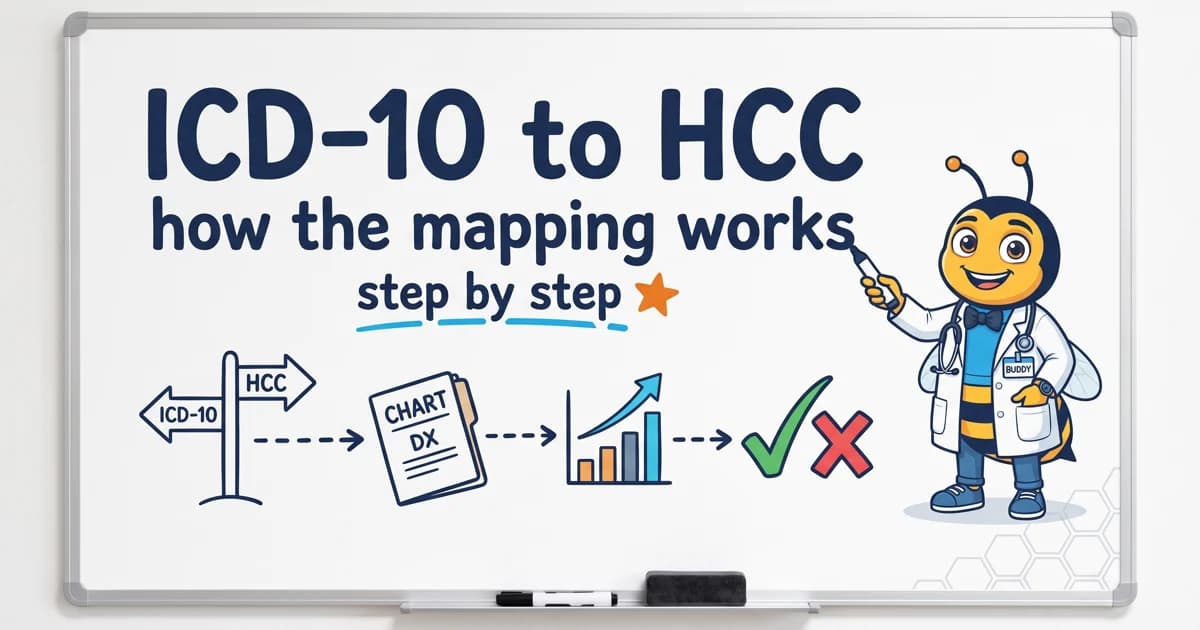
The CMS-HCC model uses a crosswalk, a mapping table, that connects ICD-10-CM diagnosis codes to Hierarchical Condition Categories. This crosswalk is updated annually on the CMS risk-adjustment model software and ICD-10 mappings page and is the backbone of the risk adjustment process.
How the Mapping Works
Step 1: Diagnosis Code Assignment
A medical coder reviews clinical documentation from a face-to-face encounter and assigns ICD-10-CM codes. The codes must be:
- Supported by the clinical documentation
- Coded to the highest level of specificity
- From an acceptable encounter type (face-to-face with a qualified provider)
Step 2: Crosswalk to HCC
Each ICD-10-CM code is checked against the CMS mapping table. For example:
| ICD-10-CM | Description | HCC (V28) | RAF Weight |
|---|---|---|---|
| E11.65 | Type 2 DM with hyperglycemia | HCC 38 | 0.166 |
| I50.9 | Heart failure, unspecified | HCC 226 | 0.36 |
| F32.1 | Major depressive disorder, moderate | HCC 155 | 0.299 |
| J44.1 | COPD with acute exacerbation | HCC 280 | 0.319 |
Step 3: Hierarchy Application
The "hierarchical" part of HCC means that when a patient has multiple related conditions, only the most severe one counts. For example:
- If a patient has both HCC 38 (Diabetes without Complications) and HCC 37 (Diabetes with Chronic Complications), only HCC 37 is counted because it sits higher in the hierarchy.
Step 4: RAF Score Calculation
The RAF score is calculated by:
1. Starting with a demographic baseline (age, sex, eligibility)
2. Adding the coefficients for each unique HCC
3. Applying interaction terms (certain HCC combinations add extra weight)
4. The final score represents the expected cost relative to the average Medicare beneficiary
A RAF score of 1.0 means the patient is expected to cost the average amount. A score of 2.5 means 2.5 times the average.
Common Mapping Pitfalls
1. Unspecified codes that lose HCC value
Using E11.9 (Type 2 DM without complications) instead of E11.65 (with hyperglycemia) might change the HCC mapping. Always code to the highest specificity.
2. Codes that dropped from V28
Several codes in the historical PY2025 V24 source do not map in CY2026 V28. The non-PACE transition is complete; PACE follows a separate CY2026 blend.
3. Missing the hierarchy
If you capture both a higher and lower HCC in the same hierarchy, the lower one is zeroed out. Understanding hierarchies prevents over-counting.
How HCC Buddy Shows Mapping
In HCC Buddy's encoder, each lookup displays an explicit mapping status:
- Navy badge, V28 HCC mapping
- Slate badge, historical PY2025 V24 reference
- Green badge, Billable code
- No payable mapping, the current source verifies that the billable code has no V28 payment HCC
- Not available for this source period, the selected source does not support a conclusion
This lets coders distinguish a mapped result from a verified no-map or unavailable result before applying member-level hierarchy and context.
Start looking up codes now at hccbuddy.com/encoder, every new account gets a 7-day free trial, no card required.
Free resource: Download the HCC Coding Cheat Sheet, a printable V28 quick reference with top HCC categories and documentation tips.
Frequently asked questions
How does the ICD-10 to HCC crosswalk work?
The CMS-HCC model uses a crosswalk, a mapping table, that connects ICD-10-CM diagnosis codes to Hierarchical Condition Categories. CMS updates this table annually on the Risk Adjustment Model Software and ICD-10 Mappings page. A coder assigns an ICD-10-CM code, looks it up in the crosswalk, and finds the corresponding HCC category and its coefficient. That coefficient adds to the patient's RAF score, which determines the plan's per-member-per-month payment.
What does the 'hierarchical' part of HCC mean?
Hierarchical means that when a patient has multiple related conditions in the same disease group, only the most clinically severe condition counts toward the RAF score. For example, if a patient has both HCC 37 (Diabetes with Chronic Complications) and HCC 38 (Diabetes without Complications), only HCC 37 is scored because it sits higher in the hierarchy. The lower-severity HCC is zeroed out. This prevents double-counting the same disease at different severity levels.
What are common pitfalls in ICD-10 to HCC mapping?
Three pitfalls arise most often. First, defaulting to an unspecified code, for example N18.9, when the record supports a mapped stage such as N18.4. Second, carrying a historical PY2025 V24 result into CY2026 V28 without checking the current source. Third, treating every mapped category as additive before applying hierarchy and member context. CY2026 non-PACE risk scores use V28 at full weight; PACE follows a separate blend.
How is a RAF score calculated from HCC mappings?
The RAF score calculation starts with the demographic factor for the selected segment, then adds supported HCC coefficients, applies hierarchies, and includes source-verified interaction terms. CY2026 non-PACE risk scores use V28 at full weight. PACE follows a separate blend, so one V28 score does not represent a PACE result.
Related Tools

HCC Buddy Coding Team
Editorial
Every HCC Buddy article is checked against the current CMS-HCC model and the active FY ICD-10-CM tabular release before it publishes.
Get HCC Coding Tips in Your Inbox
Join our newsletter for coding tips, guideline updates, and tool announcements.