
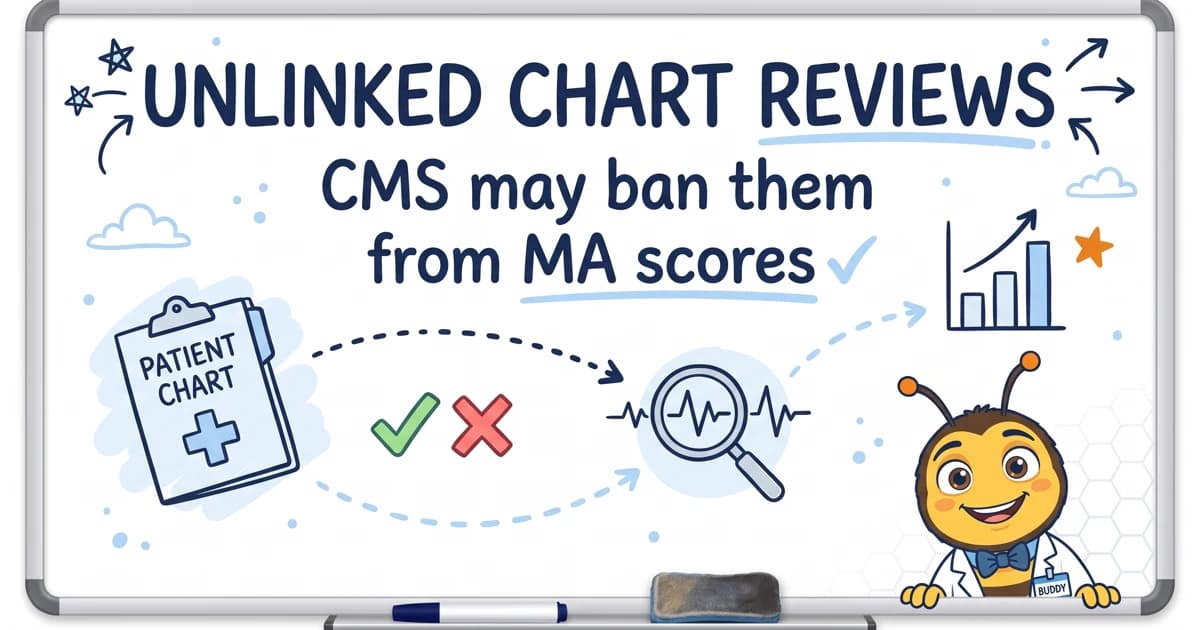
CMS May Ban Unlinked Chart Reviews from MA Risk Scores
CMS proposed excluding unlinked chart review diagnoses from risk adjustment in 2027, saving $7B+. What HCC coders need to know before the final rule.
By the HCC Buddy Coding Team
Updated: March 24, 2026
The Biggest Medicare Advantage Payment Change in Years
Update, April 6, 2026: CMS finalized the exclusion of diagnoses from unlinked chart review records for CY2027 risk-score calculation, with an exception for beneficiaries who switch from one MA organization to another. CMS also finalized excluding diagnoses from audio-only encounters identified by the applicable modifiers. See the CY2027 Rate Announcement fact sheet.
On January 26, 2026, the Centers for Medicare and Medicaid Services (CMS) released the Calendar Year (CY) 2027 Advance Notice for Medicare Advantage (MA) and Part D. The Advance Notice proposed excluding diagnoses from unlinked chart review records from Risk Adjustment Factor calculations starting in CY2027. CMS finalized that policy in April with the beneficiary-switch exception described above.
CMS estimates the finalized sources-of-diagnoses policy has an average -1.53 percent impact on the affected MA payment component. The final Rate Announcement projects an overall 2.48 percent increase in MA payments before estimated risk-score trend. Coders and coding managers should use the final policy, not the earlier proposal, for implementation planning.
What Are Unlinked Chart Reviews?
To understand the proposal, you need to understand the two ways diagnosis codes reach CMS for risk adjustment purposes.
Encounter-linked submissions come from actual clinical visits. A patient sees a provider, the provider documents and codes the visit, and those International Classification of Diseases, 10th Revision, Clinical Modification (ICD-10-CM) codes flow through claims to CMS. These diagnoses are tied to a specific date of service, a specific provider, and a face-to-face encounter.
Unlinked chart review records are different. In this workflow, a health plan or its vendor retrospectively reviews a patient's medical records -- often months after the encounter -- looking for diagnosis codes that were documented in the chart but never submitted on a claim. Those codes are then sent to CMS through a Chart Review Record (CRR) submission, often without any direct connection to a new clinical encounter where the condition was actively managed.
CMS considers a chart review "unlinked" when the diagnosis information is not associated with a specific beneficiary encounter. In other words, no one saw the patient specifically for that condition -- the code was found by mining old records.
Why CMS Is Acting Now
This proposal did not appear out of nowhere. It follows years of escalating concern about the role of chart reviews in inflating MA risk scores.
The numbers are staggering. The Medicare Payment Advisory Commission (MedPAC) estimated that chart reviews drove approximately $24 billion in MA overpayments in 2023 alone. In 2022, one in six MA enrollees underwent a chart review that resulted in increased CMS reimbursement to their health plan. Traditional Fee-for-Service (FFS) Medicare does not use chart reviews at all, which means every dollar generated through this practice represents a gap between how MA and FFS Medicare calculate payments.
Enforcement actions have intensified. The Kaiser Permanente $556 million False Claims Act settlement in January 2026, the Aetna settlement in March 2026, and the Office of Inspector General (OIG)'s new Industry Compliance Program Guidance all pointed to chart reviews as a core risk area. CMS has watched these enforcement trends and is now proposing to address the root cause at the payment methodology level.
The V28 model transition created an opening. CMS completed the non-PACE phase-in of the CMS-HCC V28 risk adjustment model in 2026. PACE used a separate CY2026 blend. The chart-review policy is a separate source-of-diagnoses change for CY2027.
What the Proposal Would Actually Change
The finalized CY2027 policy works as follows:
The practical effect is straightforward: if a diagnosis was not addressed during a real visit where a provider saw the patient, it will not generate risk adjustment revenue.
What This Means for HCC Coders
For coders working in risk adjustment, this proposal carries several important implications.
Concurrent coding becomes even more critical. If retrospective chart reviews lose their risk adjustment value, the point of capture shifts entirely to the clinical encounter itself. Coders embedded in real-time or near-real-time workflows -- reviewing documentation while the patient is still in the office or within days of the visit -- become the primary defense against missed HCCs. Organizations that have underinvested in concurrent coding will feel the impact most.
Documentation quality at the point of care matters. A proposal is not a final rule, and its status must be rechecked before use. Providers and coders should follow current documentation and coding requirements; MEAT may be taught only as an internal review aid.
Retrospective chart review teams may shrink or pivot. Organizations that have built large retrospective chart review operations will need to evaluate whether those investments still make sense. Some may redirect those resources toward prospective coding support, provider education, or clinical documentation improvement (CDI) programs that improve capture at the encounter level.
Suspect condition lists need a new strategy. Many MA plans use "suspect lists" -- conditions a patient likely still has based on prior-year data -- to guide chart reviews. Under the new rule, suspect lists would only be useful if they inform the provider before or during the encounter, prompting the provider to address the condition face-to-face. Suspect-to-retrospective-review pipelines would lose their payment impact.
The Bigger Picture: Encounter-Based Risk Adjustment
This proposal is part of a broader CMS philosophy that risk adjustment should reflect what happens during actual patient care, not what can be extracted from historical documentation through administrative processes. Combined with the V28 model's emphasis on greater diagnostic specificity, the exclusion of certain unspecified codes from HCC mapping, and the OIG's compliance guidance warning against chart review abuse, the direction is clear: CMS is building an encounter-based risk adjustment system.
For coders, this is not a reason to panic. It is a reason to double down on the fundamentals that have always defined high-quality HCC coding:
> RAF Calculator: The RAF Calculator supports CMS-HCC V28 for Payment Year 2026 and requires complete member context. HCC Buddy shows a score only after the server confirms the required source and calculation checks. If a check is unavailable or does not pass, no score is shown.
How to Prepare for CY2027
The final CY2027 Rate Announcement was released on April 6, 2026. Here is what teams can do before implementation:
1. Audit your current chart review workflows. Identify what percentage of your HCC submissions come from unlinked CRRs versus encounter-linked claims. This tells you your exposure.
2. Invest in concurrent coding infrastructure. If your organization relies heavily on retrospective capture, begin shifting resources toward real-time or near-real-time coding support.
3. Educate providers on complete encounter documentation. Every annual wellness visit, every chronic care management appointment, every specialist consult is an opportunity to capture HCCs -- but only if the provider documents the condition with specificity.
4. Review your suspect condition workflows. Ensure suspect lists are reaching providers before encounters, not just chart review teams after the fact.
Stay Current With HCC Buddy
Regulatory changes like this one are exactly why staying current on risk adjustment policy matters.
If you are not already using these tools, create a free account and start building workflows around the finalized CY2027 policy and the source rules that apply to each submission.
Related Tools
ICD-10 to HCC Encoder
Verify diagnosis-to-HCC mappings in real time during encounters.
RAF Calculator
CMS-HCC V28 Payment Year 2026 scoring with complete member context. No score is shown unless the required source and calculation checks pass.
CRC Quick Reference
Look up HCC coding rules and condition categories on the fly.

HCC Buddy Coding Team
Editorial
Every HCC Buddy article is checked against the current CMS-HCC model and the active FY ICD-10-CM tabular release before it publishes.
Get HCC Coding Tips in Your Inbox
Join our newsletter for coding tips, guideline updates, and tool announcements.