
RADV Audit Notices Sent to 471 MA Contracts, What to Do Now
CMS sent PY2020 RADV audit notices to 471 Medicare Advantage contracts. Medical record submissions open April 13. What every HCC coder needs to know.
By the HCC Buddy Coding Team
Updated: March 31, 2026
The Largest RADV Audit in History Just Landed
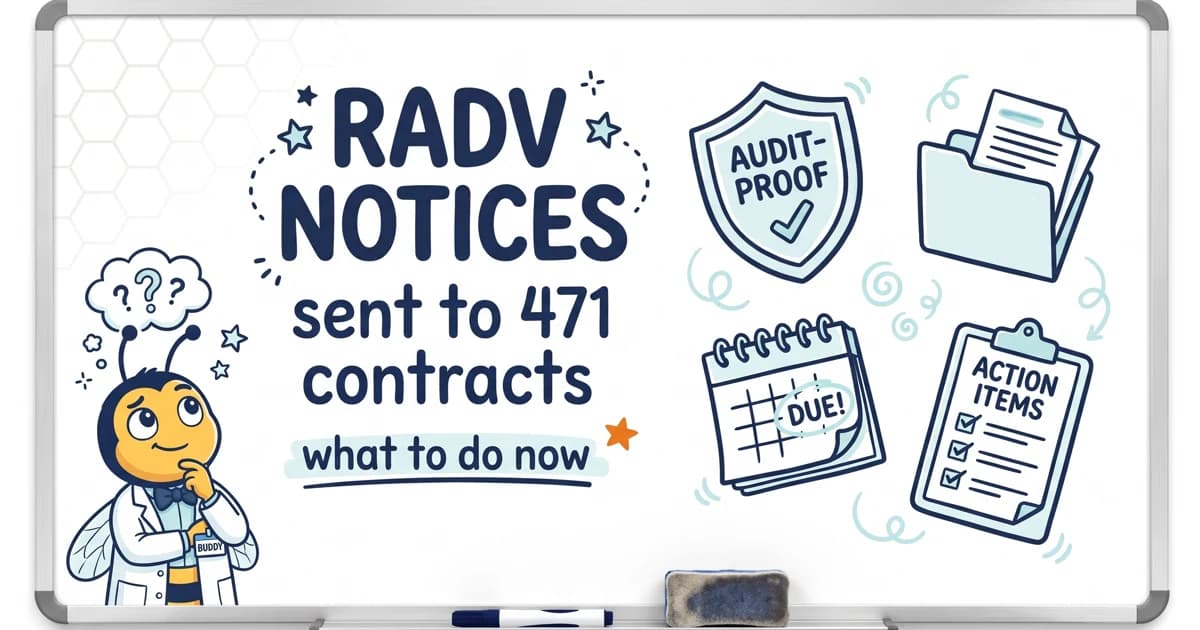
On March 20, 2026, the Centers for Medicare and Medicaid Services (CMS) released Payment Year (PY) 2020 Risk Adjustment Data Validation (RADV) audit notices to 471 Medicare Advantage (MA) contracts. That is the largest single audit cohort in the history of the RADV program, and it marks a sharp escalation from the roughly 60 contracts that were audited annually in previous cycles.
This is not a drill. If your organization holds an MA contract, or if you code for one, you need to understand what just happened and what you need to do before the medical record submission window opens on April 13, 2026.
What Is RADV and Why Does It Matter
RADV is the process CMS uses to verify that the diagnosis codes submitted by Medicare Advantage plans are actually supported by clinical documentation in the medical record. When a plan submits an ICD-10-CM code that maps to a Hierarchical Condition Category (HCC), that code drives a Risk Adjustment Factor (RAF) score, which drives payment. RADV audits check whether those codes are real.
If CMS finds that a submitted HCC code is not supported by the medical record, the plan must return the associated overpayment. The Congressional Budget Office and MedPAC have estimated that MA overpayments due to unsupported risk adjustment codes could reach $76 billion in 2026. That number is why CMS is scaling audits aggressively.
What Changed in the PY 2020 Audit
Several things are different about this audit cycle compared to previous years.
Scale. CMS moved from auditing roughly the top decile of contracts by risk score to the top quartile. That pulled 471 contracts into the audit, compared to roughly 60 in earlier rounds. If your plan was previously too small or too well-behaved to get audited, that assumption may no longer hold.
Hierarchy enforcement. CMS is taking a harder line on HCC hierarchy alignment. If a diagnosis was not submitted correctly, or if the diagnosis does not align within the same HCC hierarchy as the code originally submitted, it will not be counted. This means a valid diagnosis that maps to a different HCC than the one under audit will not save you.
Two-record limit. For each audited condition, plans may submit up to two medical records. CMS only needs one valid record to support the diagnosis. But you only get two shots. If neither record supports the code, the HCC is disallowed.
Five-month submission window restored. In response to industry pushback, CMS restored the five-month medical record submission window. The window opens April 13, 2026 and closes August 28, 2026. Hardship exception requests must be filed by September 11, 2026.
Technology-supported review. CMS confirmed that artificial intelligence tools will support the audit review process, but all coding decisions that affect overpayment determinations will be made by human certified medical coders. AI is accelerating the process, not replacing human judgment.
The Timeline You Need to Know
| Date | Event |
|---|---|
| March 20, 2026 | PY 2020 RADV audit notices released to 471 contracts |
| April 13, 2026 | Medical record submission window opens |
| August 28, 2026 | Medical record submission deadline |
| September 11, 2026 | Hardship exception request deadline |
| Late 2026 | Preliminary audit findings expected |
| 2027 | PY 2021-2024 audits expected to begin (quarterly cadence) |
What HCC Coders Should Do Right Now
1. Check if Your Contract Was Selected
If you work for or code for a Medicare Advantage organization, confirm whether your contract received a PY 2020 RADV audit notice. The notices went out March 20. If you have not heard from your compliance team, ask.
2. Pull the Sampled Enrollees and Conditions
CMS selects a sample of enrollees and specific HCC conditions for each audited contract. Get the list of sampled members and the specific HCC categories under review. Your coding response depends entirely on which conditions CMS is validating.
3. Locate and Review the Medical Records
For each sampled condition, you need to find the medical record that supports the ICD-10-CM code that was originally submitted. The record must demonstrate that the provider documented the condition during an eligible face-to-face encounter, with sufficient clinical detail to support the code.
MEAT can organize review of monitoring, evaluation, assessment or addressing, and treatment. It is not a universal element-count rule. Review the full eligible record; do not treat a problem-list entry or historical note as automatic support or automatic failure.
4. Verify HCC Hierarchy Alignment
This is the new trap. If the original submission mapped to HCC 19 under V24, but the supporting record only documents a condition that maps to HCC 37 under V28, CMS may not count it. The diagnosis must align within the correct HCC hierarchy for the payment year under audit. Since PY 2020 used V24 mappings, verify that your supporting documentation aligns with V24 HCC logic, not V28.
5. Choose Your Strongest Records
You get two records per condition. Choose carefully. The ideal record is a face-to-face encounter note where the provider explicitly documents the condition, describes current clinical status, and records an active management plan. Avoid submitting records that are ambiguous, incomplete, or rely on inference.
6. Prepare for Extrapolation
CMS has not yet confirmed whether PY 2020 audit findings will be extrapolated to the full contract population or limited to sampled enrollees. If CMS extrapolates, the financial impact of even a small number of unsupported HCCs multiplies dramatically. Code as if every record will be audited.
What This Means for Coders Going Forward
CMS has stated that it plans to begin PY 2021 through PY 2024 audits on a quarterly cadence starting later in 2026. The era of RADV as an occasional, small-scale compliance exercise is over. Every ICD-10-CM code you submit today is a code that may be audited two to four years from now.
The practical implications for daily coding:
Document specificity is not optional. Vague codes that might have survived a V24 audit will not survive a V28 audit. Code to the highest level of specificity supported by the documentation.
Use the official support test. Verify each submitted diagnosis against the full eligible record and the payment-year-specific CMS instructions. MEAT may help organize the review, but CMS does not require one mnemonic element in every note.
Unlinked chart reviews are under scrutiny. CMS has proposed, in its CY2027 Advance Notice, excluding diagnoses captured solely through retrospective chart reviews that are not linked to a face-to-face encounter. If your organization relies heavily on chart review addenda to capture HCCs, that practice may not survive the next rule cycle.
Dual-model awareness matters. PY 2020 uses V24 mappings. PY 2024 and later use V28. Coders working on RADV responses need to know which model applies to which payment year. Using the wrong crosswalk will produce the wrong answer.
How HCC Buddy Helps
HCC Buddy labels the CY2026 V28 result and the historical PY2025 V24 reference when those source rows are available. For older RADV years, use that payment year's official V24 source instead of the PY2025 comparison.
If your team is preparing RADV responses, confirm the model and official source for the payment year under audit before using a side-by-side comparison.
Related Tools
ICD-10 Encoder
Check current V28 and a labeled historical V24 reference side by side.
RAF Calculator
CMS-HCC V28 Payment Year 2026 scoring with complete member context. No score is shown unless the required source and calculation checks pass.
CRC Reference
Review HCC condition categories and their component codes.

HCC Buddy Coding Team
Editorial
Every HCC Buddy article is checked against the current CMS-HCC model and the active FY ICD-10-CM tabular release before it publishes.
Get HCC Coding Tips in Your Inbox
Join our newsletter for coding tips, guideline updates, and tool announcements.