
CRC Exam Prep Guide: What to Study, How to Practice, and What to Expect
A practical, no-fluff guide to preparing for the AAPC Certified Risk Adjustment Coder (CRC) exam. What the exam actually tests, the study sequence that works, and the reference material you should have open during practice.
By the HCC Buddy Coding Team
Updated: September 5, 2026
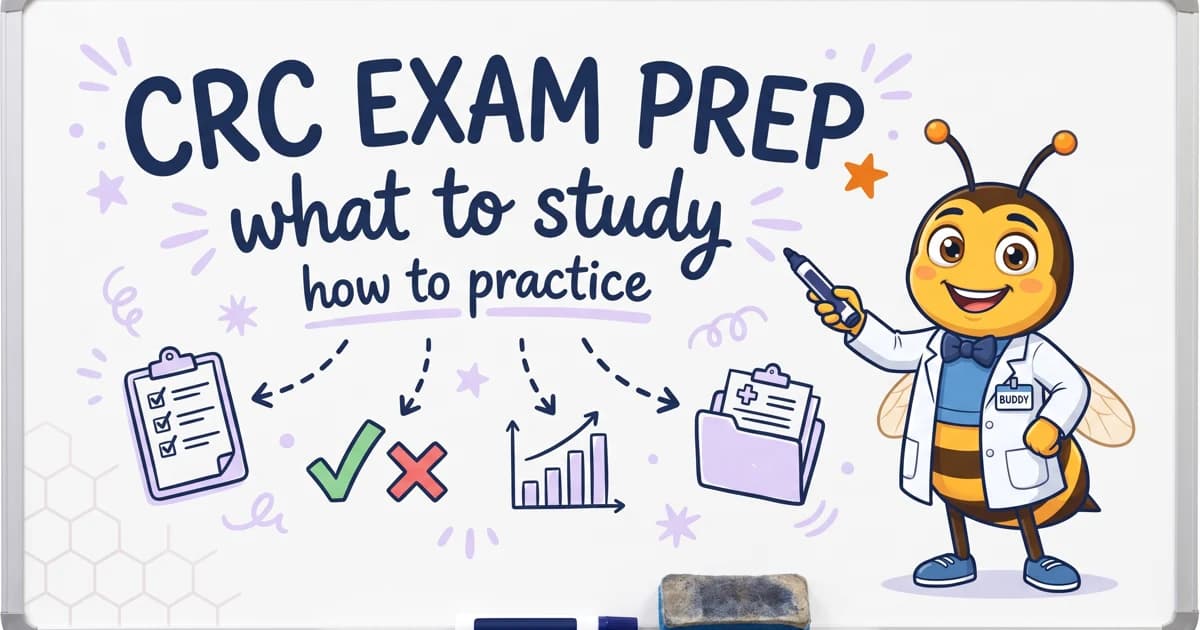
The Certified Risk Adjustment Coder (CRC) credential from AAPC is the most recognized certification for HCC coders in the United States. It is a 100-question, open-book, four-hour exam that tests whether you can accurately assign ICD-10-CM codes, review documentation (see AAPC's MEAT primer for an industry mnemonic, not an official coding rule), and understand the mechanics of the CMS-HCC risk adjustment models.
This guide walks through what the CRC exam actually tests, the study sequence that produces the highest pass rate, and the reference material you should have in front of you during practice. It is written for coders preparing for the 2026 exam cycle and does not assume you already work in risk adjustment.
What the CRC Exam Tests
The CRC exam covers seven content areas, and the question mix is relatively stable year over year. You should expect roughly:
- Diagnosis coding (ICD-10-CM), the largest single domain. Expect 20 to 25 questions on correct code assignment, specificity, combination codes, and ICD-10-CM guidelines.
- Risk adjustment models (CMS-HCC V24, V28, ESRD, RxHCC, HHS-HCC), which model is used for which population, the difference between community and institutional weights, and when each model applies.
- HCC coding categories and hierarchies, how HCCs roll up, how the hierarchy logic works (when one HCC trumps another), and how disease interactions affect RAF.
- MEAT as a documentation-review mnemonic, Monitor, Evaluate, Assess or Address, Treat. Keep it separate from the official coding rules tested in a scenario.
- Medical terminology, anatomy, and pathophysiology, enough clinical knowledge to read a chart note and recognize which conditions are being described.
- Coding audits and quality assurance, how to identify errors in another coder's work, what an RADV audit looks for, and how CMS validates submitted diagnoses.
- Compliance and regulatory concepts, CMS data submission timelines, RADV, the False Claims Act, and provider query rules.
The exam is open book. You are allowed (and expected) to bring your ICD-10-CM codebook, a set of model tables, and any approved reference material. Bringing the wrong edition of the codebook is the single most common avoidable mistake.
Study Sequence That Works
After helping a number of coders prepare for the CRC exam, the sequence that consistently produces the best results is not "read the study guide cover to cover." It is layered practice with a tight feedback loop.
Week 1 to 2, ICD-10-CM fluency. Before you touch a single HCC concept, make sure you can quickly look up codes in the ICD-10-CM codebook. Practice with a stopwatch: pick 20 diagnoses from a medical dictionary, look each one up, write down the correct code with the right number of digits. If it takes you more than 60 seconds per code, you need more reps. The CRC exam gives you roughly 2.4 minutes per question, and most questions require at least one codebook lookup.
Week 3 to 4, ICD-10-CM Official Guidelines. Read the ICD-10-CM Official Guidelines for Coding and Reporting for the current year. Not skim, read. Pay particular attention to Section I.C (chapter-specific guidelines) for the most frequently coded HCC chapters: endocrine, circulatory, neoplasms, mental health, and musculoskeletal. These guidelines are the source material for the majority of scenario questions on the exam.
Week 5 to 6, HCC mechanics. Study the CMS-HCC model structure, the hierarchy, and the model-year source behind each mapping and factor. The current CMS 2026 model software and ICD-10 mappings provides generic V28. Historical generic V24 must come from the CMS source for the payment year being reviewed.
Week 7 to 8, documentation scenarios. Practice applying the code set and Official Guidelines to the facts in each question. Do not assume a problem-list entry or a missing MEAT word makes provider clarification the correct answer.
Week 9 to 10, Full-length practice exams. Take at least two full-length timed practice exams. AAPC sells official practice exams that closely mirror the question style. Take them under real exam conditions: four hours, closed door, only the reference material you will bring to the actual exam. Review every wrong answer and every guessed answer, those are the gaps you need to close.
Reference Material for the Exam
The CRC is open book, which sounds generous until you realize that you cannot look up anything you do not already know how to find. Bring only reference material you have actually used during practice. Adding a new reference the week of the exam will slow you down, not help you.
At minimum, you should have:
- ICD-10-CM codebook, the current fiscal year edition. Do not bring an old one. The code set updates every October 1, and the exam uses the current year's codes -- the official code set lives on the CMS ICD-10-CM page.
- ICD-10-CM Official Guidelines, some codebooks include these in the front matter. Tab the chapter-specific sections for fast navigation.
- HCC category reference, a printed or tabbed list of HCC categories with their ICD-10-CM mappings. Many coders print the CMS-HCC V28 mapping file from the CMS website and bind it for quick reference.
- Personal notes on tricky areas, MEAT criteria, query rules, RADV audit triggers. Keep this short, one or two pages of dense notes, not a binder.
Tools like HCC Buddy are not allowed in the exam room, but they can help during preparation. Use the current CY2026 V28 source and a clearly labeled historical PY2025 V24 reference to practice model-year distinctions. Do not memorize a mapping without its model and payment year.
Common Mistakes First-Time Test Takers Make
Rushing the ICD-10-CM lookup. The biggest time sink on the exam is codebook navigation. If you have to flip through the alphabetic index, then the tabular list, then back to the guidelines for every question, you will run out of time. Practice until your hands know where each chapter lives.
Over-reading scenario questions. CRC scenario questions are deliberately dense, but the actual question at the end is usually narrow: which code, which HCC, which guideline applies. Read the question first, then scan the scenario for the relevant detail. Do not try to solve the whole clinical puzzle.
Treating a mnemonic as the exam rule. A problem-list, history, or copied entry does not decide the answer by itself, and neither does the presence or absence of a MEAT word. Apply the code set, Official Guidelines, and facts given in the scenario.
Mixing up V24 and V28. Some codes map differently between the models. The non-PACE phase-in ran through CY2025, and CY2026 uses V28 at full weight. PACE follows a separate blend. For exam questions, use the model and payment year stated in the scenario.
Skipping the compliance questions. The compliance and regulatory content area is small, but it includes questions about RADV audits, CMS submission deadlines, and provider-query rules. These are easy points if you study them and easy losses if you do not. The OIG work-plan item on CMS-HCC V24 and V28 trends states the objective of a planned 2024 submission analysis; it is not a completed report or an exam guide.
What to Expect on Exam Day
The CRC exam is delivered by AAPC at proctored testing centers and via live remote proctoring. The format is 100 multiple-choice questions, four hours, with a 70 percent minimum passing score. You will need to bring government-issued ID and your allowed reference materials.
Build a study schedule around your practice results. Review missed questions for the rule involved, and practice completing questions within the exam time limit. A MEAT element count does not replace the coding rules in a scenario.
After you pass, you will receive the CRC credential and become eligible to take on risk adjustment coding work for Medicare Advantage plans, ACOs, and health systems. Most entry-level risk adjustment coder roles list CRC as a requirement or strongly preferred qualification.
A Realistic Preparation Checklist
- [ ] Order the current fiscal year ICD-10-CM codebook
- [ ] Download and read the current ICD-10-CM Official Guidelines
- [ ] Download the CMS-HCC V28 mapping file from cms.gov
- [ ] Complete at least 200 practice questions across all content areas
- [ ] Take at least two full-length timed practice exams
- [ ] Tab your codebook and reference materials before exam day
- [ ] Bring two forms of ID and confirm your testing location 48 hours in advance
The CRC exam is hard, but it is not a mystery. The content areas are published, the reference material is predictable, and the question style has been stable for years. Coders who put in disciplined practice time pass.
Keep Preparing with HCC Buddy
HCC Buddy supports ICD-10-CM practice lookups with a source-labeled CY2026 V28 result and a historical PY2025 V24 reference. A result without verified source support is not shown. Use the model and payment year named in the practice question.
Related Tools

HCC Buddy Coding Team
Editorial
Every HCC Buddy article is checked against the current CMS-HCC model and the active FY ICD-10-CM tabular release before it publishes.
Get HCC Coding Tips in Your Inbox
Join our newsletter for coding tips, guideline updates, and tool announcements.